What Is Generative Engine Optimization, How It Differs from Traditional SEO, and Why It Requires a Different Approach
Generative Engine Optimization focuses on getting your content cited inside AI-generated answers instead of only ranking in traditional search results. This guide explains how GEO differs from SEO, what AI systems look for, and why AI visibility requires ongoing management.
What Is Generative Engine Optimization, How It Differs from Traditional SEO, and Why It Requires a Different Approach
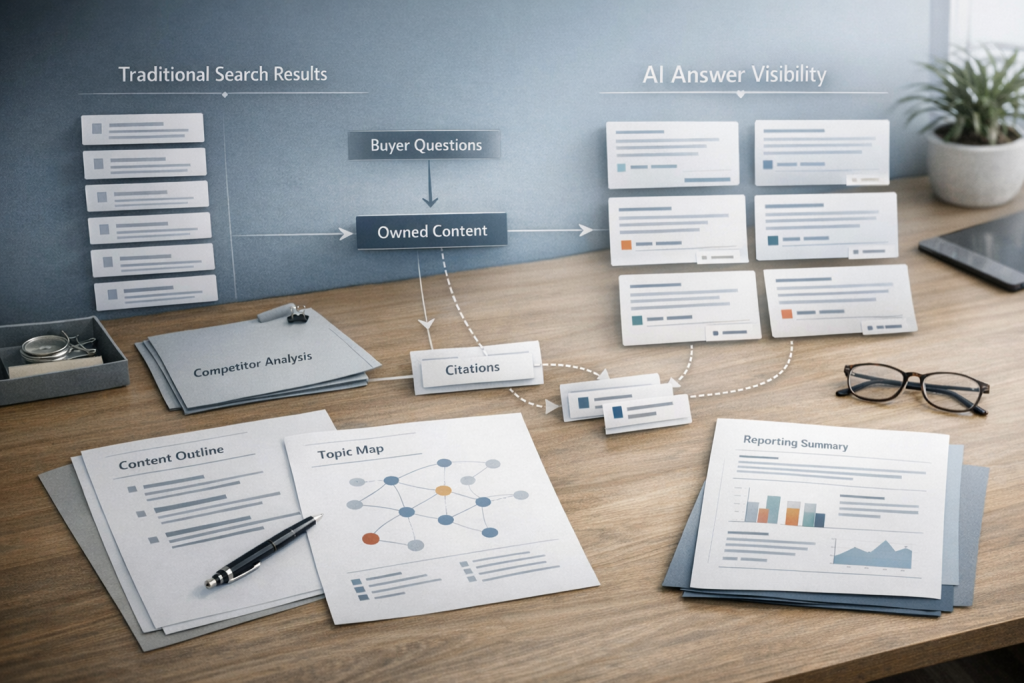
Generative Engine Optimization is the practice of structuring and creating content so that AI-powered search and answer systems are more likely to cite, summarize, or reference it when generating responses. Unlike traditional SEO, which focuses on ranking a web page in a list of search results, GEO focuses on becoming a source that AI systems draw from when they construct an answer directly for the user.
If you run a business, lead a marketing team, or manage content strategy, this distinction matters now. A growing share of your potential buyers are asking ChatGPT, Google Gemini, Perplexity, Claude, or Google AI Overviews for recommendations before they ever scroll through a traditional results page. Whether your brand appears in those AI-generated answers depends on factors that traditional SEO alone does not fully address.
This guide explains what GEO actually is, how it differs from SEO at a practical level, how AI systems decide what to cite, what it means for your content strategy, how AI visibility is measured, and why managing it is an ongoing discipline rather than a one-time project.
What Generative Engine Optimization Actually Means
The term Generative Engine Optimization (GEO) was introduced in a 2023 research paper from Princeton University and IIT Delhi. The researchers examined how content visibility shifts inside AI-generated answers and found that specific content characteristics — including the presence of citations, authoritative language, and relevant statistics — could meaningfully increase how often a source appeared within generative search results.
In plain terms, GEO is the work of making your content useful enough, structured enough, and trustworthy enough that AI systems are more likely to pull from it when they build answers. It is not a trick or a hack. It is a set of practices focused on how your content appears to systems that synthesize answers rather than return a list of links.
GEO applies across multiple AI-powered platforms, including:
- ChatGPT (when used with web search or browsing features)
- Google AI Overviews (the AI-generated summary blocks that appear above traditional Google results)
- Google Gemini
- Perplexity
- Claude (when used with search-enabled features)
- Microsoft Copilot
Each of these systems works differently under the hood, but they share a common behavior: they retrieve information from existing web content, synthesize it, and present a composed answer. Your content is either part of what they draw from, or it is not.
How GEO Differs from Traditional SEO
Traditional SEO and GEO share a common foundation, but they aim at different targets, optimize for different systems, and measure success in different ways. Understanding those differences is essential before deciding how to allocate your content and marketing resources.
The Goal Is Different
Traditional SEO aims to rank your page as high as possible in a list of search results. The user sees your title and meta description, clicks through, and lands on your site. The entire model depends on earning a click.
GEO aims to make your content the source an AI system references when it generates an answer. In many cases, the user may never click through to your site at all. Instead, your brand, your expertise, or your specific recommendation appears inside the AI-generated answer itself. Visibility happens before the click, not after.
The Optimization Target Is Different
In traditional SEO, you optimize for a search engine’s ranking algorithm. You focus on keywords, backlinks, site speed, technical structure, and user-experience signals.
In GEO, you optimize for content retrieval and synthesis systems. These systems do not simply match keywords to pages. They assess whether your content answers a question clearly, whether your source appears credible, whether your claims are supported, and whether your content can be extracted into a useful answer block without losing meaning.
The Measurement Is Different
In traditional SEO, you measure keyword rankings, organic traffic, click-through rates, and conversions from search.
In GEO, you measure whether your brand is being cited in AI-generated answers, how often your content is referenced compared to competitors, which buyer questions trigger your brand’s appearance, and which AI platforms surface you. These are fundamentally different data points, and most traditional SEO dashboards do not track them.
Side-by-Side Comparison
| Dimension | Traditional SEO | Generative Engine Optimization |
|---|---|---|
| Primary goal | Rank in a list of search results | Be cited or referenced inside an AI-generated answer |
| Target system | Search engine ranking algorithm | AI retrieval and synthesis system |
| Success metric | Keyword ranking, organic traffic, click-through rate | Citation frequency, brand mention rate, AI share of voice |
| Primary content signals | Keywords, backlinks, page speed, technical structure | Answer clarity, factual accuracy, entity recognition, source credibility |
| User interaction | User clicks a link, then reads the page | User reads an AI-generated answer that may cite the source directly |
| Content format emphasis | Pages optimized for ranking signals and on-page SEO | Content structured for extraction, synthesis, and clear attribution |
The core distinction: traditional SEO earns a position in a list. GEO earns a position inside an answer.
How AI Systems Actually Decide What to Cite
Most articles on this topic describe what GEO is without explaining the mechanism behind it. That leaves a critical gap. If you do not understand how AI systems select sources, you cannot make informed content decisions.
No one outside these companies knows the exact algorithms. But the observable behavior of major AI-search systems reveals consistent patterns in what gets cited and what gets ignored.
What AI Systems Appear to Prioritize
Crawlability and accessibility. If an AI system’s crawler cannot access your content, it cannot use your content. This is the same foundation that traditional SEO requires, but with an additional layer: different AI platforms use different crawlers. Google uses Googlebot. OpenAI uses OAI-SearchBot for ChatGPT search results. If your robots.txt blocks those crawlers, your content is invisible to those systems regardless of its quality.
Direct, clear answers to specific questions. AI systems are not scanning for keywords the way a traditional search engine does. They are looking for content that answers a question well enough to be synthesized into a coherent response. Content that buries its answer deep behind a lengthy introduction is harder for these systems to work with.
Factual accuracy and source credibility. AI systems draw from multiple sources when composing an answer. Content that includes verifiable claims, references to real research, and clear attribution tends to be treated as more reliable. Vague, unsourced claims are less likely to be selected.
Entity clarity. AI systems are increasingly sophisticated at recognizing entities: specific brands, people, locations, products, and concepts. Content that clearly identifies what it is about, who it is for, and what specific entities it references is easier for these systems to categorize and cite correctly.
Structural clarity. Content organized with descriptive headings, self-contained paragraphs, and logical section flow is easier for AI systems to parse into discrete answer blocks. A page that addresses five related questions in five clearly headed sections gives an AI system five possible extraction points instead of one ambiguous mass of text.
E-E-A-T signals. Experience, Expertise, Authoritativeness, and Trustworthiness are not just Google ranking factors. AI systems that retrieve content from the web appear to weigh similar signals when selecting which sources to cite. Content from identifiable authors with relevant expertise, published on sites with clear topical authority, tends to appear more frequently in AI-generated answers.
A Practical Example: Traditional SEO Content vs. GEO-Ready Content
Consider a B2B consulting firm that wants to be visible when a potential buyer asks an AI system: What should I look for in a fractional CFO?
A traditional SEO approach might produce a blog post built around that keyword phrase, optimized with keyword placement, internal links, and meta tags. The content is designed to rank on page one of Google. It may succeed at that goal, but if the content is structured as a generic listicle without clear, extractable answers to specific sub-questions, AI systems may not find it useful enough to cite.
A GEO-informed approach to the same topic would start by answering the core question directly in the opening paragraph. Each section would address a specific sub-question with a descriptive heading. The content would include concrete criteria, explain why each matters, and define terms a buyer might not know. It would be written so that an AI system could extract any single section and present it as a useful, self-contained answer. The page would also include clear author attribution, structured data, and an FAQ section addressing the most common follow-up questions.
Both approaches can coexist. The GEO-informed approach does not sacrifice SEO value. It strengthens it by producing clearer, better-organized content that serves both traditional ranking systems and AI retrieval systems.
What GEO Means for Your Content Strategy
If your business already invests in content marketing or SEO, GEO does not require you to start over. It requires you to shift emphasis in a few specific areas.
Write for Buyer Questions, Not Just Keywords
Traditional keyword research identifies what people type into search bars. GEO-oriented research identifies the actual questions buyers are asking AI systems, which are often longer, more conversational, and more specific than traditional keywords. Your content should directly answer those questions in clear, self-contained blocks.
Build Topical Authority Deliberately
AI systems appear to favor sources that demonstrate sustained expertise on a topic. A single blog post on a subject is less likely to be cited than a site with multiple well-structured articles covering related subtopics in depth. This is where an intentional content strategy, built around the specific buyer questions that matter to your business, compounds over time.
Use Structured Data Accurately
Structured data (also called schema markup) helps both search engines and AI systems understand what your page contains. Article schema, FAQ schema, and Organization schema give machines a structured way to interpret your content. But structured data must accurately represent what is on the page. Misusing schema to claim your page is something it is not can trigger spam penalties and erode trust with both systems and users.
Make Content Easy to Extract
AI systems do not read your entire site the way a person might. They pull discrete blocks of content that answer specific questions. Pages where individual sections can stand alone as complete, useful answers are better positioned to be referenced. Practical steps include:
- Answer the core question in the first paragraph of each section
- Use descriptive headings that match how a reader or AI system would frame the question
- Keep paragraphs short and focused on a single point
- Define technical terms the first time they appear
- Use consistent terminology throughout the article
- Separate facts from opinions and recommendations
Prioritize Original Value
AI systems have access to a vast amount of content on most topics. Content that merely restates commonly available information is less likely to be cited because the system has many equivalent sources to choose from. Content that adds original insight, better organization, clearer explanations, practical examples, or honest analysis of tradeoffs gives the system a reason to prefer your page as a source.
Does GEO Replace SEO?
No. GEO does not replace SEO. It builds on top of it.
Strong technical SEO, including crawlability, fast page speed, clean site architecture, proper indexing, and valid metadata, remains a prerequisite for GEO. If search engines and AI crawlers cannot access and understand your site, no amount of content optimization will make your pages visible in AI-generated answers.
Traditional organic rankings still drive significant traffic. Many users still click through search results. Many buying journeys still start with a traditional Google search. Abandoning SEO in favor of GEO alone would be a mistake for virtually any business.
The accurate way to think about the relationship: SEO makes your content findable in search results. GEO makes your content citable in AI-generated answers. Most businesses need both, and the practices that support each overlap substantially. Better content, clearer structure, stronger authority signals, and more useful answers serve both goals simultaneously.
How GEO Visibility Is Measured
One of the most significant differences between traditional SEO and GEO is how you know whether it is working.
Traditional SEO measurement is well-established. You track keyword rankings, organic traffic, click-through rates, and conversions. Tools for this have existed for more than a decade and are mature and reliable.
GEO measurement is newer and more complex. The key metrics are different:
- Citation presence: Is your brand appearing in AI-generated answers when buyers ask relevant questions?
- Citation frequency: How often does your brand appear compared to competitors across the same set of buyer questions?
- Platform coverage: Which AI systems cite you — ChatGPT, Gemini, Perplexity, Google AI Overviews, or others?
- Buyer-question coverage: Which specific questions trigger your brand’s appearance, and which ones do not?
- Competitor citation share: How does your visibility compare to the other brands that appear in the same AI-generated answers?
These metrics require a different kind of tracking. Most traditional SEO tools do not monitor AI citation patterns. Measuring GEO visibility typically requires systematic auditing across multiple AI platforms, tracking changes over time against a baseline, and monitoring competitor movements in the same space.
At CiteHarbor, this is a core part of what we do. We run initial AI visibility audits to establish a baseline, then track citation patterns monthly across ChatGPT, Gemini, Perplexity, Claude, and Google AI Overviews. We monitor competitor citations alongside our clients’ visibility and deliver branded PDF performance snapshots so the client never has to log into another dashboard or manage another tool. The measurement challenge is real, but it is manageable when someone is doing it systematically.
Why AI Visibility Requires Ongoing Management, Not a One-Time Fix
One of the most common misconceptions about GEO is that it is something you do once. Optimize a few pages, add some schema markup, rewrite some headings, and move on.
That is not how AI visibility works in practice. Here is why:
AI systems update continuously. The models behind ChatGPT, Gemini, Perplexity, and other platforms are updated regularly. Their retrieval systems change. Their source preferences evolve. Content that is cited today may not be cited next month if a better source appears or if the system’s behavior shifts.
Competitor content changes. Your competitors are publishing new content, improving their existing pages, and some are actively pursuing GEO strategies of their own. Citation share is relative. Even if your content stays the same, your visibility can decline if a competitor publishes something more useful.
Buyer questions evolve. The questions your potential customers ask AI systems change as markets shift, as new products emerge, and as awareness grows. Content that answered last year’s questions well may not address this year’s questions at all.
Content decays. Examples go stale. Statistics become outdated. Screenshots stop matching current interfaces. An article that was accurate and useful when published can gradually become less trustworthy if it is not maintained.
This is why we treat AI visibility as an ongoing discipline at CiteHarbor. We do not hand clients a report and walk away. We handle the full cycle: buyer-question research, targeted article creation, WordPress publishing, social media distribution, monthly citation tracking, competitor monitoring, and branded performance snapshots. The client gets a clear picture of where they stand each month without adding another tool, another dashboard, or another management burden to their team.
For businesses already stretched thin managing Google Ads, SEO retainers, and content calendars, the last thing they need is another platform to operate. That is exactly the problem we built CiteHarbor to solve.
Frequently Asked Questions
What does GEO stand for?
GEO stands for Generative Engine Optimization. It refers to the practice of creating and structuring content so that AI-powered search and answer systems are more likely to cite, summarize, or reference it when generating responses to user queries.
Is GEO the same as AEO?
GEO and AEO (Answer Engine Optimization) are closely related but not identical. AEO generally refers to optimizing content for any system that provides direct answers, including Google’s featured snippets and voice assistants. GEO is more specifically focused on generative AI systems that synthesize multi-source answers, such as ChatGPT, Gemini, and Perplexity. In practice, the two disciplines overlap significantly.
Does GEO replace SEO?
No. GEO builds on top of SEO. Strong technical SEO, including crawlability, site speed, proper indexing, and clean metadata, is a prerequisite for AI visibility. Traditional organic search still drives significant traffic for most businesses. The most effective approach combines both.
How do I know if my content is being cited by AI systems?
You can manually test by asking relevant buyer questions across ChatGPT, Gemini, Perplexity, and other AI platforms and observing whether your brand or content is referenced. For systematic tracking, you need a process that audits citation patterns across platforms on a regular basis and monitors changes against a baseline. This is a core service CiteHarbor provides for clients.
What kind of content works best for GEO?
Content that directly answers specific buyer questions, uses clear and descriptive headings, includes verifiable facts and relevant data, defines technical terms, and is organized so that individual sections can stand alone as useful answer blocks. Content from sources with demonstrated topical authority and clear authorship signals also appears to be cited more frequently.
How is GEO success measured?
GEO success is measured through AI citation presence, citation frequency across platforms, buyer-question coverage, competitor citation share, and platform-specific visibility. These metrics require specialized tracking that most traditional SEO tools do not provide.
Which AI platforms does GEO apply to?
GEO applies to any AI system that retrieves web content and synthesizes answers into a direct response. The platforms where this behavior is most prominent today include ChatGPT with web search enabled, Google AI Overviews, Google Gemini, Perplexity, Claude with search features, and Microsoft Copilot. Because each platform retrieves and weighs sources differently, tracking your visibility across all of them matters.
How long does it take to see results from GEO?
There is no fixed timeline, and anyone promising specific results within a guaranteed timeframe should be treated with skepticism. AI visibility tends to build gradually as content quality, topical authority, and buyer-question coverage improve over time. Monthly tracking helps identify whether the trajectory is moving in the right direction.
Do I need to rebuild my website for GEO?
In most cases, no. GEO is primarily about content strategy, content quality, and content structure. If your site is already technically sound for SEO, the foundation is in place. The changes typically involve how you research topics, how you structure articles, and how you track results rather than rebuilding your site architecture.
Can small businesses benefit from GEO?
Yes. AI-generated answers often surface specific, helpful sources regardless of company size. A well-structured, genuinely useful article from a smaller business can appear alongside content from much larger organizations if it answers the query well. For local service businesses, professional-service firms, and niche B2B companies, GEO can be a meaningful visibility channel precisely because AI systems are looking for the best answer, not the biggest brand.
What to Do Next
GEO is not a trend or a buzzword. It is a description of how search behavior is actually changing. Buyers are asking AI systems for recommendations, comparisons, and guidance. Whether your brand appears in those answers depends on whether your content is structured, authoritative, and useful enough for AI systems to draw from.
This does not mean SEO is over. It means there is now a second layer of visibility that most businesses are not yet tracking or managing. The businesses that start building their AI visibility baseline now, understanding where they appear, where they are missing, and what buyer questions matter most, will have a meaningful advantage as AI-mediated discovery continues to grow.
If you want to understand where your business currently stands in AI-generated answers without adding another tool or dashboard to manage, CiteHarbor handles the full process: AI visibility audits, buyer-question research, targeted content creation, WordPress publishing, social distribution, competitor citation monitoring, and branded monthly performance snapshots.