How to Track AI Citations for Your Brand Across ChatGPT, Perplexity, Gemini, Claude, and Google AI Overview
Learn how to build a practical system for tracking your brand’s visibility in AI-generated answers using prompt libraries, analytics, Search Console, and competitive reporting. This guide is built for marketing, SEO, and content teams that need a repeatable way to measure AI citation performance over time.
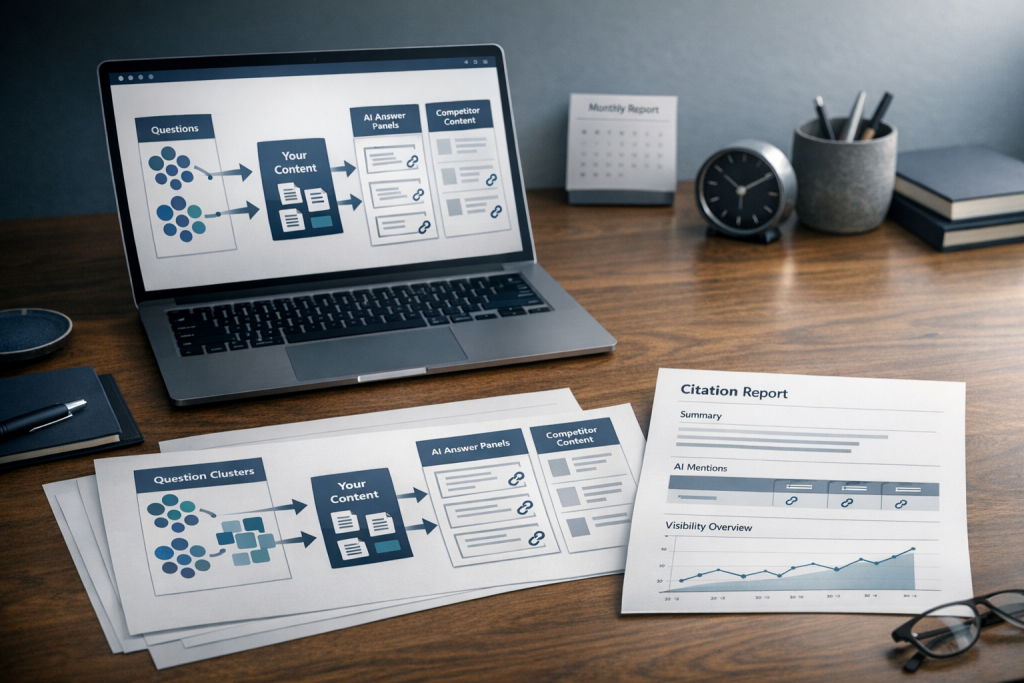
How to Track AI Citations for Your Brand Across ChatGPT, Perplexity, Gemini, Claude, and Google AI Overview
Tracking AI citations demands a repeatable system built on three foundations: a structured prompt library run against each platform on a consistent schedule, referral traffic monitoring inside your analytics stack, and defined metrics that let you measure change from one period to the next. No single method captures the complete picture, because each AI platform handles source attribution differently, responses shift with every generation, and standard analytics tools were never designed to isolate AI-driven traffic with precision.
This guide is written for marketing teams, B2B operators, professional-service firms, and SaaS companies that already invest in SEO or content marketing and need to know whether their brand surfaces — or gets skipped — when buyers turn to AI engines for guidance. It covers how to build a tracking workflow from the ground up, what to measure, how each platform behaves, and how to convert raw citation data into a report that drives real decisions.
Why Tracking AI Citations Is Different From Tracking Google Rankings
Teams experienced with keyword-position monitoring will find AI citation tracking unfamiliar. The underlying mechanics are genuinely different, and applying the same mental model produces bad data and wasted effort.
AI responses are probabilistic, not fixed
A Google ranking is a stable data point. Position four is position four — you can screenshot it, log it, and trend it over weeks. AI-generated answers operate on an entirely different principle. Submit the same prompt to ChatGPT three times in a single afternoon and you may receive three distinct sets of cited sources. These models generate responses dynamically, drawing on the query itself, whatever retrieval results are accessible at that moment, and the model’s internal weighting. There is no fixed position to anchor your tracking against.
This is why one-off spot checks produce noise rather than signal. Reliable AI citation tracking means running prompts repeatedly on a defined schedule to surface frequency patterns rather than treating any individual response as representative.
Citation behavior varies significantly across platforms
Perplexity attaches numbered inline citations with clickable URLs to nearly every response. ChatGPT includes citations when its search or browsing capability is active, but omits them on knowledge-only answers. Gemini connects sources through structured cards anchored to Google Search grounding. Claude rarely links to specific pages and tends to synthesize from training knowledge without naming sources. Google AI Overview surfaces cited pages in a collapsible panel beneath the generated summary, drawing from Google’s own index.
A tracking approach that treats all five platforms the same will produce misleading results. Each one requires a distinct observation method and a calibrated expectation of what citation visibility actually looks like on that surface.
AI referral traffic is partially hidden in standard analytics
Google Analytics 4 can surface some AI-sourced visits — Perplexity sessions, for instance, often carry a recognizable referrer string. But traffic arriving through Google AI Overview is notoriously hard to separate from standard organic visits because both flow through google.com. ChatGPT and Claude sessions may appear sporadically depending on the user’s browser and interface. Referral data adds useful context, but it is not a self-sufficient measurement tool.
Step 1: Build Your Prompt Library
The prompt library is the operational core of any AI citation tracking program. Without one, monitoring stays ad hoc, inconsistent, and impossible to compare across periods. A prompt library is a curated set of questions you submit to AI platforms on a defined schedule to observe whether your brand, your competitors, or your published content appears in the generated responses.
The four prompt categories worth tracking
Structure your library around four question types that mirror how real buyers engage with AI systems:
- Best-provider prompts: Recommendation-seeking questions. Example: What are the best HVAC companies in Phoenix for commercial buildings? These show whether your brand surfaces when a buyer is actively evaluating providers.
- Comparison prompts: Questions that weigh one option against another. Example: How does [Your Brand] compare to [Competitor] for enterprise data security? These reveal how AI systems frame your positioning relative to alternatives.
- Problem-solution prompts: Questions that describe a pain point before a provider category has been identified. Example: How do I reduce employee turnover in a mid-size law firm? These test whether your content appears at the earliest stage of buyer awareness.
- Informational prompts: Expertise-seeking questions. Example: What factors affect the cost of a commercial roof replacement? These indicate whether AI systems treat your brand as a credible knowledge source worth citing.
How many prompts produce meaningful data
A working starting library holds 20 to 50 prompts spread across all four categories. Each prompt should be submitted to every platform you are tracking at least twice per cycle to account for the variability built into probabilistic generation. Tracking five platforms with 30 prompts and two runs per prompt produces 300 individual observations per cycle — enough to identify real patterns, and enough to demonstrate why manual tracking becomes unsustainable at scale.
Phrasing prompts the way buyers actually write them
Avoid writing prompts that read like keyword research. Write them the way a buyer would actually type into ChatGPT or Perplexity — natural language, location context where it applies, and varying levels of specificity. A buyer might ask best CRM for small consulting firms one day and what CRM should a 15-person consulting firm use if they need HubSpot integration the next. Both belong in your library because AI systems may surface different sources depending on how specific or general the phrasing is.
Step 2: Define the Five Metrics That Actually Matter
Collecting citation observations without a defined measurement framework produces a pile of data and no clear direction. These five metrics give your team a consistent structure for evaluating visibility across every platform and every tracking cycle.
| Metric | What It Measures | Why It Matters | How to Capture It |
|---|---|---|---|
| Citation Rate | The share of prompt responses where your brand is mentioned or cited, out of all prompts run in the cycle | Shows how frequently AI systems surface your brand when buyers ask relevant questions | Count brand appearances across all prompt runs, divide by total runs |
| URL Citation Rate | The share of citations that include a clickable link to a page on your site | Separates traffic-driving citations from unlinked name mentions | Log which citations include a live hyperlink to your domain versus a bare brand reference |
| Share of Voice | Your citation frequency relative to tracked competitors across the same prompt set | Puts your visibility in competitive context rather than measuring it in isolation | Run identical prompts for your brand and competitors, compare citation rates directly |
| Prominence | Where your brand appears within the AI response — lead recommendation, third in a list, footnote, or passing reference | Position within a response carries real meaning; a buried mention and a top recommendation are not equivalent | Record the position and surrounding context of each citation |
| Sentiment | Whether the AI system characterizes your brand positively, neutrally, or negatively | A citation that frames your brand unfavorably can be worse than no citation | Classify the language around each brand mention as positive, neutral, negative, or mixed |
Why citation rate and URL citation rate are not the same thing
Citation rate tells you how often your brand name appears in AI responses. URL citation rate tells you how often AI systems link directly to your pages. The gap between them is meaningful. An unlinked mention builds some name familiarity but sends no traffic. A live URL citation creates a path to your site. When citation rate is strong but URL citation rate is weak, it typically means AI systems recognize your brand but are not treating your published content as the most authoritative source to link — a signal worth investigating through content structure and depth.
AI share of voice versus traditional media share of voice
Conventional media monitoring compares brand mentions across publications over a period. AI share of voice is more controlled: you run identical prompts for your brand and your competitors and compare citation counts directly. The inputs are standardized, the outputs are countable, and the comparisons are apples-to-apples. That makes AI share of voice more actionable than traditional share of voice, which is subject to editorial variability and publication timing.
Step 3: Understand How Each Platform Cites Sources
Each AI platform retrieves, processes, and presents source material through its own logic. A tracking system that ignores these differences will generate inconsistent data and misleading conclusions.
| Platform | Citation Style | Tracking Difficulty | Primary Tracking Method |
|---|---|---|---|
| Perplexity | Numbered inline citations with clickable URLs on most responses | Easiest | Direct observation of cited URLs; GA4 referral traffic filtering |
| ChatGPT | Inline citations when search or browsing is active; no citations on knowledge-only responses | Moderate | Prompt observation with search mode enabled; GA4 referral filtering |
| Gemini | Source cards linked to Google Search results; structured link panels | Moderate | Prompt observation; Google Search Console AI Overview data |
| Claude | Rarely includes direct hyperlinks; synthesizes from training knowledge without explicit attribution | Hardest | Prompt observation for brand mentions; minimal referral signal |
| Google AI Overview | Collapsible source panel beneath the generated summary; links drawn from Google’s index | Hard | Google Search Console; prompt observation; server log analysis as a supplement |
Perplexity: the most transparent citation surface
Perplexity conducts live web retrieval for most queries and attaches numbered inline citations that link directly to the source pages it draws from. This makes it the most straightforward platform to observe. You can see exactly which URLs appear, in what sequence, and tied to which parts of the answer. Perplexity referral sessions also tend to show up clearly in GA4, making it one of the few platforms where you can draw a reasonably direct line between AI citation and site traffic.
ChatGPT: citation visibility depends on which mode is active
ChatGPT produces citations when it engages its web search capability. In standard conversational mode without search, the model draws on training data and does not reference specific URLs. For tracking purposes, submit prompts with search mode active. Responses vary considerably between runs, so repeated observations are essential rather than optional. If you want your content to be eligible for inclusion in ChatGPT search results, confirm that OAI-SearchBot is permitted in your robots.txt file.
Gemini: sourcing anchored to Google Search
Gemini grounds many of its responses in Google Search results, which means the pages it references tend to overlap with pages that already perform well in traditional search. Source links appear in structured card formats. Tracking involves both direct prompt observation and reviewing Google Search Console data, since Gemini and Google AI Overview draw from related retrieval infrastructure. Strong Google Search performance provides a useful baseline for Gemini visibility, though ranking alone is not a guarantee of citation.
Claude: the most opaque platform to track
Among the five platforms, Claude offers the least citation transparency. It rarely links to specific pages and typically synthesizes responses from training knowledge without identifying the sources it draws from. Tracking Claude means running prompts and recording whether your brand name appears in the output, and if so, how it is characterized. URL citation rate on Claude will often read near zero — not because Claude is irrelevant to track, but because the methodology must center on brand mention observation rather than link tracking.
Google AI Overview: integrated into search but hard to isolate
Google AI Overview appears within Google Search results for a growing share of queries. It cites pages from Google’s index and displays them in a collapsible section beneath the generated answer. The tracking challenge is attribution: clicks from AI Overview pass through google.com and blend with standard organic search traffic in GA4. Google Search Console offers some directional visibility through search appearance filters, surfacing which queries triggered AI Overviews and whether your pages appeared. That reporting continues to develop. Server logs can add a supplementary layer by identifying AI-related crawler requests, though this reflects access rather than citation.
Step 4: Set Up Your Analytics and Search Console Tracking
Prompt-based observation tells you whether AI systems cite your brand. Analytics tracking tells you whether those citations produce measurable activity on your site. Both layers are necessary.
Filtering AI referral traffic in Google Analytics 4
Inside GA4, pull up your traffic acquisition reports and filter by session source or medium. Look for referral sources tied to AI platform domains — Perplexity sessions typically appear under perplexity.ai, and some ChatGPT-sourced traffic may surface under chat.openai.com or related subdomains. Build a custom channel group or apply regex filters to consolidate AI-platform referrals into a single trackable segment. This approach will not catch every AI-assisted visit, but it establishes a baseline you can monitor and compare across periods.
Using Google Search Console for AI Overview visibility
Google Search Console includes a search appearance filter that surfaces queries where your pages appeared in AI Overview results. Use it to identify which queries triggered AI Overview placements and whether your content was among the cited pages. The data is directional — it reflects impressions and presence rather than clicks specifically from the AI Overview panel — but it is the most direct signal currently available for this surface without relying on external tooling.
What server logs contribute and where they fall short
Server logs capture every request made to your site, including those from AI-related crawlers such as OAI-SearchBot and Googlebot. Monitoring these requests confirms that your content is being accessed and is crawlable. What server logs cannot tell you is whether that content was subsequently cited in a generated response. Treat log analysis as a crawl health check rather than a citation measurement — a useful signal, but not a substitute for prompt-based observation.
Step 5: Choose the Right Tracking Approach for Your Team
No single tool or method fits every team. The right approach depends on available capacity, the size of the prompt library you need to maintain, and how you plan to use the resulting data.
Manual tracking: where it works and where it breaks down
Manual tracking means submitting prompts by hand, logging results in a spreadsheet, and categorizing each observation against the five metrics. It is viable for teams monitoring a small prompt set — under 20 prompts — across two or three platforms. At larger scale, the time commitment grows quickly. A 30-prompt library across five platforms, run twice per cycle, generates 300 individual observations that must be recorded and categorized. That is manageable for a short pilot but difficult to sustain without a dedicated owner and protected time.
Dedicated monitoring platforms: what they solve
Purpose-built AI visibility platforms automate the prompt submission and citation recording process. They run your library across multiple AI platforms on a set schedule, capture responses, flag brand mentions and linked citations, and surface the data in a structured format. The consistency advantage is significant — automated submission removes the human variability that creeps into manual observation over time.
Enterprise SEO suite add-ons: when they make sense
Several enterprise SEO platforms have added AI visibility modules to their existing dashboards. If your team already operates inside one of these suites, the add-on approach consolidates AI citation data alongside traditional search performance without adding another tool login. The trade-off is depth: these modules tend to be less specialized than standalone monitoring platforms and may offer narrower coverage across AI surfaces.
Choosing based on your team’s actual situation
- If your team has no capacity for a new ongoing process and needs results delivered rather than managed internally: a full-service partner that owns the research, tracking, and reporting is the most direct path forward.
- If you have a dedicated SEO or content analyst with bandwidth to take on a new responsibility: a purpose-built monitoring platform with a defined internal process can work well.
- If you want to test whether AI citation tracking produces useful signal for your business before committing further: a manual pilot with 15 prompts across two platforms is a reasonable starting point.
Step 6: Track Competitors Alongside Your Own Brand
Citation tracking becomes substantially more useful when it includes competitive data. Knowing your brand appeared in 40 percent of prompt responses is informative. Knowing a direct competitor appeared in 70 percent of the same responses is the kind of data that changes what you do next.
Why competitive citation data matters as much as your own
AI citation tracking operates in a competitive environment. When a buyer asks an AI system for the best provider in your category, the output is a ranked or listed set of options. Your visibility is meaningful only in relation to who else appears and where. Competitor citation data reveals which brands AI systems treat as authoritative in your space and which buyer questions your competitors are answering that you are not.
What to look for in competitor citation patterns
Track which competitors appear most consistently, which specific pages of theirs are being cited, and whether their prominence within responses is higher or lower than yours. Patterns emerge over time: a competitor may be cited repeatedly for pricing-related prompts because they publish a detailed pricing guide, while your brand appears more often for technical comparison queries. These patterns point directly to content gaps and areas where strategic investment would shift citation outcomes.
Turning competitor data into a content action plan
When a competitor is cited for a buyer question your brand should be answering and you are absent from the response, that is a documented content gap. The response is not to replicate their page — it is to build a more thorough, better-structured answer to that specific question on your own site, in a format that AI systems can parse and reference. Citation tracking identifies the gap; content creation closes it.
Step 7: Build a Reporting Cadence and Connect Tracking Data to Business Outcomes
Citation tracking data is only valuable if it reaches decision-makers in a form they can act on and if it connects to outcomes the business actually cares about.
What a monthly citation tracking report should include
- Citation rate for the current period versus the prior period
- URL citation rate trends
- Share of voice against tracked competitors
- Platform-by-platform breakdown showing where brand visibility is strongest and where it lags
- Highest-performing and lowest-performing buyer questions from the prompt library
- Notable shifts in competitor citation patterns
- Specific content actions recommended based on the data
How to present AI citation data to leadership
Most executives and business owners do not need a detailed explanation of how probabilistic generation works. They need three things: a clear picture of where the brand currently stands, how that compares to named competitors, and what the team is doing about it. Lead with share-of-voice comparisons against specific competitors, call out the most significant gaps, and tie recommended actions to the buyer questions the business needs to be answering. A concise, branded one-page performance snapshot will land better than a dense slide deck or a dashboard link that requires a separate login.
Connecting citation trends to business signals
AI citation tracking does not produce the clean, direct attribution of paid search conversion tracking. Instead, citation trends should be read alongside indirect business signals that move in relation to AI visibility:
- Branded search volume: As AI systems cite your brand more frequently in category-relevant responses, buyers who encounter your name may search for it directly — lifting branded query volume over time.
- Direct traffic trends: A sustained increase in direct traffic alongside a rising citation rate may reflect buyers navigating to your site after encountering your brand in an AI response.
- Referral traffic from AI platforms: Where analytics can surface it, AI referral traffic is the most direct available link between citation and site activity.
- Conversion quality: As AI-driven discovery matures as a channel, monitor whether leads arriving through it differ in quality or behavior from other acquisition sources.
These are correlation signals, not confirmed causal relationships. They are also the most honest framework available for evaluating whether improved AI visibility is contributing to business outcomes.
Using tracking data to improve content and visibility over time
Each tracking cycle should produce specific content actions, not just a record of observations:
- Identify the buyer questions where your citation rate is lowest.
- Determine whether you have published content that directly addresses those questions.
- If the content exists, assess whether it is structured clearly enough for AI systems to parse and cite with confidence.
- If the content does not exist, build targeted pages that answer those specific questions with the depth, clarity, and structure that AI systems tend to favor as citation sources.
- In the following tracking cycle, rerun the same prompts to measure whether the new or updated content has shifted your citation pattern.
This converts citation tracking from a passive measurement exercise into a continuous feedback loop between data and content strategy.
Why Most Teams Struggle to Sustain AI Citation Tracking
The process outlined above is clear in concept. In practice, most marketing teams lose momentum within 60 to 90 days. The prompt library needs ongoing maintenance and expansion. Each platform demands a different observation approach. Data must be recorded consistently, compared to prior periods, benchmarked against competitors, and translated into a report that leadership can act on. Then the content identified through that report needs to be researched, written, published, and distributed.
The difficulty is not a skills problem. It is a capacity problem. Teams already managing paid search, organic SEO, content calendars, social media, and internal reporting are being asked to absorb a new continuous process that requires new tools, new methodologies, and sustained time commitments.
This is the operational problem CiteHarbor was built to address. CiteHarbor manages the entire workflow — the initial visibility audit, the prompt library, ongoing tracking across ChatGPT, Perplexity, Gemini, Claude, and Google AI Overview, buyer-question research, content creation, WordPress publishing, social distribution, competitive citation monitoring, and the branded monthly performance snapshot delivered directly to your inbox. Your team reads one PDF report instead of managing additional tool logins, dashboards, or internal processes.
The outcome is not a guarantee of citations or rankings. It is a managed, repeatable system that establishes a clear visibility baseline, builds a content strategy around real buyer questions, and delivers monthly tracking that shows exactly where you stand and where the gaps are — without layering new operational burden onto your team.
Frequently Asked Questions
How often should I run prompts to track AI citations?
A monthly cadence is appropriate for most businesses. Submit your full prompt library across all tracked platforms once per month, with each prompt run at least twice per platform to account for response variability. Weekly tracking suits brands operating in fast-moving or highly competitive categories. Daily tracking is rarely necessary and typically generates more data management overhead than actionable insight.
What is the difference between a brand mention and a URL citation in AI responses?
A brand mention occurs when an AI system names your company without linking to a specific page. A URL citation occurs when the AI system includes a live hyperlink to a page on your site. Both carry value, but URL citations connect more directly to traffic and can be tracked through analytics. Unlinked mentions contribute to name familiarity but are harder to tie to measurable outcomes.
Which AI platform is easiest to track and which is hardest?
Perplexity is the most straightforward because it attaches numbered inline citations with clickable URLs to nearly every response. Claude is the most difficult because it rarely links to specific source pages and typically synthesizes answers from training knowledge without explicit attribution. ChatGPT and Gemini sit in the middle, with citation visibility contingent on the mode or features active during the query. Google AI Overview presents moderate difficulty because its traffic blends with standard organic search in analytics.
Can I track Google AI Overview citations separately in Google Analytics?
Not with clean separation. Google AI Overview clicks pass through google.com and are difficult to distinguish from standard organic clicks in GA4. Google Search Console provides directional data through its search appearance filters, identifying queries where your pages appeared in AI Overview results. Server log analysis and third-party tools can add supplementary signal, but complete isolation of AI Overview traffic remains beyond what current analytics infrastructure supports.
How many prompts should I track for reliable data?
A minimum of 20 prompts distributed across the four categories — best-provider, comparison, problem-solution, and informational — provides enough coverage to surface patterns. A library of 30 to 50 prompts improves statistical reliability and broadens coverage of the buyer questions most relevant to your business. Scale the library in proportion to how many distinct services, products, or use cases your brand covers.
What should I do if my brand appears in AI answers with inaccurate information?
Log the inaccuracy with the prompt used, the platform, the date, and the specific incorrect language. Then determine whether the error traces back to something in your own published content, an external source, or the model’s synthesis. If your own content contains outdated or ambiguous language that could be generating the error, update it. If the source appears to be external, publishing more precise and well-structured content on your own site gives AI systems better material to draw from in future responses. There is no mechanism to directly edit an AI model’s output, but consistently publishing accurate, clearly organized content improves the likelihood that future responses reflect correct information.
Do I need a paid tool to track AI citations or can I do it manually?
Manual tracking with a spreadsheet and a defined prompt library is a viable starting point. It works well for small prompt sets across two or three platforms. As the library grows past 20 to 30 prompts and expands across five platforms, the volume of observations and the consistency required for reliable longitudinal data make paid tools or a managed service a practical necessity — not because the process is complex, but because the time investment becomes difficult to absorb inside a standard marketing workflow.
Conclusion: Build the System or Have It Built for You
Tracking AI citations across ChatGPT, Perplexity, Gemini, Claude, and Google AI Overview is a defined, learnable process with clear inputs, measurable outputs, and a direct connection to content strategy. The challenge is not understanding what the process involves — it is running it consistently enough to generate reliable data and responding to that data with content that closes the gaps it reveals.
If your team has the capacity to build and operate this system internally, this guide provides the framework to do it. If your team needs the entire workflow handled — from the initial audit and ongoing tracking through content creation, publishing, distribution, competitive monitoring, and monthly reporting — that is what CiteHarbor was built to deliver.
Start your 2-week free trial — no credit card required.