How to Track AI Citations for Your Brand Across ChatGPT, Perplexity, Gemini, Claude, and Google AI Overview
Learn how to build a practical system for tracking brand mentions, URL citations, and AI visibility trends across major AI search and answer platforms. This guide explains what to measure, how to audit results, and how marketing teams can turn the data into content decisions.
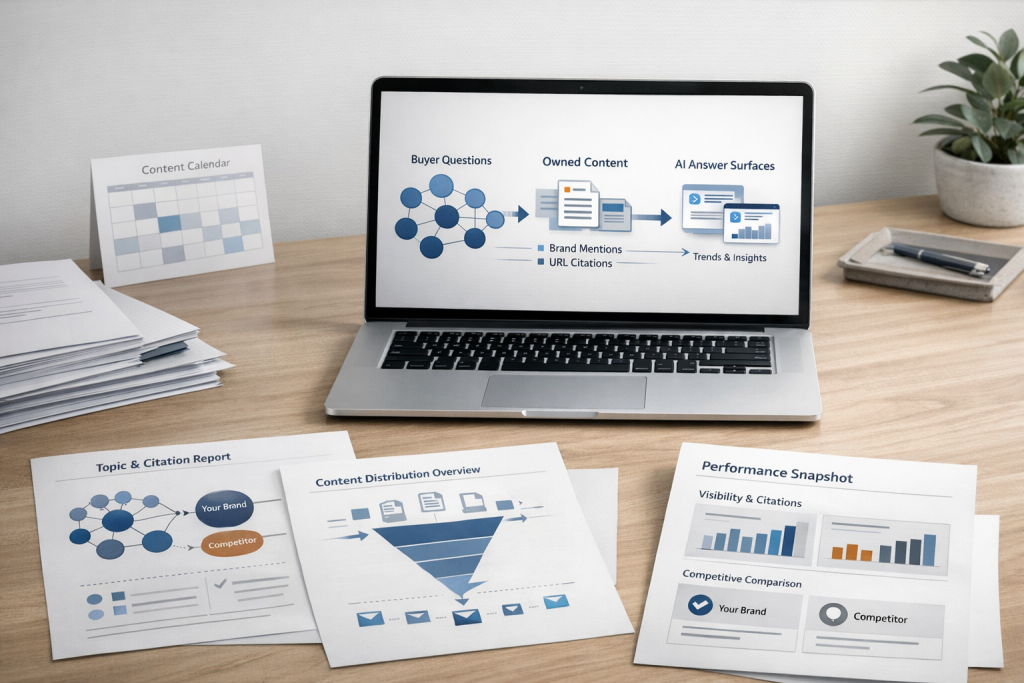
How to Track AI Citations for Your Brand Across ChatGPT, Perplexity, Gemini, Claude, and Google AI Overview
Tracking AI citations means building a repeatable system to monitor whether your brand, your URLs, or your competitors surface when someone queries an AI engine with a question your buyers are already asking. ChatGPT, Perplexity, Gemini, Claude, and Google AI Overview each handle citation data in distinct ways, which means no single tracking approach covers all five. A system worth building accounts for those platform differences and returns data your team can act on.
This guide covers how each platform exposes citations, which metrics to record, how to build a tracking process that holds up over time, what the data actually tells you, and where the real limitations are. It is written for marketing teams, B2B operators, professional-service firms, and agencies that need AI visibility benchmarks — not another software subscription to manage.
Why AI Citation Tracking Is a Different Activity Than Rank Tracking
Traditional SEO rank tracking confirms whether a specific page holds a specific position for a specific keyword in Google’s organic results. AI citation tracking asks a different question entirely: is your brand named, linked, or recommended when a buyer poses a relevant question inside a conversational AI interface?
The operational differences matter when you set up a tracking system:
- No fixed positions. AI-generated answers are not ranked lists. Your brand either appears in the response or it does not. There is no equivalent of position four.
- Non-deterministic outputs. Running the same prompt twice can produce different answers. One check tells you what happened in one session — not what typically happens.
- Platform-specific behavior. Perplexity attaches numbered source citations to nearly every factual claim. Claude generates answers from its training data without surfacing source links in most contexts. Google AI Overview functions as a search feature, not a chat interface. These platforms are not interchangeable, and treating them as such produces unreliable data.
- No universal API. Most AI platforms do not return citation data through a structured API. Tracking requires manual prompt auditing, purpose-built tooling, or a combination of both.
Applying a single uniform tracking method across all five platforms will produce misleading comparisons. The sections that follow explain what to do instead.
Brand Mentions Versus URL Citations: Why the Distinction Matters
A brand mention means your company name appears somewhere in the AI-generated response. A URL citation means a specific page on your domain is linked as a source the AI drew from. These are related but distinct signals.
A brand mention without a URL citation suggests the AI system has your company in its knowledge base but did not pull from your published content to construct its answer. A URL citation suggests your content was used as a reference. Both are worth logging, but they point to different things about how your brand and your content are influencing AI-generated answers.
Why the Same Prompt Returns Different Answers
AI language models are probabilistic systems. Temperature parameters, ongoing model updates, session context, geographic signals, and the specific model version running at query time all shape the output. A single prompt run on a single day cannot be treated as a stable result.
The practical implication: run each tracking prompt across multiple independent sessions and measure how frequently your brand appears rather than treating any single response as definitive. Patterns across weeks and months carry meaning. A single-day snapshot does not.
How Each Platform Handles Citations and What That Means for Tracking
Each AI engine has a distinct relationship with its source material and exposes that relationship to users differently. Getting clear on those differences is the prerequisite for building a tracking system that returns useful data.
Perplexity — The Most Transparent Citation Layer
Perplexity attaches numbered inline citations to nearly every factual statement in its responses, and each citation links directly to the source URL. That transparency makes Perplexity the most straightforward platform to audit — the citation data is sitting right in the answer.
What you can measure: which URLs are cited, how frequently your domain appears relative to competitors, where in the answer your citation falls, and which prompts reliably trigger citations to your content.
Primary tracking method: run buyer-relevant prompts in Perplexity, record which domains appear as numbered sources, and log citation position and frequency for each session.
Google AI Overview — Tracked Through Search Console, Not a Chat Interface
Google AI Overview is not a standalone chatbot. It is a search feature that renders at the top of certain Google results pages, drawing from Google’s indexed web content and displaying source links alongside the generated summary.
What you can measure: whether your pages appear as cited sources inside AI Overview panels, which queries trigger AI Overviews that include your content, and click-through data from those appearances via Google Search Console.
Primary tracking method: use Google Search Console to monitor impressions and clicks from queries where AI Overviews appear. You can also run searches manually and note whether your domain is cited in the AI Overview panel. Search Console’s search appearance filters can surface traffic patterns that correlate with AI Overview activity over time.
ChatGPT — Partial Citation Exposure with Referral Traffic as a Secondary Signal
ChatGPT’s citation behavior is conditional. When web search is active, responses often include source links. When the model draws from training data alone, it may name brands without linking to any external source.
What you can measure: brand mentions in web-search-enabled responses, URL citations when they appear, and referral traffic from ChatGPT-associated domains in your analytics platform.
Primary tracking method: run prompts with web search enabled, record brand mentions and URL citations, and monitor your analytics for referral traffic from ChatGPT-associated domains. To remain eligible for ChatGPT search results, verify that OAI-SearchBot is permitted in your robots.txt file.
Gemini — Overlapping with Google’s Index
Gemini draws heavily from Google’s index and knowledge systems. Responses sometimes include source links, though the citation format varies by query type and interface. Gemini’s behavior inside Google Search can differ from its behavior in the standalone Gemini app.
What you can measure: brand mentions, source links when they appear, and overlap with Google AI Overview appearances.
Primary tracking method: run prompts in the Gemini interface, record brand mentions and source links, and cross-reference with Google Search Console data. Because Gemini and Google AI Overview share underlying infrastructure, tracking them together gives a more complete picture of your visibility across Google’s AI layer.
Claude — Limited Citation Exposure
Claude’s default behavior in most usage contexts is to generate responses from its training data without surfacing inline source citations. When web search is enabled in certain interfaces, Claude may reference source URLs, but this is not its standard mode.
What you can measure: brand mentions in generated text, particularly when web search is active. Without web search, you can check whether Claude names your brand in response to relevant questions, but URL citations will rarely appear.
Primary tracking method: run buyer-relevant prompts and note whether your brand is named, in what context it appears, and whether the framing is positive, neutral, or absent. Claude returns less citation data than other platforms — weight your tracking effort to reflect that reality.
Platform Comparison Summary
| Platform | Citation Transparency | Primary Tracking Method | What You Can Reliably Measure |
|---|---|---|---|
| Perplexity | High — numbered inline citations | Manual prompt audits | URL citations, citation position, competitor domains |
| Google AI Overview | Moderate — source links in search panel | Google Search Console + manual checks | Impressions, clicks, cited URLs |
| ChatGPT | Moderate — depends on web search mode | Manual prompt audits + referral traffic | Brand mentions, URL citations when present, referral visits |
| Gemini | Moderate — variable citation format | Manual prompt audits + Search Console | Brand mentions, source links, overlap with AI Overview |
| Claude | Low — rarely surfaces source links | Manual prompt audits | Brand mentions, mention sentiment |
Step 1: Build Your Buyer Prompt Library
A prompt library is a fixed set of questions you run consistently across platforms to measure your brand’s AI visibility over time. The prompts should reflect what your buyers actually type or say when they are researching options, comparing providers, or trying to solve a problem in your category.
What Makes a Good Tracking Prompt
Effective tracking prompts fall into three categories:
- Category prompts: questions like “What are the leading [your service category] options for [your market]?” — these test whether your brand surfaces when a buyer is exploring the field.
- Comparison prompts: questions like “How does [your brand] stack up against alternatives for [specific need]?” — these test whether AI systems have enough information about your brand to include it in head-to-head comparisons.
- Problem-solving prompts: questions like “What is the best way to handle [a problem your service addresses]?” — these test whether your published content is being drawn on when buyers describe their situation.
Where to Find Prompts
Pull your initial prompt list from these sources:
- Google Search Console: review the queries already generating impressions to your site. These are documented questions real people are asking.
- Sales and support conversations: ask your sales team which questions come up during discovery. Ask your support team what buyers ask after they have signed on.
- People Also Ask: review the PAA boxes that appear for your core topics in Google. These represent question clusters Google has identified as associated with your category.
- Competitor content: scan the topics your competitors are addressing in their blog posts and service pages.
How Many Prompts to Start With
Start with 15 to 25 prompts that cover your most important buyer questions. A focused, high-intent set produces more actionable data than a sprawling list of loosely related queries. Add to the library over time as new questions emerge from customer feedback, analytics, and competitive research.
Consistency matters more than volume. Running the same prompts each tracking cycle is what makes it possible to measure change over time.
Step 2: Run Your Tracking Audits
With your prompt library in place, run each prompt across your target platforms and record the results in a consistent format.
The Manual Tracking Method
Manual tracking means opening each platform, entering each prompt, reading the response, and logging what you find. No specialized software is required — a shared spreadsheet is enough to get started.
For each prompt and platform combination, record:
- Brand mentioned: yes or no — did your brand name appear anywhere in the response?
- URL cited: yes or no — was a page on your domain linked as a source?
- Which URL: if a citation appeared, which specific page was referenced?
- Mention position: where in the response did your brand appear — early in the answer, buried in a list, or as a brief aside near the end?
- Sentiment: was the mention positive, neutral, or negative in framing?
- Competitors present: which competing brands appeared in the same response?
- Date and session: when was this check run?
What Metrics to Track Over Time
| Metric | What It Measures | How to Calculate It |
|---|---|---|
| Citation rate | How often your brand appears across all tracked prompts | Prompts where your brand appears ÷ total prompts tracked |
| URL citation rate | How often a page on your domain is linked as a source | Prompts with a URL citation to your domain ÷ total prompts tracked |
| Share of AI voice | How your brand’s citation frequency compares to competitors across the same prompt set | Your brand’s citation count ÷ total brand citations across all tracked prompts |
| Mention position | Where in responses your brand typically appears | Log position for each appearance; watch whether it trends earlier or later over time |
| Competitor citation rate | How often each competitor appears across the same prompts | Same calculation as citation rate, applied per competitor |
How Often to Run Audits
Weekly audits are the right cadence for active tracking. AI models are updated regularly, and citation patterns can shift between one week and the next. If weekly is not feasible for your team, biweekly is the minimum that produces usable trend data. Monthly audits will show broad directional movement but will miss shorter-cycle shifts driven by model updates or competitor content changes.
Keep the prompts consistent across every cycle. Swapping in new prompts each time means you are measuring different questions rather than measuring change in your visibility.
Step 3: Monitor Referral Traffic and Search Console Data
Prompt audits tell you whether your brand is being named. Referral traffic and Search Console data tell you whether those appearances are sending people to your site.
How to Find AI Referral Traffic in GA4
In Google Analytics 4, pull your referral traffic report and look for visits originating from AI-associated domains such as chat.openai.com and perplexity.ai. This traffic tends to be modest relative to organic search volume, but its presence confirms that AI-generated responses are actively routing visitors to your content.
Build a custom report or segment in GA4 to isolate referral traffic from AI-associated domains so you can track it as a trend line rather than hunting for it manually each month.
How to Use Google Search Console for AI Overview Tracking
Google Search Console can surface queries where your pages appear inside AI Overview panels. Review your search performance data for query-level impression and click patterns that shift over time. Search Console does not always cleanly separate AI Overview traffic from standard organic traffic, but sustained monitoring of query-level data can reveal movements that correspond to AI Overview activity.
What Referral Traffic Does and Does Not Tell You
Referral traffic from AI platforms confirms that your content is being surfaced and that some users are clicking through. It does not capture how many people saw your brand named in a response and did not click. It also does not reflect the brand awareness effect of being mentioned in an AI answer that carries no linked URL. Treat referral traffic as one data point in a broader picture, not the sole measure of AI visibility.
Step 4: Decide When to Scale with Automated Tooling
Manual tracking is a practical starting point for teams building their first prompt library or working with a focused set of queries. As scope expands — more prompts, more platforms, more competitors, more reporting obligations — the case for automation grows.
What Automated AI Visibility Platforms Do
Purpose-built AI visibility tools run your prompt library across multiple AI engines automatically, log the results, and generate reports on citation rates, competitor appearances, and changes over time. They remove the manual labor of session-by-session logging and can run audits at a frequency that would be impractical to sustain by hand.
When Manual Tracking Is Enough
Manual tracking holds up well when you are working with fewer than 30 prompts, covering two or three platforms, and running audits on a weekly or biweekly schedule. If your goal is to establish a baseline and develop a working understanding of your AI visibility landscape before committing to tooling, manual tracking gives you exactly that.
When Automation Makes Sense
Automation becomes the right call when your prompt set grows large, when you need consistent coverage across all five platforms, when you are monitoring multiple competitors, or when you are delivering regular reports to leadership or clients. Manual auditing scales linearly — each new prompt and each new platform adds more time to every cycle — and that accumulation eventually exceeds what a marketing team can absorb without dedicated headcount.
What to Look for in a Tracking Approach
- Platform coverage: does it cover the AI engines your buyers are actually using?
- Update frequency: can it run audits weekly rather than monthly?
- Competitor tracking: does it capture which competitors appear for the same prompts your brand is being tested against?
- Metric transparency: does it surface the specific metrics — citation rate, URL citation rate, mention position, sentiment — that support real decisions?
- Reporting format: does it deliver results in a format your team or clients can use directly, or does it require someone to log in, navigate dashboards, and build reports from scratch?
Step 5: Interpret the Data and Act on It
Collecting data without acting on it is overhead with no return. The value of AI citation tracking comes from the decisions it informs.
What It Means When a Competitor Appears but Your Brand Does Not
When a competitor is consistently cited for a buyer question your brand does not appear in, it typically points to one of three conditions: the competitor has published content that addresses that question directly, their content is structured in a way that AI systems can extract and reference efficiently, or their domain carries stronger topical authority signals for that subject area.
That is actionable information. It identifies which buyer questions your content library is not serving and gives you a concrete starting point for addressing those gaps.
How to Identify Which Domains Are Shaping AI Answers
On platforms where source links are visible — Perplexity and Google AI Overview in particular — record not just whether your brand appears but which domains are being cited as sources. Over time, patterns emerge: specific publications, industry directories, review platforms, and competitor content hubs appear repeatedly. Mapping those patterns gives you a clearer picture of the information ecosystem your content has to compete within.
How to Connect Tracking Data to Content Decisions
Use your tracking data to answer three questions on a recurring basis:
- Where are we absent? Which buyer questions produce AI responses that never mention our brand? These are content gaps worth prioritizing.
- Where are we present but outpositioned? Where does our brand appear but trail competitors in prominence or position? These are candidates for content strengthening.
- Where are we consistently visible? Which prompts reliably surface our brand? These are topics where our content is performing and should be maintained.
Publishing new content does not guarantee AI citations will follow. But tracking gives you an evidence-based map of where your visibility gaps are largest — and that is a more defensible foundation for content decisions than intuition alone.
What to Report: A Practical Tracking Summary
Whether you are presenting to leadership, a client, or your own team, AI citation tracking data should be packaged in a format that communicates clearly without requiring anyone to navigate a platform or decode a dashboard.
| Metric | What It Tells You | Where It Comes From |
|---|---|---|
| Overall citation rate | How often your brand appears across all tracked prompts | Manual audits or automated tracking |
| Citation rate by platform | Which AI engines cite your brand most and least frequently | Platform-specific prompt audits |
| URL citation rate | How often your published content is linked as a source | Perplexity, Google AI Overview, ChatGPT with web search |
| Competitor share of voice | How your visibility compares to specific competitors | Competitor tracking across the same prompt set |
| Top cited URLs | Which pages on your domain are referenced most often | URL-level citation logging |
| Visibility gaps | Which buyer questions return responses that exclude your brand | Prompts with zero brand mentions |
| AI referral traffic | Whether AI-generated mentions are driving visits to your site | GA4 referral traffic from AI-associated domains |
| Trend direction | Whether your visibility is improving, holding steady, or declining | Week-over-week or month-over-month comparison |
A branded PDF snapshot covering these metrics, delivered monthly, gives leadership a clear read on AI visibility without asking anyone to learn new software or interpret live data. That is the reporting format CiteHarbor delivers to every client.
The Honest Limitations of AI Citation Tracking
AI citation tracking is a useful discipline, but it does not produce the kind of precision that traditional rank tracking offers. Knowing the limitations helps you interpret the data accurately rather than over-reading it.
- Non-determinism: the same prompt can produce different outputs across different sessions. Measure frequency and direction, not individual results.
- No universal API: most AI platforms do not expose citation data through a structured API. Tracking requires prompt-level auditing, which is inherently more hands-on than conventional SEO monitoring.
- Frequent model updates: AI systems are updated on an ongoing basis. A model change can shift citation behavior quickly. Patterns that held last month may not hold next month.
- Correlation, not causation: if you publish new content and your citation rate rises, the content may have contributed — but the causal link cannot be confirmed. AI systems do not disclose the reasoning behind their source selections.
- Incomplete source visibility: Claude and certain ChatGPT use cases do not surface source links. Brand mentions in text are trackable, but whether your content was used as a background source often cannot be confirmed.
None of these limitations make tracking a wasted effort. They mean the data should inform your content strategy directionally rather than function as a precise measurement instrument. Teams that track AI visibility consistently over time develop a clearer and more current picture of their competitive position than teams that do not track at all.
Why Most Teams Stop Tracking After the First Month
The tracking process described in this guide is straightforward to understand. Sustaining it is a different matter. Most teams abandon it within weeks, and the reasons are consistent:
- Running 20 prompts across five platforms every week demands hours of focused, repetitive effort.
- Logging results in a spreadsheet requires a level of discipline and consistency that competes with every other priority on a marketer’s plate.
- Connecting the data to content decisions requires analytical judgment that most marketing teams are still building.
- Formatting results into a report that leadership or clients can actually use adds another production step to an already long cycle.
- Keeping the prompt library current as buyer questions evolve requires ongoing research that rarely gets scheduled.
This is not a failure of effort. It is what happens when a complex, recurring workflow lands on top of a team that is already at capacity. The organizations that sustain AI visibility tracking over time are the ones that either assign a dedicated person to own it or hand the entire workflow to someone outside the team.
How CiteHarbor Handles AI Citation Tracking as a Managed Service
CiteHarbor is built specifically to take this work off your team’s hands. Rather than providing software and asking you to operate it, CiteHarbor runs the complete tracking and content response workflow:
- Initial AI visibility audit across ChatGPT, Perplexity, Gemini, Claude, and Google AI Overview to establish your starting baseline.
- Buyer-question research to build a prompt library grounded in the questions your actual buyers are asking right now.
- Monthly citation tracking across all major AI engines, with competitor citation monitoring built in.
- Targeted article creation based on the buyer questions and visibility gaps the tracking surfaces.
- WordPress publishing and social media distribution handled entirely by CiteHarbor — your team does not manage posting or content operations.
- Branded PDF performance snapshots delivered by email each month — no dashboard to log into, no software to learn.
Your team receives a clear monthly picture of where your brand stands in AI-generated answers, what shifted since the prior period, and what content was published to close the identified gaps — without a single new tool, workflow, or management task added to your operation.
Frequently Asked Questions
How do I know if ChatGPT is mentioning my brand?
Run buyer-relevant prompts in ChatGPT with web search turned on and check whether your brand name appears in the response. Log what you find and repeat the same prompts across multiple sessions to identify patterns rather than drawing conclusions from one check. Referral traffic from ChatGPT-associated domains in GA4 serves as a secondary confirmation signal.
Can I track Perplexity citations without a paid tool?
Yes. Perplexity displays numbered inline citations with direct source links inside every response. You can run prompts manually, record which domains are cited, and log changes over time in a spreadsheet. No paid tooling is required to start building a picture of your Perplexity citation visibility.
What is the difference between a brand mention and a citation in AI search?
A brand mention means your company name appears in the AI-generated text. A citation means a page on your domain is linked as a source the AI referenced. A mention indicates the AI system has your brand in its knowledge base. A citation indicates your published content was used as a reference. Both are worth tracking — they reflect different levels of content influence on AI-generated answers.
How often should I run AI citation audits?
Weekly audits produce the most actionable trend data. If that cadence is not sustainable, biweekly is the minimum that generates meaningful comparisons over time. Monthly audits will reveal broad directional movement but can miss shorter-cycle changes driven by model updates or shifts in competitor content.
What does share of voice mean in AI search?
Share of AI voice measures how frequently your brand appears relative to competitors across the same tracked prompt set. If your brand appears in 8 out of 20 tracked prompts and a competitor appears in 14, those numbers describe your relative share of voice for that query set. It is a directional indicator, not a precise market share figure.
Why does Claude rarely show citations?
Claude’s standard behavior is to generate responses from its training data without surfacing inline source citations. When web search is active in supported interfaces, Claude may reference source URLs, but that is not its default mode. As a result, Claude returns less trackable citation data than platforms like Perplexity or Google AI Overview, and tracking effort should be weighted accordingly.
How do I track AI referral traffic in Google Analytics 4?
In GA4, open your traffic acquisition reports and filter for referral sessions from AI-associated domains such as chat.openai.com and perplexity.ai. Create a custom report or audience segment to isolate this traffic so you can follow it as a trend over time rather than locating it manually on a monthly basis.
What metrics should I report to clients or leadership?
Report overall citation rate, citation rate broken out by platform, URL citation rate, competitor share of voice, top cited URLs, visibility gaps, AI referral traffic volume, and trend direction over the reporting period. A concise summary format — a branded PDF snapshot rather than a live dashboard — is what most leadership audiences can actually use.
Can citation tracking be summarized in a report instead of a dashboard?
Yes, and for most teams a report format is more practical. A monthly PDF that covers citation metrics, competitor comparisons, content published during the period, and trend direction gives decision-makers what they need without asking anyone to log into a tool or interpret live data. This is the format CiteHarbor produces for every client engagement.
Conclusion: Start with a Baseline, Build from There
AI citation tracking is not a one-time project. It is an ongoing discipline that gives your team visibility into how your brand appears — or fails to appear — when buyers turn to AI engines with the questions that shape their decisions. The platforms behave differently, the data carries real limitations, and the landscape shifts regularly. But teams that track their AI visibility consistently over time build a clearer picture of their competitive position than teams that assume their Google rankings capture the whole story.
If you want to see where your brand currently stands across ChatGPT, Perplexity, Gemini, Claude, and Google AI Overview — without adding another tool to manage — start your 2-week free trial with CiteHarbor. No credit card required. You will receive a baseline visibility audit, buyer-question research, and a complete picture of your AI citation landscape, handled entirely for you.