How Roofing Companies Build Visibility in ChatGPT, Gemini, and Google AI Overviews
A practical guide for roofing companies that want to improve visibility in ChatGPT, Gemini, and Google AI Overviews. Learn the priorities that matter most, from Google Business Profile and NAP consistency to answer-first content, structured data, and AI prompt tracking.
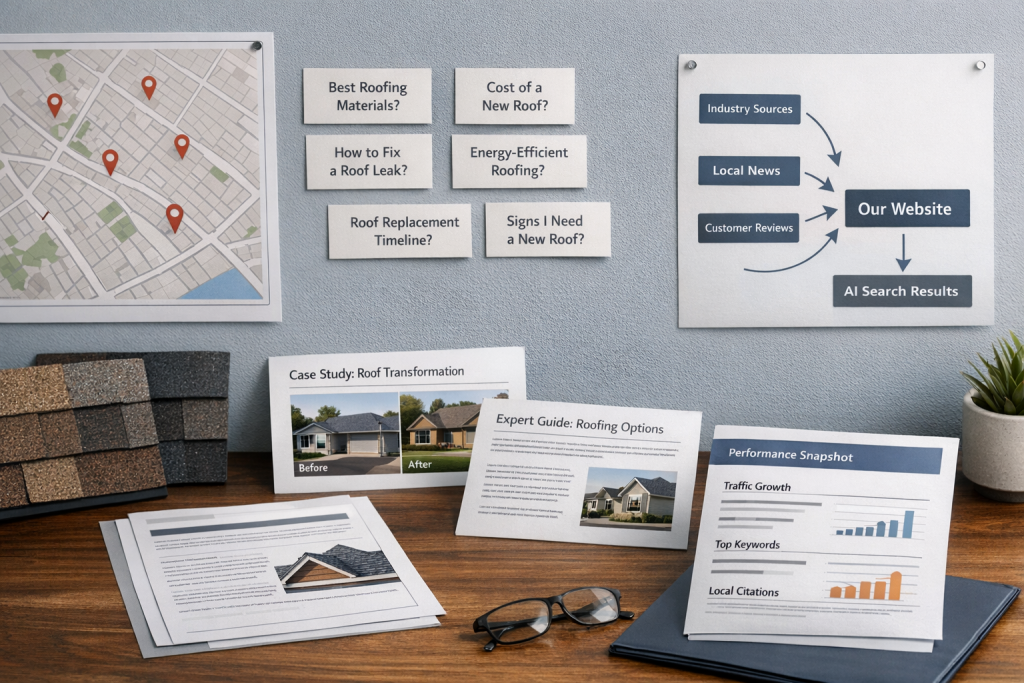
How Roofing Companies Build Visibility in ChatGPT, Gemini, and Google AI Overviews
A roofing company builds AI visibility by becoming a business that AI systems can discover, verify, and confidently reference — not by chasing a new set of keywords. The foundation is consistent business information, a thorough Google Business Profile, specific and credible reviews, and content that directly answers the questions homeowners actually ask AI assistants. What changes from traditional SEO is the emphasis: AI systems synthesize signals from across the web to decide which providers to mention, which means external corroboration, structured data, and first-party evidence from real projects matter more than they ever did in a ten-blue-links environment.
This guide walks through a prioritized, practical playbook for roofing companies that already invest in marketing and want to understand what AI search requires. It covers what to do first, what to do next, what does not work, and how to measure progress over time.
Why AI Search Works Differently for Local Roofing Companies
From Ranking Pages to Recommending Businesses
Traditional search returns a list of links. The homeowner clicks through several, compares, and decides. AI search works differently. When a homeowner asks ChatGPT, Gemini, or encounters a Google AI Overview, the system generates an answer that synthesizes information from multiple sources. Instead of showing ten links and letting the user sort it out, the AI names specific businesses, explains why they might be a good fit, and cites sources.
For a roofing company, this means the goal shifts from ranking a page to becoming a business the AI system has enough confidence to mention by name. That confidence comes from how consistently your business information appears across the web, how clearly your website answers relevant questions, and how much independent corroboration exists from third-party sources like review platforms, industry directories, and local publications.
What AI Systems Are Actually Evaluating
AI systems do not rank pages the way Google’s traditional algorithm does. They build a picture of entities — businesses, people, places, concepts — by pulling signals from across the web. For a roofing company, the AI is trying to answer questions like: Is this a real business? Where does it operate? What services does it provide? Do other credible sources confirm this information? Does the company’s own content demonstrate genuine expertise?
This is entity confidence, not keyword density. A roofing company with a complete Google Business Profile, consistent directory listings, detailed project documentation on its website, and specific reviews mentioning real services in real neighborhoods gives AI systems far more to work with than a company with a keyword-stuffed homepage and a blog full of generic advice.
How ChatGPT Search, Gemini, and Google AI Overviews Differ — and Where They Overlap
These three systems access information differently, but they reward many of the same signals.
Google AI Overviews draw from Google’s existing index and knowledge systems. They have access to everything Google Search already knows about your business, including your Google Business Profile, your indexed pages, and your review signals. If you are already doing strong local SEO, you have a foundation here.
Gemini accesses Google Business Profile data directly. This makes GBP completeness and accuracy especially important for Gemini-powered answers. Gemini also uses Google’s search index, so content that is well-indexed by Google is accessible to Gemini.
ChatGPT Search uses its own web crawler, OAI-SearchBot, to retrieve pages in real time. If your robots.txt file blocks OAI-SearchBot, ChatGPT Search cannot access your content. This is a distinct technical requirement that does not apply to Google’s systems.
The overlap is substantial: all three systems favor businesses with consistent, verifiable information across platforms, clear and specific website content, and independent third-party corroboration. The differences are mostly technical — which crawlers need access, which data sources each system draws from — and those differences are manageable once you understand them.
Step 1: Establish Your Roofing Company as a Verifiable Local Entity
This is the highest-priority work. Everything else builds on it. If AI systems cannot confidently identify who you are, where you operate, and what you do, none of the content or technical work matters.
What “Entity” Means for a Local Service Business
In AI-search terms, an entity is a distinct, recognizable thing — a business, a person, a place — that systems can identify across multiple sources. The more places AI systems find your roofing company’s name, address, phone number, service descriptions, and coverage area in agreement with one another, the more confidently they can surface your business in a relevant answer. Gaps and contradictions between sources reduce that confidence; alignment across sources builds it.
NAP Consistency Across Every Platform That Matters
NAP stands for Name, Address, Phone number. Consistency here means your business name appears in exactly the same form everywhere it is listed — not one variation on your website, a slightly different version on a directory, and a third form on your social profiles. The same precision applies to your address format and phone number.
Platforms where consistency matters most:
- Google Business Profile
- Your website (especially the footer, contact page, and about page)
- Yelp, Angi, HomeAdvisor, and roofing-specific directories
- Better Business Bureau
- Your state contractor licensing board listing
- Facebook, Instagram, and LinkedIn business profiles
- Local chamber of commerce or trade association memberships
- Any local publication or news mention that references your company
AI systems cross-reference these sources. Inconsistencies create ambiguity. Ambiguity reduces confidence. Reduced confidence means the AI is less likely to mention your company by name.
Google Business Profile as an AI Data Source
Google Business Profile is not just a local SEO signal anymore. It is a direct data source for Gemini and Google AI Overviews. When Gemini handles a query about roof replacements in a specific city, it can draw directly from GBP data — your business categories, service descriptions, operating hours, service area, photos, reviews, and Q&A section.
A complete GBP profile for a roofing company should include:
- Correct primary category (Roofing Contractor) and relevant secondary categories
- A detailed business description that names specific services, materials, and service areas
- Complete service area settings covering every city and neighborhood you serve
- Individual service listings with descriptions (roof replacement, roof repair, storm damage restoration, gutter installation, etc.)
- High-quality photos of real completed projects, not stock images
- Regular Google Posts showing recent work, seasonal information, or homeowner tips
- Answers in the Q&A section that address common homeowner questions directly
- A consistent flow of reviews with owner responses
Every field you leave empty is information the AI system cannot use. Every field you complete with specific, accurate detail is a signal the AI can draw from.
Step 2: Build Content That AI Systems Can Extract and Cite
The Difference Between a Page AI Ignores and a Page AI Cites
AI systems cite pages that directly answer a question with specific, quotable information. They tend to skip pages that are vague, generic, or structured in ways that make it difficult to extract a clear answer.
A page built around phrases like “quality roofing services for homeowners across the region” gives the AI almost nothing actionable. A page that states the typical cost range for an architectural shingle replacement in a specific city — broken down by roof size, pitch, and material grade — gives the AI a concrete, quotable data point it can use when a homeowner asks about local roofing costs.
The difference is specificity. AI systems need concrete information, not marketing language.
How to Structure Answer-First Content
The most effective pattern for AI-visible content follows a simple sequence:
- State the question clearly in the heading
- Answer it directly in the first one to two sentences of the section
- Explain the reasoning or context behind the answer
- Provide evidence — examples, project details, material comparisons, or local conditions that support the answer
This structure works because AI systems can extract the direct answer even if they do not use the entire section. It also works for human readers, who get the answer immediately and can decide whether to keep reading for more detail.
What Homeowner Questions Actually Drive AI Search
Homeowners do not open an AI assistant and type a generic service category. They ask specific, conversational questions — the kind that reflect a real decision they are trying to make. The questions that matter most are the ones tied to active buying or evaluation moments:
- How much does a roof replacement cost in [city]?
- What is the best roofing material for [climate condition]?
- How do I know if my roof needs to be replaced or just repaired?
- What should I look for when hiring a roofing contractor?
- How long does a roof replacement take?
- Does homeowners insurance cover storm damage to a roof?
- What is the difference between architectural shingles and three-tab shingles?
- Who are the best roofing companies in [city]?
- What questions should I ask a roofing contractor before hiring?
Each of these questions is a potential AI-answer moment. If your website addresses them with specific, local, credible detail, your content becomes available for AI systems to reference. If your website does not address them, the AI will reference someone else’s content — or answer without mentioning any specific company at all.
Understanding which buyer questions matter most, and how AI systems currently answer them, is the research step that most roofing companies skip entirely. It is also the step that makes everything else more effective, because it determines what content to create and how to structure it.
What Makes a Local Page Genuinely Useful Versus Thin
Many roofing companies have city pages — a page for every city they serve. Most of these pages are thin: the same template content with the city name swapped in. AI systems can recognize this pattern, and thin city pages do not provide enough specific information to be worth citing.
A genuinely useful local page includes information that is specific to that location:
- Common roofing challenges in that city or neighborhood (hail exposure, wind patterns, HOA requirements, building code specifics)
- Materials that perform well in that local climate
- References to completed projects in that area, with enough detail to be credible
- Relevant permit or inspection information specific to that jurisdiction
- Neighborhood-level context that a homeowner would recognize
This is harder to create than a template city page. It requires local knowledge. That is precisely why it works — AI systems are looking for content that demonstrates real expertise, and templated content does not demonstrate anything.
Step 3: Turn Your Projects Into Citable Evidence Pages
What an Evidence Page Is and Why It Outperforms Generic Blog Content
An evidence page is a detailed documentation of a real project your company completed. It is the single most powerful type of content a roofing company can create for AI visibility, because it contains information only your company can produce. No competitor can replicate your actual project details, photos, material choices, and outcomes.
This is what first-party evidence means: original content based on real work. AI systems are trained to value content that adds genuinely new information to the web. A blog post that rewrites generic roofing advice adds little. A detailed project page showing what you found during an inspection, what you recommended, what materials you used, and what the result looked like adds real information that did not exist before.
What to Include in a Roofing Project Case Study
A strong evidence page for a roofing company should include:
- Location: city, neighborhood, or general area (do not include the homeowner’s exact address)
- Project type: full replacement, repair, storm damage restoration, commercial reroof, etc.
- Problem identified: what the inspection revealed, what the homeowner’s concern was
- Materials selected: specific product names, manufacturers, material grades
- Why those materials were chosen: climate suitability, homeowner budget, aesthetic preferences, warranty considerations
- Timeline: how long the project took from inspection to completion
- Before-and-after photos: real images of the actual project
- Any relevant challenges: structural issues discovered, weather delays, code compliance requirements
- Outcome: what the homeowner received, any warranty details
This format gives AI systems rich, specific, quotable information. When a homeowner asks about roof replacement in your city, a page with this level of detail is far more likely to be referenced than a generic service description.
How to Build a Library of Evidence Pages Systematically
The key is consistency. Document every significant project, not just the showpiece jobs. Over time, this builds a library that covers different service types, different neighborhoods, different materials, and different price points. Each page becomes a potential AI-citation asset, and the collection as a whole reinforces your company’s entity signal as a real, active, credible roofing contractor in your service area.
Most roofing companies never do this. The ones that do create a content advantage that is extremely difficult to replicate, because the content is based on work that only they performed.
Step 4: Make Your Expertise Machine-Readable With Structured Data
What Schema Markup Actually Does for AI Systems
Schema markup — also called structured data — is code added to your website that labels specific pieces of information in a way search engines and AI systems can read directly. Instead of requiring the AI to interpret a paragraph and infer that a business name and city are present, schema markup explicitly identifies those facts in a standardized format.
Think of it as filling out a form for AI systems. The form has fields for your business name, address, phone number, service area, services offered, review ratings, and more. When you provide this form in a standard format, AI systems can read it immediately and with high confidence.
Which Schema Types Matter Most for a Roofing Company
- LocalBusiness (or the more specific HomeAndConstructionBusiness): labels your company’s core identity, location, and contact information
- Service: identifies specific services you offer (roof replacement, roof repair, gutter installation)
- Review / AggregateRating: makes your review data machine-readable
- FAQPage: labels FAQ content so AI systems can extract question-answer pairs directly
- BreadcrumbList: helps AI systems understand how your pages relate to each other
These should be implemented accurately. The information in your schema must match what appears on the visible page. Schema that claims five-star ratings, services you do not offer, or locations you do not serve will create problems, not advantages.
What Schema Does Not Do
Schema is one signal among many. It helps AI systems read your information accurately, but it does not override weak content, missing reviews, or inconsistent business information. Treat schema as a communication tool, not a magic switch. Implementing perfect schema on a thin, generic website will not produce AI visibility on its own.
Step 5: Build External Trust Signals AI Systems Can Verify
Why AI Systems Cross-Reference the Web Beyond Your Own Site
Your website tells AI systems what you claim about your business. External sources tell AI systems whether those claims are corroborated. AI systems are designed to assess confidence, and independent confirmation from third-party sources significantly increases that confidence.
When your company is mentioned on a local news site, listed in an industry directory, featured in a trade association’s member directory, or reviewed on multiple platforms, the AI system has more evidence that your business is real, active, and credible.
The Difference Between a Directory Listing and a Genuine Third-Party Mention
A directory listing — Angi, HomeAdvisor, Yelp, BBB — confirms your business exists and provides basic information. This is valuable, but it is the minimum.
A genuine third-party mention goes further. It might be a local newspaper article about a community project you participated in, a roofing industry association feature, a supplier case study naming your company, or a local business publication profile. These mentions carry more weight because they represent independent editorial decisions to reference your company, not just a listing you created yourself.
Both directory listings and genuine mentions matter. But roofing companies that have both are giving AI systems a richer, more verifiable picture than companies that only have directory profiles.
Reviews as an AI Trust Signal
Reviews matter for AI visibility, but specificity matters more than volume alone. A short, vague review gives the AI almost nothing to work with. A review that names the service performed, describes the materials installed, mentions the neighborhood, and recounts a specific detail from the project — like rotted decking discovered during tear-off — gives the AI concrete, verifiable information it can treat as credible evidence.
You cannot control what customers write, and you should never script reviews. But you can encourage detailed feedback by asking specific questions after a project: What service did we perform? How was the communication? Would you describe the result? Homeowners who are happy with their experience will often provide detailed reviews when prompted with genuine, open-ended questions.
Review volume still matters for overall credibility, but the reviews that contribute most to AI visibility are the ones that contain specific service details, location references, and authentic descriptions of the experience.
Step 6: Ensure AI Systems Can Actually Access Your Website
Technical Crawlability Basics for AI Search
A well-built website with great content is invisible to AI systems if their crawlers cannot access it. This is a common problem that many roofing companies do not realize they have.
The essential checks:
- Robots.txt: review your robots.txt file to confirm you are not accidentally blocking important pages. Some website templates or security plugins block crawlers by default.
- OAI-SearchBot: this is OpenAI’s web crawler for ChatGPT Search. If your robots.txt blocks OAI-SearchBot, your content cannot appear in ChatGPT search results. This is a separate crawler from GPTBot, which OpenAI uses for model training — you can allow one and block the other.
- Noindex tags: check that important pages do not have noindex meta tags applied accidentally. This tells search engines not to include the page in their index.
- Page errors: broken pages, server errors, and redirect chains prevent crawlers from accessing your content.
- HTML accessibility: your main content should be available in standard HTML that crawlers can read, not locked inside JavaScript-rendered elements that require a browser to display.
The Search Console Generative AI Control Setting
Google Search Console now includes a Generative AI control setting. This setting allows site owners to control whether their content can appear in Google’s AI-generated features, including AI Overviews. The default setting allows inclusion. If someone on your team changed this setting — or if you are not sure — it is worth checking. A roofing company that wants AI visibility should confirm this setting is not inadvertently blocking AI-feature inclusion.
Google Search Console also offers a Generative AI performance report that shows how your pages are appearing in AI-generated search features. This is a new and underused data source that can show which of your pages are being surfaced and for which types of queries.
What About llms.txt?
Some marketing advice recommends that roofing companies create an llms.txt file — a structured text file intended to help large language models navigate your site. The practical reality: llms.txt may have some utility with certain AI systems, but Google has stated clearly that it has no effect on Google Search ranking or AI Overview inclusion. Creating one is not harmful, but it should not be a priority. The steps above have clearer, more observable effects on AI visibility across the platforms that matter most to roofing companies.
How to Measure Whether AI Visibility Work Is Actually Working
Why Traditional SEO Metrics Do Not Capture AI Visibility
Your Google Search rankings, organic traffic, and keyword positions do not tell you whether AI systems are mentioning your company. A roofing company can rank well in traditional search and still be completely absent from ChatGPT, Gemini, and Google AI Overview answers. These are different systems with different behaviors, and they require separate tracking.
Building a Prompt Testing Framework
The most direct way to understand your AI visibility is to test it. Run the kinds of questions your potential customers would ask across multiple AI platforms and record what happens.
Categories of prompts to test:
- Discovery prompts: questions about which roofing companies operate in your city, or which contractor to call for storm damage repair in your service area.
- Problem prompts: questions a homeowner asks after noticing a leak or suspecting hail damage — what to do next, whether a full replacement is necessary.
- Research prompts: questions about what a roof replacement costs in your city, or which materials hold up best in your local climate.
- Comparison prompts: questions about how to evaluate competing roofing contractors or assess the fairness of an estimate.
For each prompt, record: which platform you tested (ChatGPT, Gemini, Google AI Overview), whether your company was mentioned, what sources were cited, what competitors appeared, and the date of the test.
| Prompt | Platform | Your Company Mentioned | Competitors Mentioned | Sources Cited | Date |
|---|---|---|---|---|---|
| Best roofing companies in [city] | ChatGPT | Yes / No | [Names] | [URLs] | [Date] |
| Roof replacement cost in [city] | Gemini | Yes / No | [Names] | [URLs] | [Date] |
| Storm damage roof repair near [area] | Google AI Overview | Yes / No | [Names] | [URLs] | [Date] |
This is not a one-time exercise. AI answers change as systems update their information. Monthly or quarterly testing gives you a baseline and lets you track whether your visibility is improving, declining, or holding steady.
What to Track and How Often
At minimum, a roofing company investing in AI visibility should track:
- Whether the company is mentioned by name across major AI platforms for key buyer questions
- Which competitors are being mentioned and for what types of questions
- Which of the company’s own pages are being cited as sources
- Google Search Console Generative AI performance data
- Changes over time as new content is published and business information is updated
This tracking is the only reliable way to understand whether AI visibility work is producing observable results. Without it, you are guessing.
What to Do First: A Priority Order for Roofing Companies
Not everything has equal weight. If your roofing company is starting from scratch on AI visibility, here is the recommended priority sequence:
- Complete and verify your Google Business Profile. Fill every field. Add real photos. Post regularly. Respond to reviews. This is the highest-impact, lowest-effort step because GBP data feeds directly into Gemini and Google AI Overviews.
- Fix NAP consistency. Audit your business name, address, and phone number across all major platforms and directories. Correct inconsistencies. This strengthens your entity signal across every AI system.
- Check technical crawlability. Review your robots.txt, confirm OAI-SearchBot is not blocked, check for accidental noindex tags, and verify the Search Console Generative AI control setting. This takes an hour and removes invisible barriers.
- Research the buyer questions that matter. Identify which homeowner questions are being asked in AI systems in your market. Test prompts. Record baselines. This tells you what content to create.
- Create answer-first content for high-priority buyer questions. Start with the questions that represent the most valuable buying moments. Structure content so AI systems can extract direct answers.
- Build evidence pages from completed projects. Document real projects with specific details, materials, locations, and photos. This creates content only your company can produce.
- Implement structured data. Add LocalBusiness, Service, and FAQPage schema to the appropriate pages. Verify accuracy.
- Pursue external mentions and directory completeness. Ensure you are listed in every relevant directory and look for opportunities to earn genuine third-party mentions.
- Establish ongoing monitoring. Set up monthly prompt testing and review your Search Console Generative AI report regularly.
Steps one through three can often be completed in a week. Steps four through nine are ongoing work that compounds over time.
Why Most Roofing Companies Will Not Do This Themselves
The playbook above is straightforward to understand and genuinely difficult to execute consistently. Most roofing companies are already managing crews, job scheduling, material procurement, customer communication, insurance coordination, and whatever their current marketing agency is producing. Adding buyer-question research, content creation, WordPress publishing, social distribution, prompt testing, citation tracking, and competitor monitoring on top of that is a meaningful operational burden.
This is the problem CiteHarbor was built to solve. CiteHarbor handles the full workflow: initial AI visibility audit, buyer-question research specific to your market and service area, targeted article creation, WordPress publishing, social media distribution, monthly citation tracking across ChatGPT, Gemini, Google AI Overviews, Claude, and Perplexity, competitor citation monitoring, and a branded PDF performance snapshot delivered to you each month.
There is no dashboard to manage. No software to learn. No content calendar to maintain. CiteHarbor performs the research, creates the content, publishes it, distributes it, monitors the results, and reports back — so you can focus on running your roofing company while your AI visibility builds in the background.
Frequently Asked Questions
Does my roofing company need a separate strategy for ChatGPT versus Google AI Overviews?
Mostly no. The core work — business information consistency, GBP completeness, answer-first content, structured data, external corroboration — benefits you across all platforms. The main technical difference is that ChatGPT Search requires OAI-SearchBot access through your robots.txt file, while Google AI Overviews draw from Google’s existing index. Make sure you are accessible to both, and the same content strategy supports visibility in both systems.
How do I know if my roofing company is already appearing in AI search results?
Test it directly. Open ChatGPT, Gemini, and a Google search that triggers an AI Overview. Enter the questions a homeowner in your area would realistically ask — about which roofing company to hire, what a replacement costs locally, or who handles storm damage in your city. Note whether your company appears, which competitors show up, and which pages are cited. Google Search Console’s Generative AI performance report can also show whether your pages are surfacing in AI-generated features.
What is the most important first step for AI visibility?
Complete your Google Business Profile thoroughly. It is the single highest-impact starting point because GBP data feeds directly into Google AI Overviews and Gemini, it strengthens your entity signal for all AI systems, and it can usually be improved significantly within a day or two.
How long does it take to see results from AI visibility work?
AI visibility builds gradually. Some changes — like fixing NAP consistency or completing your GBP — can produce observable effects within weeks. Content-based improvements typically take longer because AI systems need to crawl, index, and develop confidence in new pages. The realistic expectation is that meaningful, observable improvement in AI visibility happens over months of consistent work, not days. This is why ongoing tracking matters: it helps you see progress even when changes are incremental.
Does traditional SEO still matter if I am optimizing for AI search?
Yes. Google AI Overviews draw from Google’s search index, which means traditional SEO fundamentals — crawlability, site structure, page quality, authority signals — directly affect your eligibility for AI-generated features. AI visibility is not a replacement for SEO. It is an additional layer that builds on the same foundation but requires specific attention to content structure, entity signals, and cross-platform consistency that traditional SEO may not emphasize.
What kinds of content does ChatGPT actually cite?
ChatGPT Search cites pages that provide direct, specific, quotable answers to the question being asked. Pages with clear headings, answer-first paragraph structure, specific data points, and credible detail are more likely to be cited than pages with vague marketing language or generic advice. First-party evidence pages — like detailed project case studies — are particularly valuable because they contain unique information that cannot be found elsewhere.
What is the difference between being mentioned by AI and being recommended by AI?
Being mentioned means the AI includes your company name in its response, often as one option among several. Being recommended means the AI specifically suggests your company as a strong choice, sometimes with reasoning like review quality, service specifics, or project experience. Recommendation-level visibility requires a stronger set of signals — more detailed reviews, more specific content, more external corroboration — than simple mention-level visibility. Both are valuable, but building toward recommendation-level visibility is the higher goal.
The Next Step for Your Roofing Company
AI search is not a future consideration for roofing companies. It is where homeowners are already asking questions, comparing contractors, and making shortlists. The roofing companies that build clear, consistent, well-documented visibility across these platforms now are the ones that will have an observable presence when buyers ask AI for help choosing a contractor.
The work is not mysterious, but it is substantial and ongoing. If your team has the capacity to handle buyer-question research, content creation, publishing, distribution, citation tracking, and competitor monitoring alongside running your roofing business, this playbook gives you a clear path. If you would rather have the entire workflow handled for you — from audit to content to publishing to monthly reporting — that is exactly what CiteHarbor does.