How HVAC Companies Get Mentioned When Homeowners Ask AI for a Local Recommendation
Learn how AI systems decide which local HVAC companies to mention when homeowners ask for recommendations, and what business profiles, reviews, content, and citations matter most. This guide gives HVAC owners and marketers a practical framework for improving AI visibility and tracking results over time.
How HVAC Companies Get Mentioned When Homeowners Ask AI for a Local Recommendation
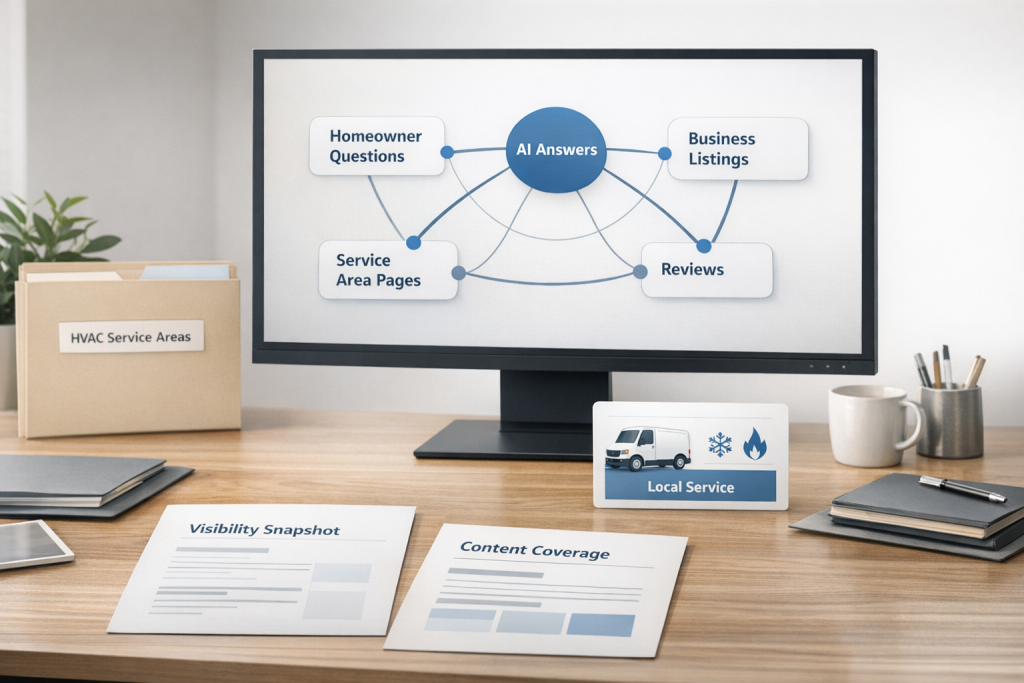
AI systems recommend HVAC companies they can verify. When a homeowner asks ChatGPT, Gemini, or Perplexity for an HVAC recommendation in their city, the AI does not search a ranked list. It assembles an answer from every source it can find — your website, your business profiles, your reviews, third-party directories, and local mentions — and surfaces the companies it can confirm are real, relevant, and trustworthy. The goal is not to trick an AI model. It is to make your company easy for that model to identify, validate, and confidently include in a recommendation.
This article explains the mechanism behind AI local recommendations, the specific signals that influence which HVAC companies get mentioned, what to build and maintain on your end, and how to track whether any of it is working. Every section is written for an HVAC company owner or marketing lead who already invests in some form of digital marketing and wants to understand this newer layer of buyer discovery.
Why AI Recommendations Work Differently From a Google Search
What AI systems are actually doing when a homeowner asks for a recommendation
When someone types “best HVAC company near me” into a traditional search engine, the engine returns a list of pages ranked by relevance and authority. The user clicks, evaluates, and decides. The search engine’s job is to present options.
When someone asks an AI assistant the same question, the system does something fundamentally different. It builds a synthesized answer. It pulls from multiple sources — business profiles, review platforms, web content, directories, news mentions — and tries to construct a response that names specific businesses, explains why they might be a good fit, and answers the homeowner’s underlying question. The AI is not ranking pages. It is making a recommendation, or at least assembling what looks and reads like one.
That difference matters because the signals that help a page rank on Google are not identical to the signals that help an AI system feel confident enough to name your company in a generated answer.
The difference between being listed and being recommended
AI systems sometimes mention a business as one name in a generic list. Other times, they describe a business with specific context — the services it offers, the areas it covers, what reviewers say about it. The second version is far more valuable because it carries implied endorsement and gives the homeowner a reason to act.
What appears to drive the difference is the depth and consistency of information the AI can find about a business. If the only signal is a basic directory listing, the business might appear in a list. If the AI can cross-reference a detailed business profile, specific service descriptions, verified reviews that mention actual work, and third-party content that references the company, it has enough material to say something meaningful.
Why most HVAC companies are invisible to AI systems right now
Most local HVAC companies have some digital presence — a website, a Google Business Profile, maybe a few dozen reviews. But that presence is often inconsistent across platforms, thin on specifics, and missing from the sources AI systems tend to draw from most heavily.
Common gaps include:
- A Google Business Profile that is incomplete or has outdated service categories
- No Bing Places profile, even though ChatGPT draws local data through Bing
- Reviews that say “Great service!” but never mention what work was done or where
- A website with no pages that answer the specific questions homeowners ask AI
- Inconsistent business name, address, or phone number across directories
- No mentions on third-party sources that AI systems treat as credible
None of these gaps are difficult to fix individually. The challenge is fixing all of them, maintaining them over time, and knowing whether the work is producing results.
The Signals AI Systems Use to Evaluate Local HVAC Companies
No one outside these AI companies knows exactly how their recommendation logic works. But based on observable patterns — what AI systems cite, what they mention, and what they leave out — certain signals appear to carry weight consistently.
Business profile completeness and cross-platform consistency
AI systems pull local business data from structured sources: Google Business Profile, Bing Places, Yelp, Apple Maps, the Better Business Bureau, Angi, and industry-specific directories. The more complete and consistent your information is across these platforms, the more confidence an AI system appears to have when including your company in an answer.
NAP consistency — your business Name, Address, and Phone number matching exactly across every platform — is a baseline signal. If your Google listing says “Johnson HVAC Services” but your website says “Johnson Heating and Cooling” and Yelp says “Johnson HVAC LLC,” an AI system has three slightly different entities instead of one clear one. That ambiguity reduces the likelihood of a confident recommendation.
Review specificity, not just star count
A high star rating helps, but AI systems appear to draw more from the content of reviews than from the aggregate score alone. Reviews that describe specific work give the AI something to reference.
Weak review: “Great company, highly recommend! 5 stars.”
Strong review: “Johnson HVAC replaced our 15-year-old furnace with a high-efficiency unit. The crew arrived on time, explained the options clearly, and finished the install in one day. They also caught a ductwork issue and fixed it before closing up.”
The second review gives an AI system specific details it can use: the service performed, the quality of communication, the timeliness, and even an unexpected finding. When an AI assembles a recommendation, this kind of detail becomes the raw material for a more substantive mention.
Content that answers real homeowner questions
When a homeowner asks an AI “What should I look for in an HVAC company?” or “How much does it cost to replace a furnace in [city]?”, the AI looks for content that directly answers that question. If your website has a page that addresses that question clearly — with real information, not marketing fluff — it becomes a candidate for extraction.
This is different from traditional blog content that targets keywords. The content that AI systems tend to extract and reference is:
- Written in plain language
- Organized around a specific question
- Direct in its answer within the first few sentences
- Detailed enough to be useful but not padded with filler
- Specific to a service area or service type when relevant
A page titled “How to Know When Your AC Needs Replacing vs. Repairing” that opens with a clear, two-sentence answer and then walks through the decision criteria is far more useful to both homeowners and AI systems than a generic page titled “Our HVAC Services.”
Third-party mentions and entity strength
Entity strength is a practical concept: it describes how much independent evidence exists across the web that your business is real, active, and connected to the services and geography you claim. Every time your company is mentioned on a source that is not your own website — a local news article, a chamber of commerce directory, a manufacturer’s dealer page, a trade publication, a community sponsorship mention — it adds to the body of evidence an AI system can use.
For a local HVAC company, the most realistic sources of third-party mentions include:
- Local chamber of commerce or business association directories
- Manufacturer and distributor dealer locator pages
- Local newspaper or community publication mentions
- Home services platforms and directories
- Local event sponsorship acknowledgments
- Trade association membership listings
These are not exotic or expensive to build. They are the kinds of mentions that happen naturally when a business is active in its community and industry — but many HVAC companies have never confirmed whether those mentions exist, are accurate, or align with their other listings.
Structured data and schema markup
Schema markup is code added to your website that communicates to search engines and AI crawlers exactly what your page is about, in a format those systems can parse without ambiguity. For an HVAC company, the most relevant schema types are LocalBusiness, Service, and FAQ.
LocalBusiness schema conveys your business name, address, phone number, service area, hours, and category in a machine-readable structure. Service schema describes the specific work you perform. FAQ schema marks up question-and-answer pairs so they can be identified and pulled cleanly by AI systems.
Schema is not a magic solution. It is one signal among many. But it makes your information easier for AI systems to parse, which reduces friction between your content and the system trying to use it. Think of it as removing a barrier rather than adding a boost.
What to Build: A Practical Framework for HVAC AI Visibility
The signals described above translate into a specific set of actions. Here they are in a logical sequence, starting with the most foundational.
Step 1: Complete and verify your Google Business Profile
Your Google Business Profile should include:
- Accurate business name, address, and phone number
- All relevant service categories selected
- A complete business description that names your services and service areas
- Current business hours, including seasonal hours if applicable
- Photos of your team, vehicles, and completed work
- A link to your website
- Responses to reviews, especially detailed ones
This is foundational. Google’s own AI features, including AI Overviews, draw from this data. If it is incomplete or outdated, you are invisible to one of the largest AI recommendation surfaces that exists.
Step 2: Claim and complete your Bing Places profile
This is the most commonly overlooked step for local service companies. ChatGPT sources much of its local business data through Bing’s index. If your Bing Places profile does not exist or is incomplete, ChatGPT may not have the structured data it needs to include your company in a local recommendation.
Claiming a Bing Places listing is free and takes minutes. The information should match your Google Business Profile exactly.
Step 3: Build service-plus-city pages that answer real questions
A “service-plus-city” page is a page on your website that covers a specific service in a specific area — for example, “Furnace Replacement in Long Beach, CA” or “Emergency AC Repair in Pasadena.”
The difference between a useful page and a thin one is whether it actually helps a homeowner:
Thin page: “We offer furnace replacement in Long Beach. Call us today for a free quote!”
Useful page: “If your furnace is more than 15 years old, requires frequent repairs, or heats unevenly, replacement is often more cost-effective than continued repair. In Long Beach, most residential furnace replacements take one to two days and involve selecting between single-stage, two-stage, and modulating units. Here is how each option compares for typical Long Beach homes…”
The useful version gives an AI system material to work with. It answers a question a homeowner might actually ask, provides specific decision criteria, and connects the information to a real geography.
Step 4: Make your reviews work harder
You cannot control what customers write in reviews. But you can influence the specificity of reviews by:
- Asking customers to mention the specific service they received
- Following up after a job with a simple prompt: “If you have a minute to leave a review, it helps other homeowners when you describe the work we did and how the experience went”
- Responding to reviews with additional detail: “Glad to hear the ductwork repair in your attic went well — and that the new zoning setup has made a real difference upstairs”
This is not review manipulation. It is making the review record more informative for both future homeowners and the AI systems that read those reviews.
Step 5: Create content AI systems can actually extract and quote
The content that AI systems tend to reuse shares a few characteristics:
- It answers a specific question in the first one to three sentences
- It uses plain language a homeowner would understand
- It organizes information under clear, descriptive headings
- It includes enough specificity to be useful but not so much jargon that it loses the reader
- It is structured so that a paragraph or short section can stand alone as a complete answer
For an HVAC company, the most productive content topics are the questions homeowners actually ask before, during, and after a buying decision. Questions like:
- “How do I know if my AC needs replacing or just repairing?”
- “What size HVAC system do I need for a 2,000 square foot home?”
- “What is the difference between a heat pump and a furnace?”
- “How often should I have my HVAC system serviced?”
- “What should I look for when choosing an HVAC company?”
Each of these can be a standalone page or a clearly labeled section within a longer resource. The key is that the answer is direct, specific, and easy to extract.
Step 6: Build consistent mentions across third-party sources
Audit your presence on every directory and platform that might reference your company. Confirm that your business name, address, phone number, and service descriptions are uniform across all of them. Claim listings on platforms you may have overlooked — industry-specific directories, local business associations, manufacturer dealer locator pages, and home services platforms.
Each consistent mention strengthens the body of evidence that AI systems draw from when deciding whether to include your company in an answer.
Step 7: Add schema markup that AI crawlers can read
If your website does not already have LocalBusiness and Service schema, adding it gives crawlers a structured, machine-readable summary of your business information. If you create FAQ content, marking it up with FAQ schema makes it easier for AI systems to identify and extract the question-and-answer pairs.
Schema implementation is usually a one-time technical task, but it should be reviewed periodically to make sure the information stays accurate — especially if you add new services or change your business address or hours.
How to Know If It Is Working: Monthly AI Visibility Testing
The biggest gap in most AI visibility advice is what happens after implementation. You have completed your profiles, published new content, and cleaned up your citations. How do you know whether AI systems are actually mentioning you?
The test prompts to run every month
Open ChatGPT, Gemini, Perplexity, and Microsoft Copilot. Ask each one a set of questions that a homeowner in your area might realistically ask:
- “What is the best HVAC company in [your city]?”
- “Who should I call for furnace replacement in [your city]?”
- “Can you recommend an AC repair company near [your neighborhood]?”
- “What HVAC companies in [your city] have the best reviews?”
Record which companies are mentioned, in what order, and with what level of detail. Note whether your company appears, and if so, whether it is merely listed or described with context.
What to record and track
For each prompt and each AI platform, track:
- Whether your company was mentioned
- Whether it was listed generically or described with specific context
- Which competitors were mentioned
- What sources the AI cited or appeared to reference
- Whether the answer changed from the previous month
Over time, this data reveals patterns — which platforms mention you most frequently, which competitors appear consistently, and whether your visibility is improving, declining, or unchanged.
What to do when competitors are being mentioned and you are not
If a competitor consistently appears and you do not, study what they have that you lack. Common differences include:
- A more complete Bing Places or Google Business Profile
- More detailed, service-specific reviews
- Content pages that directly answer the question you asked the AI
- Mentions on third-party sources you are absent from
- Stronger NAP consistency across directories
This is diagnostic, not discouraging. Every gap you identify is a specific action you can take.
The Management Reality: Why Most HVAC Companies Fall Behind
What consistent execution actually requires
The tactics in this article are individually straightforward. The difficulty is in the aggregate. Maintaining a complete, accurate Google Business Profile. Keeping Bing Places updated. Monitoring review volume and responding to reviews. Publishing content that answers buyer questions on a regular schedule. Verifying citation consistency across directories. Running monthly AI visibility tests across multiple platforms. Tracking competitor mentions. Analyzing what changed and deciding what to do next.
For an HVAC company owner who is already managing technicians, scheduling, equipment, and customers, this is a significant ongoing workload.
Why one-time setup is not enough
AI systems update their knowledge over time. New competitors publish content. Reviews accumulate. Business information changes. A profile that was complete six months ago may be outdated today. A content library that answered the right questions last year may not match what homeowners are asking now.
AI visibility is not a project with a finish line. It is an ongoing process — which is exactly why so many companies start strong and then fall behind.
What a full-service approach looks like
CiteHarbor exists specifically for businesses that understand this problem but do not have the internal capacity to manage it. Instead of handing you a dashboard and a list of recommendations, CiteHarbor handles the full workflow: initial AI visibility auditing across ChatGPT, Gemini, Perplexity, Claude, and Google AI Overview. Buyer-question research to identify the questions homeowners in your market are actually asking AI systems. Targeted article creation designed to answer those questions clearly enough to be extracted and cited. WordPress publishing and social media distribution. Monthly AI citation tracking and competitor citation monitoring. And a branded PDF performance snapshot delivered to you — not a login you have to manage.
The point is not to add another platform to your stack. It is to take this work off your plate entirely.
Frequently Asked Questions
Does my HVAC company need a separate AI visibility strategy, or is regular SEO enough?
Regular SEO covers some of the same ground — site structure, content quality, business profiles — but it does not address AI-specific factors like Bing Places completeness, buyer-question content formatted for extraction, cross-platform entity consistency, or monthly AI citation tracking. The two disciplines overlap, but AI visibility requires additional, targeted work.
How does ChatGPT decide which HVAC company to recommend?
ChatGPT’s exact recommendation logic is not public. Based on observable patterns, it appears to draw heavily from Bing’s local data index, review platforms, and web content that directly answers the question asked. Companies with complete Bing Places profiles, detailed reviews, and specific service content appear more frequently than those without.
Does having more Google reviews help with AI recommendations?
Review volume matters, but review content appears to matter more for AI recommendations specifically. Detailed reviews that describe what service was performed, the customer’s experience, and the outcome give AI systems more usable material than a large number of generic five-star ratings.
Does Bing really matter for AI visibility?
Yes. ChatGPT sources local business data through Bing’s index. If your company does not have a complete, accurate Bing Places profile, ChatGPT may not have the structured information it needs to include you in a local recommendation. Most HVAC companies overlook this entirely.
Can I guarantee my company will appear in AI recommendations?
No. No one can guarantee a specific AI citation or recommendation. AI systems are operated by private companies with proprietary logic that changes over time. What you can do is build the strongest possible foundation — complete profiles, consistent information, useful content, and genuine third-party mentions — so that when an AI system evaluates your company, it has enough evidence to include you confidently.
How long does it take to see results from AI visibility work?
There is no fixed timeline. Some changes — like completing a Bing Places profile — can influence AI outputs relatively quickly. Others — like developing a library of content that addresses buyer questions or building up a body of detailed reviews — tend to produce results that grow gradually over several months. Consistent monthly tracking is the only reliable way to measure progress.
What to Do Next
If you are an HVAC company owner or marketing lead who has read this far, you likely recognize two things: this work matters, and it is a lot to manage on your own. The gap between understanding what to do and actually executing it consistently, month after month, is where most companies stall.
CiteHarbor handles the entire AI visibility workflow for local service businesses — auditing, buyer-question research, content creation, publishing, distribution, citation tracking, competitor monitoring, and monthly reporting. No dashboard to manage. No freelancers to coordinate. No guesswork about whether it is working.