How to Appear in Google AI Overviews: The Content Architecture That Gets Your Company Cited
Learn how companies can improve their chances of being cited in Google AI Overviews by combining strong organic rankings, extractable content structure, authority signals, and technical SEO fundamentals.
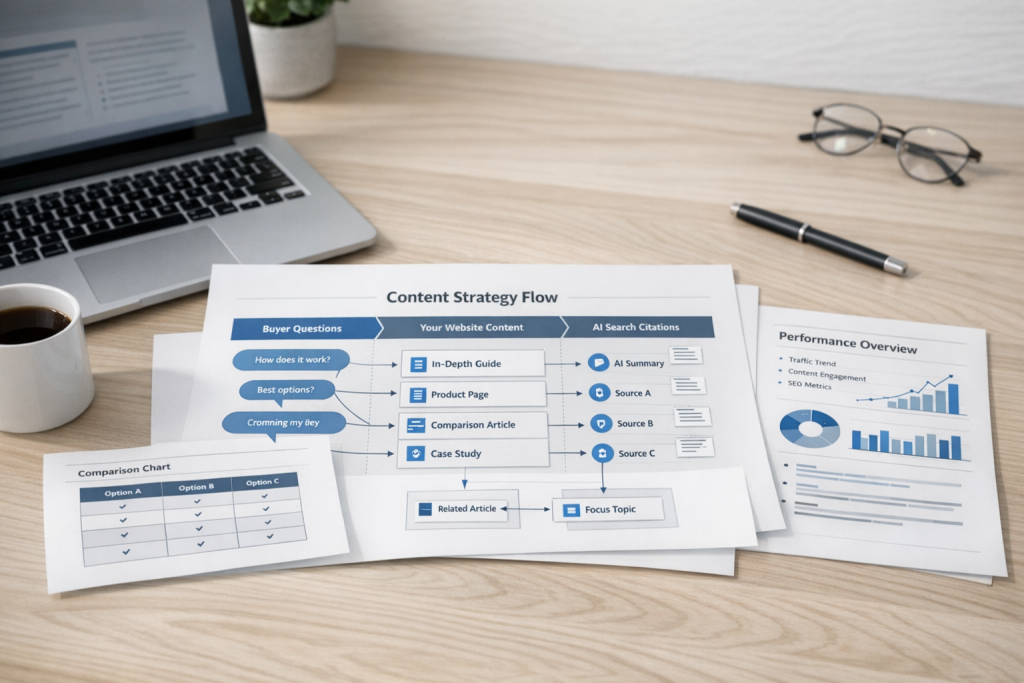
How to Appear in Google AI Overviews: The Content Architecture That Gets Your Company Cited
Your company appears in Google AI Overviews when your pages already rank well organically and are structured so Google’s AI can extract a clear, self-contained answer from them. There is no application form, no paid placement, and no toggle to flip. What exists is a specific kind of content architecture — built around real buyer questions, supported by authority signals, and written so each section can stand alone as a coherent answer — that makes your pages significantly more likely to be selected, summarized, and cited.
This article explains what that architecture looks like, why most existing content falls short even when it ranks on page one, and what a growth-oriented business can do — starting this month — to close the gap between traditional search visibility and AI-search visibility.
What Google AI Overviews Are and How They Choose Sources
Google AI Overviews are AI-generated answer summaries that appear at the top of certain search results pages. When a user asks a question that benefits from synthesis — pulling together information from multiple angles — Google’s AI reads, evaluates, and clips content from pages it considers trustworthy and relevant, then assembles a summarized response with linked source citations.
How AI Overviews Differ from Featured Snippets
Featured snippets pull a single passage from a single page. AI Overviews synthesize information from multiple sources into a new, combined answer. This means your content does not need to be the single best result — it needs to be one of the most extractable and trustworthy results for a specific subtopic or angle within the query.
This distinction matters for strategy. A page optimized to win a featured snippet is optimized to be the answer. A page optimized for AI Overview citation is optimized to be a useful source that the AI can draw from. The content requirements are related but not identical.
Why Organic Ranking Is Still the Entry Requirement
Google’s AI Overviews draw from pages that are already indexed, crawlable, and performing well in organic search. Pages that do not rank on the first page or two for relevant queries are rarely cited in AI Overviews. Strong organic performance is the prerequisite, not the finish line. It gets your page into the consideration set. What determines whether the AI actually cites you is how your content is structured, how clearly it answers the question, and how much authority your site carries on the topic.
The Extraction Problem: Why Most Pages Get Ignored
Most companies that already invest in SEO and content marketing have pages that rank. What they do not have is content structured for AI extraction. This is the gap that explains why a company can hold page-one positions and still be absent from AI Overviews.
What Writing for Extraction Actually Means
Writing for extraction means structuring your content so that each section delivers a complete, self-contained answer that makes sense even if it is pulled out of the article and displayed on its own. Google’s AI does not read your page the way a human does — start to finish, absorbing context along the way. It identifies the section most relevant to the query, evaluates whether that section contains a clear and trustworthy answer, and clips it.
If your key insight is buried in the fourth paragraph of a long section, surrounded by setup and qualifications, the AI is less likely to find it useful. If your key insight is the first sentence of a clearly headed section, followed by supporting detail, the AI can extract it cleanly.
The Stand-Alone Paragraph Test
Before publishing any article, apply this test to each major section: read the first two sentences of the section in isolation. If a reader who saw only those two sentences would understand the point and find it useful, the section passes. If those sentences require surrounding context to make sense, rewrite them.
This is not about dumbing down your content. It is about front-loading clarity. The supporting detail, nuance, and examples still belong in the section — they just come after the direct answer, not before it.
What AI Systems Look for When They Clip Content
Based on observable patterns in how AI Overviews cite sources, the following content characteristics appear to increase the likelihood of extraction:
- Descriptive headings that match real questions. A heading that reads “Our Approach” gives neither a reader nor an AI system useful signal about what the section contains. A heading that reads “How to Structure Content for AI Extraction” tells both exactly what to expect.
- Short, declarative opening sentences in each section. Active voice, specific claims, plain language.
- Consistent terminology throughout. Switching between “AI Overviews,” “AI search results,” and “AI answer boxes” within the same article creates ambiguity for both readers and AI systems evaluating your content.
- Separated facts, opinions, and recommendations. When a section mixes factual statements with speculative advice, the AI has a harder time identifying what to extract as a trustworthy claim.
Content Structure That Increases AI Overview Eligibility
The structural patterns that make content extractable are specific and repeatable. They are not about gaming an algorithm — they are about making your expertise easier to find, understand, and use.
Start with a Direct Answer
Every major section of your article should open with a bottom-line-up-front statement. Answer the sub-question that the heading implies before you explain, qualify, or expand. This is sometimes called the BLUF approach, and it is the single most consistent pattern in content that gets cited across AI search surfaces.
Here is what the difference looks like in practice:
Unfocused opening: “When it comes to AI Overviews, there are quite a few variables at play. Some of them are technical, others relate to how your content is written, and still others depend on how Google’s systems interpret your site over time. What we’ve found is…”
Extraction-ready opening: “Content appears in AI Overviews when it ranks organically, answers a specific question directly, and is written so the AI can lift a clear passage without requiring surrounding context to make sense of it.”
The second version is more useful to a human reader and more extractable by an AI system. It delivers the answer immediately and invites the reader to continue for supporting detail.
Use Descriptive Headings That Match Real Questions
Your section headings should function as clear signals of what the section contains. A vague heading like “Key Considerations” tells neither a reader nor an AI system what to expect. A specific heading like “Which Query Types Are Most Likely to Trigger AI Overviews” tells both exactly what the section covers.
Write headings as if each one might appear as a standalone line in an AI-generated response. If the heading is generic, it will not be selected.
Build Self-Contained Sections
Each section should be able to stand alone as a useful mini-answer. Avoid cross-references that depend on surrounding context — phrases like “building on what we covered above” or “as noted in the previous section” signal that the content cannot be extracted cleanly. If an AI system pulls one section from your page, that section should make complete sense on its own.
Use Comparison Tables and Structured Lists Strategically
When you are comparing options, contrasting approaches, or listing criteria, a simple HTML table or a well-labeled list is often more extractable than prose. AI systems can parse table data when it is semantically clear and well-labeled. Use tables for comparisons, ordered lists for steps, and unordered lists for criteria or characteristics.
The Query Types That Trigger AI Overviews Most Often
Not every Google search triggers an AI Overview. Understanding which query types are more likely to generate AI Overviews helps you prioritize which content to create and improve first.
| Higher-Opportunity Query Patterns | Lower-Opportunity Query Patterns |
|---|---|
| Multi-step how-to questions (“how to evaluate an HVAC contractor”) | Simple navigational queries (“company name login”) |
| Comparison and evaluation queries (“best CRM for small law firms”) | Single-fact lookups (“what time does the store close”) |
| Complex decision-support queries (“should I refinance my commercial lease”) | Branded queries with clear destination (“Nike running shoes”) |
| Long-tail conversational questions (“what happens if I miss a quarterly tax payment”) | Queries with a single definitive answer (“capital of France”) |
| Process and workflow queries (“how to file a lien in California”) | Queries dominated by shopping results or local packs |
How to Find These Queries in Your Market
The highest-value queries are the ones your actual buyers ask before they contact a provider. These are not always the highest-volume keywords in your industry. They are often longer, more specific, and more decision-oriented.
This is where buyer-question research differs from traditional keyword research. Keyword research identifies what people type into Google. Buyer-question research identifies the questions your prospects are actually trying to resolve — the ones that shape whether they contact your company or a competitor. These questions often surface in sales calls, support tickets, consultation requests, and review sites, not just in keyword tools.
At CiteHarbor, buyer-question research is the foundation of every content engagement. We map the questions your market is asking across Google, ChatGPT, Gemini, Perplexity, and Claude, identify where your content already covers those questions, and find the gaps where your brand is absent from AI-generated answers. That question map drives every article we create.
Authority Signals That AI Systems Recognize
Content structure gets your page into the extraction consideration set. Authority signals determine whether the AI trusts your page enough to cite it.
E-E-A-T in Practical Terms
E-E-A-T — Experience, Expertise, Authoritativeness, and Trustworthiness — is the framework Google applies when evaluating content quality. For AI Overviews specifically, these signals appear to influence which sources the AI selects when multiple pages offer comparable answers to the same question.
In practical terms, this means:
- Experience: Content that reflects real operational knowledge — not just research summaries — tends to be more useful and more citable. If your article about commercial roofing maintenance reads like it was written by someone who has managed roofing projects, that signal matters.
- Expertise: Author credentials, professional context, and depth of explanation all contribute. Pages that explain why something works, not just what to do, demonstrate expertise more clearly.
- Authoritativeness: This is built over time through consistent, high-quality coverage of your topic area. One article does not establish authority. A library of useful, well-structured content on related buyer questions does.
- Trustworthiness: Accurate information, honest about limitations, no exaggerated claims, and a site that functions well technically. Pages that overstate results or make unsupported promises undermine trust.
Entity Authority: Making Your Company Recognizable to AI
Entity authority refers to how well AI systems can identify and understand your company as a distinct, real business that operates in a specific category and geography. When Google’s AI encounters your brand name, it should be able to connect that name to a clear set of signals: what you do, where you operate, what your reputation looks like, and what topics you cover.
Building entity authority involves:
- A complete, accurate Google Business Profile with consistent name, address, and phone number across the web.
- Consistent mentions across directories, industry sites, and review platforms that corroborate what your website says about your company.
- A well-structured website that clearly communicates your services, locations, and areas of expertise — not just through content, but through site architecture.
- Third-party mentions and reviews that verify your claims independently. When multiple sources confirm the same information about your business, AI systems have more reason to treat your content as reliable.
Schema Markup: Which Types Matter and Why
Schema markup is structured data you add to your HTML to help search engines understand what your page contains. It does not directly cause AI Overview citations, but it reduces ambiguity — and reducing ambiguity makes your content easier for AI to process.
The most relevant schema types for businesses working to improve AI visibility:
- Article schema: Tells search engines the page is an article, who authored it, when it was published, and when it was last updated. Recommended for every blog post.
- Organization schema: Establishes your company as a recognized entity with a name, logo, location, and contact information. Recommended at the site level.
- FAQPage schema: When your page contains a genuine FAQ section with clear questions and answers, this schema makes those Q&A pairs more discoverable and more extractable.
- LocalBusiness schema: For companies with a physical location or defined service area, this strengthens geographic signals.
The critical rule: only add schema that accurately matches what is visible on the page. Schema that misrepresents your content can create trust problems with both Google and AI systems.
Technical Foundations That Cannot Be Skipped
Content and authority work only if your pages are technically accessible. These requirements are straightforward but frequently overlooked.
Crawlability and Indexing
If Google cannot crawl and index your page, it cannot appear in AI Overviews. Check for:
- Pages accidentally blocked by robots.txt
- Pages carrying a noindex tag
- Broken internal links or redirect chains
- Orphan pages with no internal links pointing to them
Clean HTML
Your main content should be in standard, crawlable HTML — not hidden behind JavaScript rendering, expandable accordions, or dynamically loaded elements that require user interaction to display. AI systems extract content from what is visible in the page source. If your best content is buried in a tab that requires a click to open, it may not be extracted.
Page Speed and Mobile Experience
These are not unique to AI Overview optimization. They are baseline requirements for organic ranking, which is itself the prerequisite for AI Overview eligibility. A slow or poorly formatted page reduces both its organic ranking potential and its extraction potential.
How to Identify Which of Your Pages Are Closest to Being Cited
Most companies do not need to start from scratch. They need to find the pages that are already close to AI Overview eligibility and improve them first.
Reading Google Search Console for AI Overview Signals
Google Search Console’s performance reports can show you which queries are generating impressions and clicks. If a page has high impressions but low clicks for a question-type query, it may be appearing below an AI Overview that is absorbing the clicks. That page is a candidate for structural improvement — it is already relevant enough to appear in results but not structured well enough to be cited in the AI Overview itself.
Auditing Your Existing Page-One Content
Identify the pages on your site that already rank on page one for buyer-relevant queries. For each page, ask:
- Does this page open with a direct answer to the query?
- Are the section headings descriptive and question-aligned?
- Can each section pass the stand-alone paragraph test?
- Is the content factually current and complete?
- Does the page use appropriate schema markup?
Pages that rank well but fail these structural tests are your highest-priority improvement opportunities.
Prioritizing Improvements by Impact
Start with pages that target higher-opportunity query types — how-to, comparison, decision-support, and process queries. Complex, multi-part questions are the category most likely to produce AI Overview results. Structural improvements on pages targeting navigational or single-fact queries will deliver less return.
What to Avoid: Common Mistakes That Reduce AI Overview Eligibility
Some common content and SEO practices actively work against AI Overview visibility:
- Vague, internal-facing headings. Headings like “Our Process” or “Key Takeaways” do not signal what the section answers. Replace them with descriptive, question-aligned headings.
- Padding introductions with unnecessary context. If your page spends the first 200 words explaining what AI Overviews are before answering the actual query, the direct answer is too deep in the page for reliable extraction.
- Keyword stuffing in titles and headings. Google explicitly warns against this. It looks spammy to readers and search systems alike.
- Publishing thin, unreviewed AI-generated content at scale. Volume without quality does not build authority. It dilutes it.
- Ignoring content freshness. If your article references outdated tools, statistics, or practices, AI systems may prefer a more current source.
- Treating AI visibility as a one-time optimization. The queries that trigger AI Overviews change. Competitor content changes. AI systems update their selection patterns. Ongoing monitoring and content updates are necessary to maintain and improve visibility over time.
A Practical 90-Day Visibility Improvement Plan
If your company is serious about improving its presence in Google AI Overviews, here is a phased approach that balances quick improvements with longer-term authority building.
Days 1–30: Audit and Improve Existing Content
- Run a baseline AI visibility audit to understand where your brand currently appears and where it is absent across Google AI Overviews, ChatGPT, Gemini, Perplexity, and Claude.
- Identify your existing pages that rank on page one for buyer-relevant queries.
- Apply the stand-alone paragraph test to each page. Restructure sections that fail.
- Rewrite openings to lead with direct answers.
- Replace vague headings with descriptive, question-aligned headings.
- Add or correct Article, Organization, and FAQPage schema where appropriate.
- Fix any technical issues — broken links, noindex tags, crawl blocks, slow load times.
Days 31–60: Publish Original Expert Content
- Map the buyer questions your market is asking that your current content does not cover.
- Create targeted articles for the highest-priority gaps — focusing on how-to, comparison, and decision-support queries.
- Write each article using extraction-first structure: direct answer openings, descriptive headings, self-contained sections, and consistent terminology.
- Publish to your WordPress site with proper internal linking to related service pages and existing content.
- Distribute through social channels to build initial engagement and indexing signals.
Days 61–90: Build Authority and Measure Results
- Monitor Google Search Console for changes in impressions and click-through rates on improved pages.
- Track AI citation patterns across major AI search platforms to see whether your brand is beginning to appear in relevant answers.
- Review competitor citation activity to understand where your market stands.
- Identify the next round of buyer-question gaps to target.
- Update any content from the first 30 days that needs refinement based on what you have learned.
This is the kind of ongoing cycle that builds AI visibility over time. It is not a one-time project. It is a managed process — and it is exactly what CiteHarbor handles for clients who want the results without the operational burden.
Why AI Visibility Is a Managed Process, Not a One-Time Fix
The most common mistake companies make with AI visibility is treating it like a project with a finish line. They improve a few pages, add some schema, publish a handful of articles, and wait.
In practice, AI visibility requires the same kind of ongoing attention that organic search has always required — but across more surfaces and with less transparency into how selections are made. The queries that trigger AI Overviews shift. Competitor content changes. AI models update. Buyer questions evolve.
For companies already managing Google Ads, SEO programs, content calendars, and social channels, adding AI visibility monitoring and content production to the internal workload can feel like one more dashboard, one more set of reports, and one more workflow to manage.
This is the problem CiteHarbor was built to solve. Instead of handing you a software platform to operate, CiteHarbor handles the full execution cycle: AI visibility auditing, buyer-question research, content creation, WordPress publishing, social distribution, competitive citation monitoring, and branded monthly performance snapshots delivered as a PDF — not another login.
The result is that your company builds a useful, AI-optimized content library on your own site, tracked against a real baseline, without adding management burden to your team.
Frequently Asked Questions
Does my Google Business Profile help me appear in AI Overviews?
A complete, accurate Google Business Profile strengthens your entity signals — the information that helps AI systems recognize your company as a real, established business in a specific category and location. While a Business Profile alone does not trigger AI Overview citations, it contributes to the overall authority and trust picture that AI systems evaluate when selecting sources.
Do I need to do something different from regular SEO to appear in AI Overviews?
Strong organic SEO is the prerequisite. What AI Overviews add is a structural requirement: your content needs to be written so each section can stand alone as a clear, extractable answer. Most traditional SEO content is not built this way. The topic coverage and keyword targeting may be sound, but the content architecture may not be suited to AI extraction.
What kinds of searches trigger AI Overviews?
AI Overviews appear most often for complex, multi-part questions — how-to queries, comparison queries, decision-support queries, and process queries. They are less common for simple navigational lookups, branded searches, and single-fact questions.
How long does it take to start appearing in AI Overviews?
There is no guaranteed timeline. Companies that already have strong organic rankings and well-structured content may see improvements within weeks of making structural updates. Companies building authority from a lower baseline should expect a longer ramp — typically measured in months, not days. Consistent content production and ongoing monitoring accelerate the process.
Can I pay to appear in AI Overviews?
There is no paid placement for organic AI Overviews. Google does offer ad placements within and around AI Overviews, but the organic AI-generated answers themselves are based on content quality, relevance, authority, and structure — not advertising spend.
How do I know if my content is being cited in AI Overviews?
Google Search Console is beginning to surface some AI-related performance data, but it does not yet provide comprehensive citation tracking across all AI search surfaces. To understand your full AI visibility picture — across Google AI Overviews, ChatGPT, Gemini, Perplexity, and Claude — you need a dedicated monitoring process. CiteHarbor tracks AI citations across all major platforms and delivers this data in a monthly branded snapshot, so you do not need to run the monitoring yourself.
Does AI Overview visibility mean more traffic to my website?
The relationship between AI Overview citations and website traffic is still developing. Being cited in an AI Overview means your brand name and a link to your page are visible to the searcher. Whether that translates to a click depends on the query, the quality of the AI-generated summary, and how compelling your cited content appears. What is clear is that being absent from AI Overviews means your competitors occupy that visibility instead.
Conclusion: Make Your Content Worth Citing
Appearing in Google AI Overviews is not about a secret technique or a one-time optimization. It is about building content that is genuinely useful, clearly structured, and supported by real authority — then maintaining and expanding that content over time as buyer questions evolve and AI systems update.
The companies that will win AI visibility are the ones that take this seriously as an ongoing discipline, not a campaign. They research what their buyers are actually asking. They structure every page so the AI can find the answer. They track their visibility across platforms. And they keep improving.
If you want to see where your company currently stands in AI search — across Google AI Overviews, ChatGPT, Gemini, Perplexity, and Claude — without adding another tool, another dashboard, or another workflow to your plate, CiteHarbor can help.