AI Visibility Software vs. Done-for-You Agency: How to Make the Right Call
Most teams choosing between AI visibility software and a managed agency are really deciding between data and execution. This guide helps marketing leaders and business owners assess bandwidth, expertise, and reporting needs so they can choose the right path.
AI Visibility Software vs. Done-for-You Agency: How to Make the Right Call
Either path can produce results — but which one is right for your business comes down to a question most comparison guides never ask: does your team have the capacity and expertise to convert AI visibility data into consistent, strategic action? When the honest answer is no, software becomes an expensive dashboard nobody acts on. When the answer is yes, a platform may be the smarter long-term investment.
This article walks through what each option actually requires on a day-to-day basis, where each one breaks down when it is mismatched to the buyer, and how to assess which situation your team is genuinely in. It is written for marketing leaders, business owners, and growth teams who have already decided AI search matters and are now working out how to address it.
What AI Visibility Means in Practice
AI visibility is about whether your brand surfaces when a potential buyer asks an AI system — ChatGPT, Google Gemini, Perplexity, Claude, or Google’s AI Overviews — a question your business is positioned to answer. When someone searches for the best HVAC contractor in their city, or asks which B2B platforms handle proposal automation, AI systems draw from content across the web to construct a response. Some brands get named. Others are left out entirely.
This is a fundamentally different dynamic from traditional search rankings. A business can hold a strong position on the first page of Google and still be completely invisible inside AI-generated answers. Closing that gap is what AI visibility work is designed to do.
Why This Decision Is Worth Getting Right
AI-powered search is not displacing Google on any near-term timeline, but it has become a real layer in how buyers discover, evaluate, and shortlist providers. When competitors are showing up in AI-generated recommendations and your brand is not, that is a gap traditional SEO will not close on its own. The question is not whether to address it — it is how, and with what resources.
That is where the choice between software and a managed agency becomes consequential.
What AI Visibility Software Platforms Actually Do
AI visibility platforms are fundamentally monitoring tools. They track where and how your brand appears across AI search environments. Most offer some version of the following:
- Citation tracking — recording whether AI systems mention your brand when responding to relevant queries
- Competitor benchmarking — showing how frequently competitors appear alongside or instead of your brand in AI-generated answers
- Query monitoring — following a defined set of buyer-relevant questions across multiple AI engines
- Visibility scoring — summarizing your brand’s relative presence in AI search into a reportable metric
- Dashboard reporting — surfacing all of this in a live interface your team can access on demand
What Software Tells You — and What It Leaves to You
A well-built platform tells you where your brand stands. It shows which queries your brand appears in, which competitors are being cited instead of you, and which buyer questions are generating AI responses that exclude you entirely.
What it does not do is change any of that.
Software does not determine which buyer questions deserve priority. It does not produce content structured to improve your citation likelihood. It does not publish that content to your site, distribute it through your channels, or measure whether it moved your baseline over time. It does not deliver a clear monthly summary explaining what shifted and why.
A platform hands you the map. Everything that happens next is on your team.
When a Software-First Approach Makes Sense
Choosing a platform as your primary tool works well under a specific set of conditions:
- Your marketing team has genuine available bandwidth to take on content research, creation, and publishing
- At least one person on the team has working knowledge of AI search behavior and content strategy for generative engines
- You already have a content production workflow that can absorb additional research and distribution tasks without disruption
- Your main objective is independent measurement — for example, you are already working with an agency and want a separate tracking layer
When all four of those conditions hold, a platform may be the right starting point. For most growth-stage companies, professional-service firms, and regional businesses, at least two of those conditions are not in place.
What a Done-for-You AI Visibility Agency Actually Does
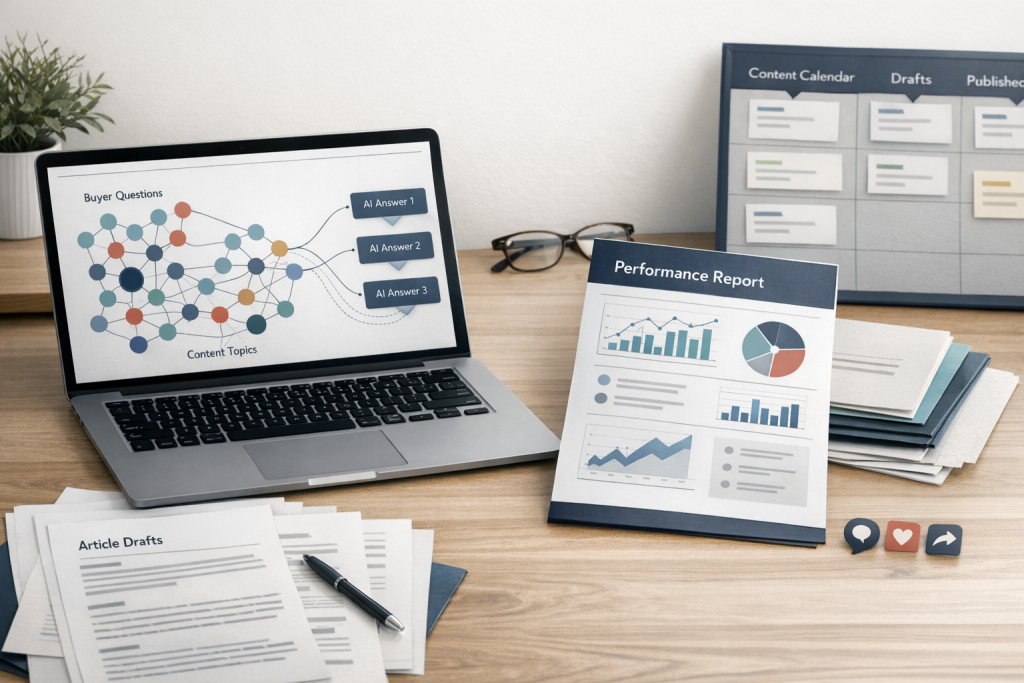
A managed AI visibility agency takes ownership of the full workflow — not just the monitoring portion. The right partner handles research, strategy, content production, publishing, distribution, tracking, and reporting as an integrated service.
At CiteHarbor, that means a specific set of deliverables built to function as a complete system:
- AI visibility auditing — a baseline assessment of where your brand currently appears and where it is absent across ChatGPT, Perplexity, Google Gemini, Claude, and Google AI Overviews
- Buyer-question research — identifying the specific questions your potential customers are directing at AI systems, and pinpointing which gaps represent the highest-priority opportunities for your brand
- Targeted article creation — producing content built around those buyer questions, organized so that AI systems can process, reference, and draw from it more readily
- WordPress publishing — handling direct publication to your website so the content lives on your domain and builds your owned library over time
- Social media distribution — extending content reach by distributing across your social channels beyond the website
- Monthly AI citation tracking — ongoing monitoring of how your brand appears across AI search environments, measured against an established baseline
- Competitive intelligence — tracking where competitors are being cited and how their AI presence compares to yours
- Branded PDF performance snapshots — a finished monthly summary delivered directly to you, rather than a dashboard you need to log into and interpret on your own
How This Differs from a Traditional SEO Retainer
Many businesses have been through a conventional SEO content arrangement: a vendor publishes a fixed number of articles each month, typically organized around search volume data, and the team waits to see whether rankings improve. Some of those engagements produce real results. Many generate content that does not move the needle.
AI visibility content operates differently in two meaningful ways. The research process begins with the questions real buyers are asking inside AI environments — not keyword volume pulled from a search tool. And the content itself is structured to be clear, well-organized, and substantive enough that AI systems can parse it, extract from it, and treat it as a credible source when constructing answers. This practice is commonly called Generative Engine Optimization, or GEO.
GEO is not a shortcut or a workaround. It is a content discipline grounded in the same principles that make any content worth reading: clarity, accuracy, useful structure, and genuine depth. The difference is that the primary audience includes AI systems evaluating what sources to draw from, alongside the human readers those systems are trying to help.
When an Agency-First Approach Makes Sense
A managed AI visibility service is the right fit when:
- Your team does not have room to absorb another content production workflow
- Nobody on the team has hands-on experience with GEO content strategy, AI search behavior, or AI citation patterns
- You have grown frustrated managing multiple tools, freelancers, and content calendars that produce results you cannot clearly attribute
- You want a single partner accountable for research, execution, and reporting — rather than assembling those pieces from separate vendors
- You need to demonstrate progress to leadership and want a clear monthly report rather than raw platform data to interpret yourself
The Real Tradeoff: Insight vs. Execution
The most common framing for this decision centers on bandwidth, expertise, and budget. Those factors are real, but they tend to obscure the more fundamental issue.
The actual tradeoff is between understanding what needs to happen and having the capacity to make it happen, consistently, over time.
The Most Common Mistake Buyers Make with AI Visibility Software
A team purchases a platform. They run an initial audit. The dashboard surfaces a clear picture of gaps — buyer questions where competitors appear and the brand does not. The data is legible. The opportunity is obvious.
And then the work stalls.
Not because anyone lacks motivation, but because nobody has the recurring time to research which gaps matter most, produce content structured for AI systems, get it published, distribute it, and then track whether it produced any movement. The subscription renews. The dashboard sits open. The gaps do not close.
This is the insight-execution gap — and it is the most costly pattern in AI visibility. Data has value only when someone acts on it. Acting on it requires a specific, sustained set of skills and capacity that most marketing teams do not have available to redirect.
What Accumulates When Data Sits Without Action
The consequences are not sudden. They build slowly:
- The subscription renews each month while the team continues to fall behind on execution
- Competitors who are executing — through an agency or a well-staffed internal team — build their AI presence steadily while yours holds flat
- The team carries the weight of another tool they are underusing, which compounds dashboard fatigue and erodes confidence in the category as a whole
- When leadership requests a progress update, the response is the same data the platform surfaced months earlier, with no forward movement to point to
This is not an indictment of monitoring software. Strong tracking tools provide genuine value. The problem is purchasing a monitoring tool when what the situation actually calls for is someone to do the work.
Side-by-Side Comparison
| Factor | AI Visibility Software Platform | Done-for-You AI Visibility Agency |
|---|---|---|
| What you receive | Data, dashboards, tracking, and gap identification | Research, strategy, content, publishing, distribution, tracking, and reporting — managed on your behalf |
| Internal time required | High — someone must interpret data, plan content, produce it, publish it, distribute it, and track results | Low — the agency manages the workflow; the client reviews reports and provides direction |
| Expertise required internally | Team needs GEO content strategy knowledge, AI search behavior familiarity, and content production capacity | Expertise is supplied by the agency |
| Speed to first action | Depends on when the team can begin executing against the data | Execution starts as part of the engagement from the beginning |
| Reporting format | Live dashboards the team must access and interpret independently | Branded PDF snapshots delivered monthly — no dashboard login required |
| Content ownership | You create and own the content — if you create it | Content is published to your WordPress site and social channels — fully owned by you |
| Ongoing management burden | Significant — the platform is a tool, not a service | Minimal — the agency functions as the service |
| Best fit | Teams with available bandwidth, GEO expertise, and an existing content workflow | Teams that want AI visibility handled as a managed, full-service operation |
How to Decide: A Practical Framework
Rather than landing on a vague answer, use these three questions to assess which path fits your team’s actual situation.
Question 1: Does Someone on Your Team Have Dedicated, Recurring Bandwidth?
AI visibility is not a one-time project. It requires ongoing buyer-question research, content production, publishing, distribution, and tracking — sustained over months. If no one on your team can commit meaningful, recurring time to this work — not just oversight, but hands-on execution or close management of a freelancer — a software platform alone will underdeliver.
Question 2: Are You Primarily Tracking Progress or Building Presence?
If an AI visibility strategy is already running and you need an independent layer of measurement, a software platform is a reasonable addition. If you are starting from zero and need to establish your AI presence from the ground up, tracking alone will not advance that goal. You need execution first, with measurement running alongside it.
Question 3: How Soon Do You Need to Demonstrate Progress?
AI visibility work does not produce overnight results. But a managed partner that begins executing immediately — auditing, researching buyer questions, producing and publishing content, distributing it — generates observable activity and establishes trackable baselines faster than a platform sitting idle while the team waits for bandwidth to free up.
Decision Guide by Business Type
B2B SaaS teams with a two-to-four person marketing group: You likely have some content capacity but limited GEO expertise. A managed partner handles the specialized AI visibility work while your team stays focused on product marketing, demand generation, and campaigns already in motion.
Professional-service firms — law, wealth management, consulting: Most professional-service firms do not maintain an internal content team. A managed AI visibility partner eliminates the need to hire writers, coordinate freelancers, or develop fluency in a new marketing category. The firm reviews monthly reports and stays focused on client delivery.
Local and regional service businesses — HVAC, roofing, medical practices: These businesses need visibility in the buyer questions tied to their specific geography and service area. They rarely have the bandwidth or interest to operate a software platform. A full-service partner that manages everything from research through reporting is the practical path.
Multi-location operators and franchise groups: Building AI visibility at scale requires systematic research, content production, and tracking across locations and service lines. Software alone does not solve the execution challenge. A managed partner with experience building visibility across a multi-location footprint is the more appropriate fit.
The Hybrid Approach: When Both Make Sense Together
For some businesses, pairing a managed agency with an independent monitoring platform is worth considering. It is not the right structure for every situation, but it fits certain circumstances well.
What the Hybrid Model Looks Like in Practice
The agency handles all execution: buyer-question research, content creation, publishing, distribution, competitive intelligence, and reporting. The software platform adds a separate tracking layer the internal team can consult independently, outside of agency-delivered reports.
This structure works best when:
- The marketing team wants to cross-reference agency reporting against an independent data source
- The team has the experience to interpret raw platform data without needing it translated into narrative
- Budget supports both without creating pressure to cut one before either has had time to demonstrate value
A Realistic Path from Managed to In-House
Some businesses intend to bring AI visibility in-house over time. That is a reasonable long-term direction, but it requires honest planning about what that transition actually involves:
- Begin with managed execution — let the agency establish your baseline, build your initial content library, and demonstrate what sustained AI visibility work produces over time
- Learn from what is being produced — use monthly reports and content outputs to develop internal familiarity with buyer-question research, GEO content structure, and citation tracking methodology
- Hire or develop for the role — when the timing is right, bring on someone who can own AI visibility work internally, using the processes and content library the agency built as a foundation
- Transition with intention — move execution in-house gradually, and consider retaining an independent monitoring platform for ongoing tracking as the internal team takes over
Most businesses underestimate the volume of recurring work that AI visibility requires. Moving from managed to in-house is not a simple handoff. It means building an internal capability that can sustain the same quality and consistency the agency was delivering.
What to Look for in an AI Visibility Agency
Not every agency offering AI visibility services has the depth to deliver meaningful results. When evaluating a managed partner, these are the questions worth pressing on:
- Do they audit across multiple AI platforms? A credible agency should assess your brand’s presence in ChatGPT, Perplexity, Google Gemini, Claude, and Google AI Overviews — not just one system in isolation.
- Do they conduct buyer-question research specific to your market? The content strategy should be grounded in the questions your actual buyers are asking AI systems — not recycled keyword lists from a generic tool.
- Do they create and publish content, or only advise? There is a meaningful gap between an agency that tells you what to write and one that writes, publishes, and distributes it on your behalf.
- Do they track AI citations over time against a clear baseline? One-time audits provide useful context, but AI visibility is an ongoing discipline. Consistent monthly tracking against an established baseline is the only reliable way to assess whether the work is producing movement.
- Do they monitor competitor presence in AI search? Understanding where competitors are appearing — and where they are not — is essential context for making sound decisions about your own content priorities.
- How do they deliver reporting? If the agency’s answer is another dashboard, you have not reduced the management burden. Look for delivered reporting — a finished document like a branded PDF — that summarizes progress clearly without requiring you to log in and interpret raw data.
- Do they handle distribution? Content that is produced but not published or distributed does not build AI visibility. A full-service partner should manage WordPress publishing and social distribution as part of the standard engagement.
- Can they write in your brand voice? For professional-service and B2B brands in particular, content that reads as generic or machine-produced erodes credibility. Ask specifically how the agency ensures content reflects your brand’s tone and subject-matter depth.
Frequently Asked Questions
What does AI visibility software actually track?
Most platforms monitor whether your brand is named in AI-generated responses across systems like ChatGPT, Gemini, Perplexity, and Claude. They typically follow a defined set of buyer-relevant queries, surface competitor citation data, and produce a visibility score or dashboard summary. The core limitation is that tracking tells you where you stand — it does not help you improve that position.
Is AI visibility software sufficient on its own?
For most businesses, no. A platform identifies gaps, but closing those gaps requires buyer-question research, content creation, publishing, distribution, and sustained tracking. If your team does not have the bandwidth and expertise to carry out that work consistently, the software will surface the same gaps month after month without resolution.
What happens after an AI visibility audit?
The audit establishes where your brand appears and where it is absent. The substantive work begins after that: identifying which buyer questions deserve priority, producing content structured for AI systems to process and reference, publishing it to your website, distributing it through your channels, and monitoring whether your visibility baseline shifts over time. At CiteHarbor, all of that is managed for the client.
How much internal time does AI visibility require?
With a software-only approach, expect significant ongoing time for research, content production, publishing, and reporting. With a full-service partner like CiteHarbor, internal time is largely limited to reviewing monthly reports and providing feedback. Research, content, publishing, distribution, tracking, and reporting are all handled on your behalf.
What is GEO and why does it matter for this decision?
GEO stands for Generative Engine Optimization. It refers to the practice of structuring content so that AI systems — which produce answers using large language models — are more likely to process, reference, and cite it. GEO is not a substitute for SEO. It is a complementary discipline focused on a different discovery layer. When choosing between software and an agency, a key consideration is whether your team has GEO expertise in-house or needs a partner to supply it.
Can we use both a software platform and an agency at the same time?
Yes. Some businesses engage a managed agency for execution and maintain a separate software platform for independent tracking. This structure works well when the team wants to verify agency-reported progress against its own data source and has the experience to interpret raw platform output. It is not necessary for every business, but it can add a useful layer of confidence.
How long before AI visibility work produces observable changes?
AI visibility is a compounding, ongoing process. How quickly citation patterns shift depends on the competitiveness of your market, the quality and consistency of content production, and how AI systems incorporate new source material over time. No specific timelines can be guaranteed. What a managed partner can provide is a clear baseline, consistent execution, and monthly tracking so you can assess whether the work is producing measurable movement.
How do I tell a capable AI visibility agency from a generic one?
Look for an agency that audits across multiple AI platforms, conducts buyer-question research specific to your market, creates and publishes content on your behalf, tracks citations monthly against an established baseline, monitors competitor presence, and delivers reporting in a format you do not have to interpret yourself. If the agency’s offer amounts to strategic advice, a dashboard login, or generic blog content without AI search strategy behind it, the value proposition is fundamentally different.
The Bottom Line
The software-versus-agency decision is not really a question about tools. It is a question about whether your team can sustain the ongoing research, content production, publishing, distribution, and tracking that AI visibility requires — or whether you need a partner to own that entire workflow on your behalf.
Software provides data. An agency provides execution. The right answer depends on the distance between what you know needs to happen and what your team can realistically deliver, consistently, over the long term.
If you are looking for a hands-off AI visibility partner that manages auditing, buyer-question research, content creation, WordPress publishing, social distribution, citation tracking, competitive intelligence, and monthly performance snapshots — without adding another dashboard to your stack — CiteHarbor was built for exactly that.