Why Your SaaS Company Ranks on Google But Disappears from ChatGPT Product Comparisons
Learn why strong Google rankings do not guarantee visibility in AI-generated product comparisons, and what SaaS companies can do to strengthen their presence across ChatGPT and other AI platforms.
Why Your SaaS Company Ranks on Google But Disappears from ChatGPT Product Comparisons
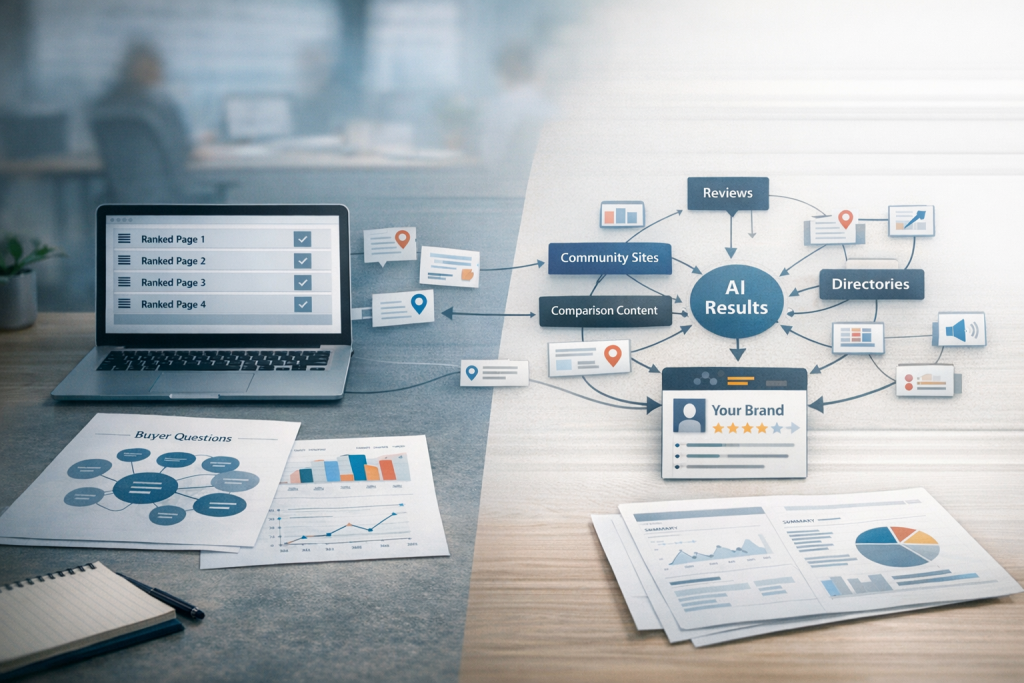
Google and ChatGPT are solving different problems, and they pull from different inputs to do it. Google evaluates individual pages against specific queries using keywords, backlinks, technical signals, and content relevance. ChatGPT constructs a picture of your brand by drawing on dozens of independent sources — software review platforms, community threads, analyst write-ups, directory entries, and structured information distributed across the web. When those sources are sparse, contradictory, or nonexistent, your company does not show up in AI-generated product comparisons — no matter how well your pages perform in organic search.
This creates a genuinely disorienting situation for SaaS teams that have put real resources into SEO. Keyword rankings are holding. The blog is driving traffic. Domain authority looks healthy. But when a buyer opens ChatGPT, Gemini, Claude, or Perplexity and asks which tools to consider in your category, your competitors get named and you do not. The issue is not a failure of SEO. The issue is that AI-generated answers are shaped by a different set of inputs than Google search results, and most SaaS content programs were never designed with those inputs in mind.
This article breaks down exactly why that gap exists, what creates it at a structural level, and what SaaS companies can realistically do to close it.
Google Ranks Pages — ChatGPT Builds a Brand Profile
The distinction sounds simple, but it has significant consequences for how SaaS companies should think about content strategy and web presence.
What Google is actually doing when it ranks your pages
Google crawls and indexes individual pages, then scores them against specific queries using signals like keyword match, linking authority, technical performance, content depth, and engagement quality. When your SaaS product ranks for best project management software, Google is making a page-level judgment: this particular URL is a strong match for this particular query based on these measurable inputs.
Google ranking is fundamentally page-level. It rewards pages that satisfy a query, not brands that own a category. A SaaS company with a handful of well-optimized pages can outrank a much larger competitor on targeted keywords without being the more widely recognized brand in the space.
What ChatGPT is actually doing when it builds a product comparison
When a buyer asks ChatGPT something like What are the best project management tools for mid-size teams?, the system is not ranking URLs. It is assembling a response from everything it has ingested about that product category — training data, retrieved web content, review platform records, community conversations, directory entries, news coverage, and structured information from across the web.
The goal is to answer the question the way a knowledgeable analyst would: by identifying which brands appear most consistently, most favorably, and most specifically across many independent sources. What the system is looking for is distributed third-party consensus, not page-level optimization signals.
A SaaS company can rank on the first page of Google for category keywords and still be completely absent from AI product comparisons if the broader signal environment — the cumulative picture of the brand across the web — is thin, fragmented, or internally inconsistent.
Five Reasons SaaS Companies Disappear from AI Product Comparisons
The gap between Google ranking and AI visibility almost always traces back to one or more of these specific structural problems. Most SaaS companies are dealing with at least two or three simultaneously.
Your third-party footprint is thin or absent
AI systems lean heavily on third-party sources when constructing product comparisons. Platforms like G2, Capterra, TrustRadius, Product Hunt, and Crunchbase get referenced frequently because they contain structured, comparative, review-based data about software products. Reddit threads, Quora responses, and niche community forums also factor in because they carry real user language and opinions — precisely the kind of material AI systems are built to process and synthesize.
If your SaaS company has an incomplete G2 profile, a handful of outdated reviews, minimal community presence, and little coverage from industry publications or analysts, the AI system simply does not have enough third-party material to work with. It will not include a product in a comparison when the evidence base is too thin to support a confident, specific recommendation.
This is a fundamentally different dynamic than Google, where a single well-linked page can rank independently of what exists elsewhere on the web about your brand.
Your brand signals are inconsistent across the web
Entity consistency means your company name, product category, core use case, and market positioning are described in a coherent, compatible way across every directory, listing, profile, and mention that exists on the web. When those descriptions diverge — different category labels on G2 versus Capterra, different positioning on LinkedIn versus your homepage, different product names in press coverage versus your documentation — AI systems have difficulty constructing a clear, unified picture of what your product actually does and who it serves.
Google can absorb a degree of inconsistency because it evaluates pages in isolation. AI systems that synthesize across many sources are more sensitive to fragmentation, because their goal is to produce a single coherent understanding of your brand from many inputs.
Your content answers keyword queries but not buyer questions
Most SaaS content programs are organized around keyword research: which terms have volume, which pages can rank, which topics fill the editorial calendar. That approach produces content calibrated for Google’s page-level ranking system. But AI product comparisons are triggered by buyer-intent questions — things like What is the best CRM for real estate teams? or How does Tool A compare to Tool B? or What should I look for in an invoicing platform? — and the content required to answer those questions is structurally different from a keyword-optimized blog post.
Answer-ready content leads with a direct response to a specific buyer question in clear, extractable language. It states the answer first, supports it with concrete detail, and does not make the reader work to find the point. Most SaaS blog posts do the opposite — they build toward conclusions, layer in positioning language, and embed practical information inside marketing narrative. AI systems struggle to extract a clean, citable answer from that kind of writing.
You have no comparison or alternative pages
When a buyer asks an AI system to compare products in a category, the system actively looks for content that already addresses that comparison directly. If your website does not include comparison pages, alternative-to pages, or structured content that situates your product relative to others in the market, you are leaving a significant gap in the on-site content that AI systems draw on when building product comparison answers.
Many SaaS companies avoid this kind of content because it feels confrontational or raises concerns about naming competitors by name. But the absence of comparison content forces the AI system to rely entirely on third-party sources — and if those sources do not prominently feature your product alongside the alternatives, you will not appear in the comparison at all.
Your pricing and positioning are hidden behind friction
AI systems tend to surface products where the information buyers actually need — pricing, use cases, limitations, ideal customer profile — is clearly stated and publicly available. SaaS companies that put pricing behind a contact form, lock feature details inside gated documentation, or rely on vague positioning language make it harder for AI systems to extract and present useful, specific information about their product.
This does not mean every SaaS company needs to publish a full pricing page. But the more friction that exists between an AI system and the information buyers are trying to find, the less likely that product is to appear in a comparison where the AI needs to give a specific, helpful answer.
A Quick Self-Diagnosis: Which Gap Applies to Your Company?
Before moving to action, it helps to identify which specific gaps are most relevant to your situation. Work through these questions honestly:
- Do you have an active, well-maintained profile on at least two major software review platforms (G2, Capterra, TrustRadius) with recent reviews from current users?
- Is your company described consistently — same name, same category, same core use case — across your website, review profiles, directories, LinkedIn, and press coverage?
- Does your website include content that directly addresses buyer comparison questions — for example, pages framed around best tools for a specific use case, your product versus a named competitor, or alternatives to a well-known platform?
- Can someone read the opening two sentences of your key pages and immediately understand what your product does, who it is built for, and what makes it different?
- Is your pricing — at least at a range or tier level — publicly accessible without requiring a form submission or a sales call?
- Do your founders or team members participate in community discussions — Reddit, industry forums, Quora — where buyers in your category actively research their options?
- Have you tested whether your brand appears at all when you ask ChatGPT, Gemini, Claude, or Perplexity to recommend products in your category?
If three or more of those answers are no, the gap between your Google rankings and your AI visibility likely has specific, addressable causes. The question is whether you have identified which causes are doing the most damage and have a structured plan to work through them.
How to Close the Gap: A Prioritized Action Plan
Not every action produces equal impact, and not every SaaS company is starting from the same place. What follows is ordered by what typically generates the most meaningful signal for the least initial effort, moving toward actions that require sustained investment over time.
Start with your third-party review presence
Claim and fully build out your profiles on the review platforms where buyers in your category do their research. G2 and Capterra are the most frequently referenced by AI systems when generating software comparisons, but industry-specific directories may also be relevant depending on your market. Actively request reviews from engaged customers. Keep profiles current with accurate screenshots, updated feature lists, and current positioning language.
This tends to be the highest-leverage starting point because review platforms contain structured, comparison-ready data that AI systems already treat as credible, citable sources.
Fix entity consistency across directories and listings
Audit how your company is described across every directory, listing, profile, and public mention you can locate. Look specifically for inconsistencies in your company name, product category, core use case description, and market positioning. Bring the language into alignment so that every source gives an AI system the same basic picture of your product.
The descriptions do not need to be word-for-word identical across every source, but the core positioning — what you do, who you serve, which category you belong to — should be consistent enough that an AI system processing all of those sources independently would arrive at the same understanding from each one.
Build comparison and alternative content
Develop content on your website that directly addresses the comparison and alternative queries buyers use when evaluating options. This includes pages built around your product versus specific competitors, best-in-category recommendations for defined use cases, and alternatives to established platforms in your space. The content should be factual, balanced, and genuinely useful to a buyer working through a decision — not a thinly veiled sales argument.
Comparison content earns its place because it mirrors the structure of the questions AI systems receive. When a buyer asks an AI to compare products, the system reaches for content that already does that work.
Make your content answer-extractable
Go through your most important pages — homepage, product pages, cornerstone blog posts — and ask whether an AI system could pull a clear, specific, citable answer from the first few sentences of each section. If the writing builds toward a conclusion rather than opening with one, restructure it. State the answer first. Back it up with specifics. Cut jargon that adds length without adding clarity.
This is not about simplifying your content. It is about structuring it so that both human readers and AI systems can immediately identify what the content says and why it is relevant.
Engage in community conversations where buyers research
Founders, product leaders, and team members who show up in Reddit threads, industry forums, and community discussions generate natural-language signal that AI systems incorporate. The goal is not self-promotion. It is being present in the conversations where buyers ask real questions about your category, contributing genuine expertise, and building a record of helpful, authentic participation over time.
Community engagement produces a qualitatively different kind of signal than marketing content. AI systems appear to draw on community discussions with some regularity — particularly Reddit — because those sources contain unfiltered opinions from actual users and practitioners.
The Tracking Problem: How Do You Know If You Are Improving?
One of the most frustrating aspects of AI visibility for SaaS teams is the absence of any native measurement layer. There is no equivalent of Google Search Console for ChatGPT, Gemini, Claude, or Perplexity. You cannot open a dashboard and see how often your brand appeared in AI-generated answers, which prompts triggered those appearances, or how your visibility has shifted over time.
This is why establishing a baseline before making any changes is essential. You need to know where things stand right now: which AI systems mention your brand, in response to which buyer questions, in what context, and with what degree of consistency. Without that starting point, there is no way to evaluate whether your efforts are producing results.
Tracking AI visibility requires a different methodology than tracking search rankings. It means monitoring citation patterns across multiple AI platforms, identifying which buyer questions generate brand mentions, benchmarking your visibility against competitors in the same category, and recording how the picture changes over time. This is continuous work, not a one-time exercise.
CiteHarbor manages this entire workflow for SaaS companies — from an initial visibility audit across ChatGPT, Gemini, Claude, Perplexity, and Google AI Overview, through monthly citation tracking, competitor citation monitoring, and branded PDF performance snapshots that show exactly where a brand is appearing, where it is absent, and how the picture is evolving. The objective is to give SaaS teams a clear, honest read on their AI visibility without adding another platform to manage or another internal process to run.
What This Actually Takes: Honest Expectations
Closing the gap between Google rankings and AI visibility is not a quick fix. It is a sustained effort that touches content strategy, third-party signal development, entity consistency, buyer-question research, ongoing tracking, and regular content production. How long it takes depends on your starting point, your category, and how competitive the landscape is.
Some improvements — correcting inconsistent directory listings, completing an underdeveloped G2 profile — can generate signal relatively quickly. Others — building out a library of comparison content, developing meaningful community engagement, accumulating a steady stream of fresh third-party reviews — require months of consistent execution.
No one can guarantee that a specific set of actions will cause a specific AI system to cite your brand. AI systems are not transparent, their behavior shifts over time, and the relationship between content inputs and AI outputs is probabilistic rather than deterministic. What is possible is to systematically improve the conditions under which AI systems are more likely to surface your brand: sharper signals, more consistent information, better-structured content, and a more substantial third-party presence.
This is why many SaaS teams choose to work with a dedicated partner rather than absorbing AI visibility work into an already stretched internal team. The full scope of the work — buyer-question research, content creation, WordPress publishing, social distribution, review platform management, citation tracking, competitor monitoring, and monthly reporting — is a significant operational undertaking when layered on top of existing SEO, paid media, and content programs.
CiteHarbor is built specifically to carry that load. The complete workflow — auditing, research, content creation, publishing, distribution, tracking, competitive intelligence, and reporting — runs as a single managed monthly process. SaaS teams receive a branded performance snapshot rather than another dashboard to log into. No new platform to manage. No freelancers to coordinate. No additional internal overhead.
Frequently Asked Questions
Does Google ranking help at all with ChatGPT visibility?
The two are not entirely disconnected. Content that ranks on Google exists on the web and is accessible to AI systems — that matters. But earning a Google ranking for a keyword does not mean AI systems will draw on that content when constructing a product comparison. AI systems weight third-party consensus, entity consistency, and answer-readiness more heavily than page-level ranking signals. Google ranking is a necessary condition for web presence, but it is not sufficient on its own for AI visibility.
What review platforms matter most for AI product comparisons?
For software categories, G2 and Capterra appear most frequently in observed AI-generated product comparisons. TrustRadius, Product Hunt, and Crunchbase also contribute. Industry-specific directories may carry additional weight depending on the category. The common factor is that the platform contains structured, comparative, review-based data that AI systems can process and reference when building a product recommendation.
How do I know if my brand is being mentioned in ChatGPT responses?
The most direct approach is manual testing: query ChatGPT, Gemini, Claude, and Perplexity using the buyer questions that matter most in your category and observe whether your brand surfaces. This produces a rough starting point but is not scalable or systematic. Ongoing measurement requires tracking citation patterns across multiple AI platforms over time, comparing your visibility against competitors, and recording which buyer questions generate mentions and which do not. This is the type of tracking CiteHarbor delivers through its monthly visibility reporting.
Why does a competitor with weaker SEO appear in ChatGPT but I do not?
The most common explanation is that the competitor has a more developed third-party presence — more reviews, more community mentions, more coherent brand signals distributed across the web — even if their individual pages do not rank as well in Google. AI systems building a product comparison are not scoring individual URLs. They are assembling a picture of which brands are well-recognized, well-reviewed, and consistently described across many independent sources. A competitor with a strong G2 profile, active Reddit participation, and consistent directory listings may appear in AI comparisons even when their blog content does not outrank yours on Google.
Do I need to change my website, or is it mostly about off-site signals?
Both dimensions matter. Off-site signals — review profiles, community participation, directory consistency, press coverage — are critical because AI systems depend heavily on distributed third-party consensus. But on-site content is also a factor, particularly whether your pages are structured to answer buyer questions directly and whether your content is organized in a way that allows AI systems to extract clear, specific answers. The most effective approach works on both simultaneously: build a stronger third-party presence and restructure on-site content to be more answer-ready.
What is the difference between being mentioned and being cited in an AI response?
Being mentioned means your brand name appears somewhere in the AI-generated output. Being cited means the AI system has identified your content or website as a source that supports its answer. Citation carries more weight as a signal of authority and credibility. Most SaaS companies that are frustrated by AI invisibility are experiencing neither — they are not mentioned or cited in any form. Tracking which situation applies for different buyer questions helps clarify where to concentrate improvement efforts first.
How long does it take to see improvement in AI visibility?
There is no dependable timeline, because AI system behavior does not shift in the predictable, measurable way that Google ranking changes can be roughly estimated. Some improvements — completing a review profile, resolving entity inconsistencies — can generate signal within a few weeks. Others — developing a content library around buyer comparison questions, building meaningful community engagement — play out over months. Systematic tracking against an established baseline is the only reliable way to assess whether progress is happening, which is why setting that baseline early is worth prioritizing.
The Core Takeaway
If your SaaS company ranks on Google but does not appear in AI product comparisons, the problem is not that your SEO has failed. The problem is that Google ranking and AI visibility run on different signals, and most SaaS content programs were built to serve one system without accounting for the other.
Google scores individual pages. AI systems construct a consensus picture of your brand from many sources distributed across the web. Closing the gap requires a different kind of work: building a stronger third-party presence, establishing entity consistency, creating content that answers buyer comparison questions directly, and tracking your visibility over time so you can see what is actually shifting.
This is substantial, ongoing work. It is not a one-time audit or a single content push. It is a sustained execution process that spans research, content creation, publishing, distribution, tracking, and reporting.
If you want to see where your SaaS company currently stands — which AI systems are mentioning you, which buyer questions you are absent from, and how you compare against competitors in your category — CiteHarbor’s 2-week free trial gives you that baseline without a credit card or a new platform to manage.