What Is Generative Engine Optimization, and How Is It Different from SEO?
Learn what Generative Engine Optimization (GEO) is, how it differs from traditional SEO, and what businesses should know about earning visibility in AI-generated answers.
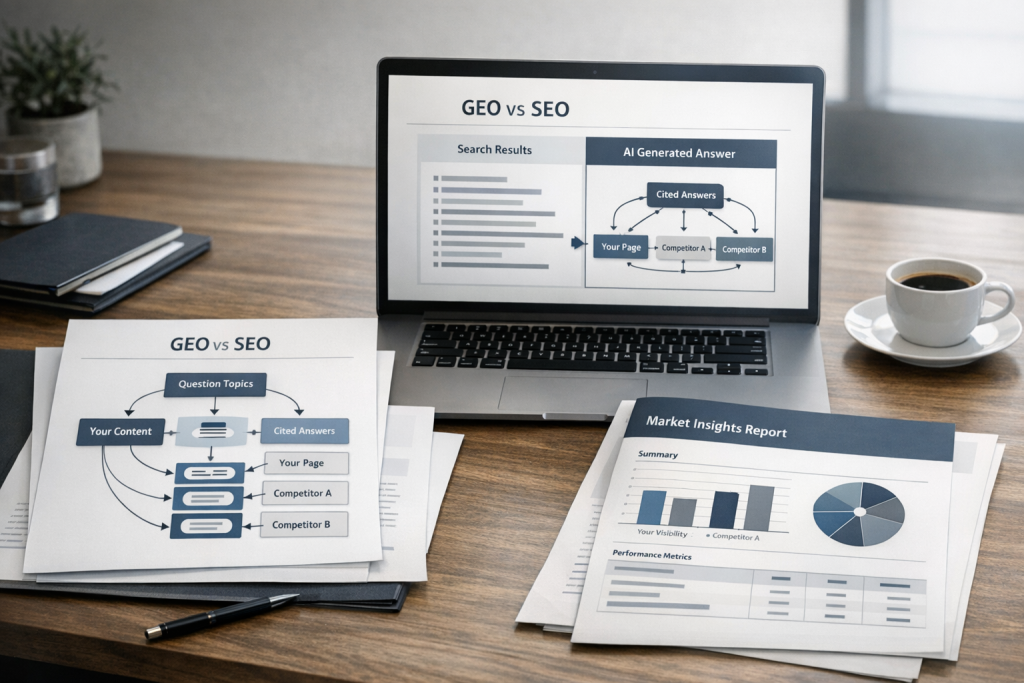
What Is Generative Engine Optimization, and How Is It Different from SEO?
Generative Engine Optimization, or GEO, is the practice of making your brand and content more likely to be cited, summarized, or referenced when AI tools generate answers to questions your buyers are already asking. Tools like ChatGPT, Google AI Overviews, Perplexity, Claude, and Microsoft Copilot are increasingly where research begins — and GEO is how you earn a place in those answers. Traditional SEO puts you on a list. GEO puts you inside the response.
That distinction matters more than it sounds. If your business depends on being found by buyers who are evaluating solutions, you now have two discovery layers to think about: the search results page you already know, and the AI-generated answer that increasingly appears above it, alongside it, or in place of it.
This article explains what GEO is, how it differs from SEO, what AI systems actually weigh when selecting sources, and what growth-oriented businesses should consider doing about it. No hype, no panic, no algorithm tricks. Just a clear explanation of a real shift in how buyers find providers.
What Generative Engine Optimization Actually Means
GEO is the work of increasing the likelihood that AI-powered answer tools will surface your brand, cite your content, or recommend your business when users ask questions related to what you do.
When someone brings a question to ChatGPT, Perplexity, or Google’s AI Overview, the system does not return a ranked list of links the way a traditional search engine does. Instead, it composes an answer by drawing on multiple sources, weaving them into a coherent response, and sometimes attributing specific claims to specific pages. GEO is the discipline of positioning your content so that it becomes one of those sources.
The platforms where GEO applies today include:
- ChatGPT — used by millions of buyers to research products, services, and providers
- Google AI Overviews — the AI-generated summary that now appears at the top of many Google search results
- Perplexity — an AI search engine built around answering questions with attributed sources
- Google Gemini — Google’s conversational AI, which draws from web sources to compose answers
- Claude — Anthropic’s AI assistant, increasingly used for research and decision support
- Microsoft Copilot — embedded into Bing and across Microsoft’s product suite
Each of these tools operates differently under the hood, but they share one behavior that matters for your business: they decide which sources to trust, draw from, and credit. GEO is the ongoing work of becoming one of those trusted sources.
How GEO Differs from SEO: A Direct Comparison
| SEO | GEO | |
|---|---|---|
| Primary goal | Rank higher in a list of search results | Be cited, summarized, or referenced inside an AI-generated answer |
| What you are optimizing for | Search engine algorithms that rank pages | AI systems that select, synthesize, and attribute sources |
| Key signals | Keywords, backlinks, page speed, technical structure, domain authority | Factual clarity, entity definitions, source reputation, third-party mentions, content consistency across the web |
| Success metric | Rankings, organic traffic, click-through rate | Citation frequency, brand mentions in AI outputs, share of AI-generated answers in your category |
| Content scope | Primarily your own website | Your website plus your brand’s presence across the open web — reviews, forums, earned media, analyst coverage, third-party mentions |
| User behavior | User scans a list of results and clicks a link | User reads a synthesized answer and may never visit the source directly |
The most important difference is not captured in that table. It is this: SEO is fundamentally about your website. GEO is fundamentally about your reputation across the entire web.
When a search engine ranks your page, it is evaluating that page against other pages. When an AI system decides whether to cite your brand in an answer, it is drawing on everything it has encountered about your brand — your site, review platforms, industry publications, forums, social media, competitor comparison pages, and third-party articles that mention you.
This is the single biggest conceptual shift. GEO is not just about reformatting your content. It is about becoming the source AI systems reach for, across every context where your category comes up.
Why GEO Matters Now
AI Answers Are Already Changing How Buyers Research
When Google’s AI Overview appears at the top of a search result, a meaningful share of users read the synthesized answer without clicking any organic result. When a buyer asks ChatGPT or Perplexity to recommend a provider in a specific category, the AI produces an answer that may or may not include your brand — regardless of where you rank on Google.
This is not a future scenario. It is already happening. Business owners and marketing leaders across industries — HVAC, legal, B2B SaaS, wealth management, roofing, medical groups — are finding that their Google rankings hold steady while their lead pipeline becomes harder to account for. One contributing factor: a second discovery layer now exists, and many brands have no presence in it at all.
The Zero-Click Dynamic
In traditional search, visibility produces a click. In AI-generated answers, visibility often means being mentioned or recommended without a click ever happening. The user receives their answer directly from the AI. Your brand either appears in that answer or it does not.
This creates a new form of value: ambient credibility. When an AI system consistently references your brand as a relevant source, it builds recognition and trust even among users who never land on your site. Over time, that pattern shapes how buyers perceive your authority in a category.
When AI-Driven Traffic Does Click Through, It Tends to Be Higher Intent
Users who arrive at your site after first encountering your brand inside an AI-generated answer are often further along in their decision process. They have already moved through a research and comparison step inside the AI tool. By the time they click, they are closer to making a decision. This is a directional observation based on emerging usage patterns, not a guaranteed outcome — but it is worth factoring in as you think about where GEO fits in your broader marketing approach.
What AI Systems Actually Look For — and Why It Is Not Just About Formatting
Most explanations of GEO focus heavily on content formatting: use clear headings, write FAQ sections, add schema markup, answer questions directly. These things matter. But they are contributing factors, not the whole picture.
AI systems are not just reading your website. They are reading about you across the open web. Here is what appears to influence whether an AI tool cites a brand or source:
Trust and Reputation Across the Web
AI systems draw from an enormous body of web content. When your brand appears consistently across review platforms, industry publications, practitioner forums, analyst reports, earned media, and third-party comparison articles, the AI has more corroborating evidence to support citing you. When your brand exists primarily on your own site, the AI has fewer signals to work from and less confidence in your standing.
This is the dimension most GEO guides underemphasize. Improving your blog post headings is useful. But if your brand has thin presence outside your own domain, those better-formatted posts may still not earn a citation.
Entity Clarity
AI systems work better when they can clearly establish what your brand is, what it does, who it serves, and how it connects to other concepts in your category. Content that spells out these relationships directly — rather than assuming the reader already understands the context — is easier for AI to parse and reference accurately.
For example, a wealth management firm that consistently communicates across its site and content that it serves high-net-worth individuals in Southern California with retirement planning and estate strategy is giving AI systems clear, usable entity information. A firm whose content is vague about its focus and clientele is harder for AI to categorize and therefore less likely to be cited.
Factual Accuracy and Source Consistency
AI systems are built to avoid surfacing claims that contradict what other credible sources say. When your content aligns with what reputable sources establish, it is more likely to be included. When your content makes unsupported or unusual assertions, it is less likely to be trusted.
This does not mean saying only what everyone else says. It means your original perspective should be grounded, specific, and defensible — not speculative or overstated.
Structural Clarity
This is where formatting genuinely matters. AI systems extract information more reliably from content that uses:
- Clear headings that describe what each section addresses
- Short paragraphs organized around a single idea
- Direct definitional statements
- FAQ-style question-and-answer blocks
- Comparison structures that isolate specific differences
- Schema markup that accurately reflects the content type
These structural signals help AI systems understand what your page is about, locate the relevant answer it contains, and pull the most useful section. But structure without substance does not hold up. A cleanly formatted page with nothing original to offer is unlikely to be cited over a less polished page that contains genuinely useful, specific information.
A Concrete Example
Consider a B2B consulting firm that has invested heavily in SEO. Its website ranks on the first page of Google for several competitive terms. Its blog publishes regularly. Its domain authority is solid.
Now imagine a buyer asks an AI tool: which firms specialize in growth consulting for mid-market SaaS companies?
The AI does not consult Google rankings to answer that question. It draws on what it has absorbed from across the web. If the consulting firm has been covered in industry publications, mentioned in third-party reviews, discussed in practitioner forums, and referenced in analyst reports — and if its own content clearly communicates what it does, who it serves, and what distinguishes its approach — it has a stronger chance of appearing in that AI-generated answer.
A competing firm with weaker Google rankings but broader third-party presence and sharper entity definitions may be cited instead. That is the practical reality GEO is designed to address.
Does GEO Replace SEO?
No. GEO does not replace SEO. It extends it.
SEO still drives organic traffic. It still matters for buyers who use traditional search. It still supports the technical foundation — crawlability, indexability, site structure, page speed — that AI systems also depend on. If your site is not accessible to search engine and AI crawlers, GEO cannot help you.
What GEO adds is a second layer. SEO gets your content indexed and ranked. GEO increases the likelihood that your content and your brand are cited, summarized, or recommended when AI tools compose answers in your category.
For businesses already investing in SEO or content marketing, GEO is not a replacement. It is the next question worth asking: we rank well on Google — but do we show up when buyers ask AI tools who to consider in our space?
How to Think About Measuring GEO
This is one of the least-discussed aspects of GEO, and one of the most important. Traditional SEO metrics — rankings, organic traffic, click-through rate — do not fully apply to GEO. If a buyer encounters your brand inside an AI-generated answer and never visits your site, that interaction leaves no trace in your analytics dashboard.
An honest assessment of GEO measurement today:
- Citation tracking is possible but requires dedicated monitoring. You can systematically query AI platforms with questions relevant to your business and record whether your brand appears in the responses. This is not something Google Analytics or a standard SEO platform will do for you.
- Baseline auditing is the necessary starting point. Before you can measure progress, you need to know where you currently stand. Which buyer questions in your category are already generating AI answers? Does your brand appear in any of them? Do your competitors?
- Competitive citation data adds essential context. Knowing your brand is not cited is useful. Knowing that two or three competitors are cited while you are not is more useful. It defines the gap and helps you prioritize.
- Tracking visibility over time reveals trajectory. Monthly snapshots of citation presence, buyer-question coverage, and competitive positioning show whether your GEO efforts are producing movement in the right direction.
The measurement tools and methodologies for GEO are still developing. Anyone who claims perfect measurement is overstating what is currently possible. But baseline auditing, systematic citation tracking, and competitive monitoring are practical, available, and genuinely useful today.
At CiteHarbor, this is a core part of what we do. We run the initial AI visibility audit, track citations monthly across ChatGPT, Perplexity, Gemini, Claude, and Google AI Overview, monitor competitor citations, and deliver a branded PDF performance snapshot so clients can see where they stand without logging into another platform.
GEO and SEO Together: What Growth-Oriented Businesses Should Know
If you are already investing in SEO, Google Ads, or content marketing, here is how to think about where GEO fits.
Your Website Is Necessary but Not Sufficient
SEO focuses on making your website the strongest answer for a given search query. GEO requires that and a broader presence across the web. Your site needs to be crawlable, well-structured, and rich in clear, useful content. But your brand also needs to appear in the places AI systems draw from: review platforms, industry articles, third-party mentions, and earned media.
Buyer Questions Are the Foundation
GEO does not begin with keywords. It begins with buyer questions. What are your ideal customers actually asking AI tools? Not just what they type into a search bar, but what they ask conversationally — what approach works best for this problem, who should I be talking to about this, what are the real differences between these options?
Understanding those questions — and building content that answers them directly, clearly, and credibly — is the core of a GEO content strategy. This calls for a different research process than traditional keyword work.
The Management Burden Is Real
GEO adds operational work. Auditing your current AI visibility, mapping buyer questions across AI platforms, creating content built for citation, publishing and distributing that content, tracking citations over time, and monitoring competitors — this is an ongoing commitment, not a one-time project.
For many marketing teams already stretched across SEO, paid media, and content production, absorbing GEO as another internal workflow is not realistic. This is why some businesses choose a full-service partner that owns the entire process — research, content creation, WordPress publishing, social distribution, citation tracking, competitor monitoring, and monthly reporting — rather than adding another software platform to manage.
That is the model CiteHarbor was built for. We do not hand you a dashboard and step back. We do the work: audit, research, write, publish, distribute, track, and report. Each month, the client receives a branded PDF performance snapshot showing where they stand, how visibility has shifted, and what competitors are doing. No extra logins. No tool fatigue. No new internal workflow to absorb.
Frequently Asked Questions
What is GEO in simple terms?
GEO is the practice of making your brand and content more likely to appear in AI-generated answers. When someone asks an AI tool a question related to your business, GEO is the work you do to increase the likelihood that your brand is cited, mentioned, or recommended in the response.
Which AI platforms does GEO apply to?
GEO applies to any AI system that composes answers by drawing from web sources. The platforms most relevant to businesses today include ChatGPT, Google AI Overviews, Google Gemini, Perplexity, Claude, and Microsoft Copilot. The specific platforms will continue to evolve, but the underlying behavior — AI tools synthesizing answers from across the web — is the constant that GEO addresses.
Can I do GEO and SEO at the same time?
Yes. GEO and SEO are complementary, not competing. Strong SEO provides the technical foundation — crawlability, indexability, site structure — that AI systems also depend on. GEO adds a layer focused on AI citation, off-site brand presence, and buyer-question coverage that SEO alone does not address.
How do I know if my content is being cited by AI?
You need to systematically query AI platforms with questions relevant to your business and record whether your brand appears in the responses. This is not captured in Google Analytics or standard SEO tools. It requires dedicated AI visibility monitoring, either managed internally or through a service partner. CiteHarbor provides this as part of its monthly tracking across major AI platforms.
What types of businesses benefit most from GEO?
GEO is most relevant for businesses where buyers research actively before making a decision — and where that research is increasingly happening through AI tools. This includes B2B services, professional services such as law, financial planning, and consulting, local services with high-value transactions like HVAC, roofing, and medical, SaaS companies, multi-location operators, and any business where being recommended or cited in an AI answer builds trust and drives qualified leads.
How long does it take to see results from GEO?
GEO is a compounding process, not a quick fix. Building AI visibility depends on content quality, off-site presence, buyer-question coverage, and the competitive landscape in your category. Some businesses see shifts in AI citation patterns within weeks of a focused effort. Others take longer. The essential first step is establishing a baseline so you can measure change over time.
Is AI visibility separate from traditional SEO?
Yes and no. AI visibility shares many of the same foundations as SEO — crawlable pages, clear content, strong site structure. But it also depends on signals that SEO does not typically address: third-party brand mentions, entity clarity across sources, alignment with buyer questions, and citation patterns in AI outputs. Treating them as identical misses the second layer. Treating them as entirely separate ignores the shared foundation they both require.
What to Do Next
If you have been investing in SEO or content marketing and you are starting to wonder whether your brand appears in AI-generated answers, the first step is straightforward: find out where you actually stand.
An AI visibility audit gives you a clear picture. Which buyer questions in your category are generating AI answers? Is your brand cited in any of them? Are your competitors? Where are the gaps?
Once you have a baseline, you can make informed decisions about whether to invest in GEO, what to prioritize, and whether to build the capability in-house or work with a partner who handles it for you.
CiteHarbor provides the full process: AI visibility auditing, buyer-question research, targeted content creation, WordPress publishing, social distribution, monthly citation tracking across ChatGPT, Perplexity, Gemini, Claude, and Google AI Overview, competitor citation monitoring, and branded PDF performance snapshots — all without requiring you to manage a new platform or add a new internal workflow.