How to Identify the Pages That Cause AI Engines to Cite Your Competitors
Learn how to trace competitor AI citations back to specific pages, analyze why those pages get referenced, and turn the findings into a practical content strategy. This guide covers prompt testing, page analysis, and ongoing monitoring for better AI visibility.
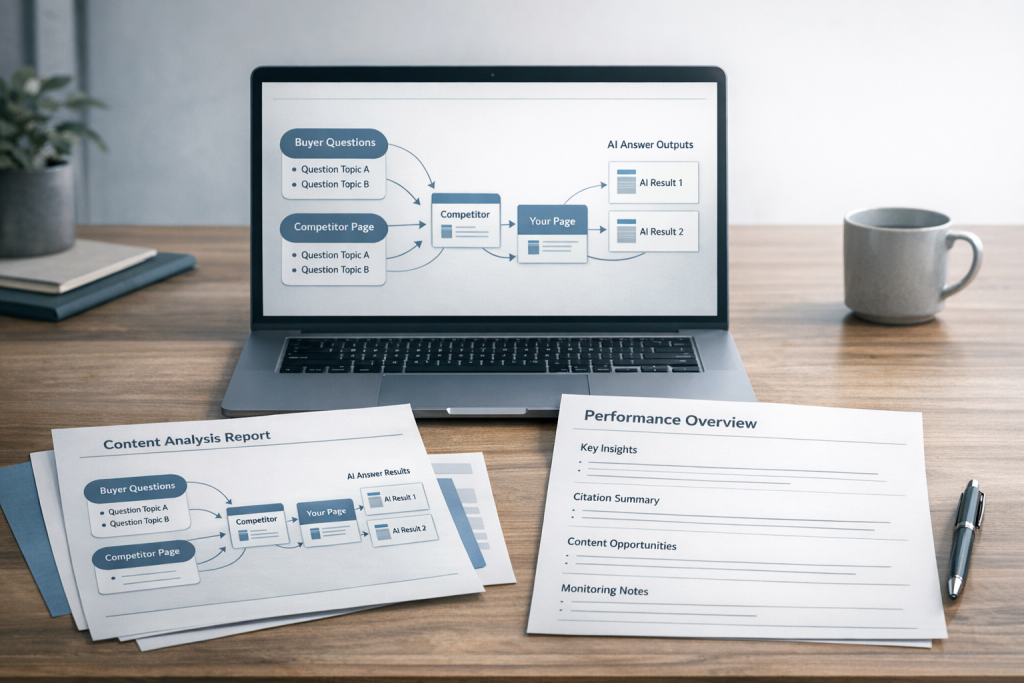
How to Identify the Pages That Cause AI Engines to Cite Your Competitors
When an AI engine like ChatGPT, Gemini, Perplexity, or Claude cites a competitor in response to a buyer question, that citation almost always traces back to a specific page on the competitor’s website — not the brand in general. Identifying those pages is the first step toward understanding the gap between your AI visibility and theirs. The process requires structured prompt testing, page-level analysis, pattern recognition across multiple AI environments, and ongoing monitoring. This article walks through each phase so you can see exactly where competitor citations originate and what to do with that information.
What It Actually Means When an AI Engine Cites a Competitor
AI citations are not the same as search rankings
A traditional search ranking places a link on a results page. An AI citation does something different: it weaves a competitor’s information, name, or recommendation directly into a generated answer. When a buyer asks an AI engine who the best provider is in a given category, or how to solve a specific problem, the AI system may reference a competitor’s page as a source — sometimes with a visible link, sometimes by paraphrasing the content without attribution, and sometimes by naming the brand outright.
This distinction matters because a page that ranks well in Google does not automatically get cited by AI engines, and a page that AI engines cite may not rank prominently in traditional search at all. The signals that make a page useful to an AI system overlap with but are not identical to the signals that produce high search rankings.
What triggers a citation at the page level
AI engines select pages to cite based on how clearly and directly a page answers a question, how well it matches the specific query a user is asking, and how structured and extractable the content is. A page that directly addresses a buyer question in plain language, uses clear headings that match likely queries, and provides specific answers rather than vague generalities is more likely to be pulled into an AI-generated response.
This is not a guaranteed formula. AI citation behavior is not fully transparent, and no one outside the companies building these systems has direct access to the selection logic. What we can observe is that certain page-level characteristics appear repeatedly when we trace citations back to their sources. That observation is the foundation of the audit process described below.
Phase One: Surface the Citations Through Prompt Testing
The starting point for any competitor citation audit is systematically querying AI engines with the same kinds of questions your buyers ask. This is not a casual exercise — it requires deliberate query construction and careful documentation.
How to construct test queries that reveal competitor citations
Begin with your actual buyer questions. These are the questions prospects ask your sales team, the queries that drive traffic to your website, and the problems your service or product solves. Translate those into natural-language prompts you can enter into AI engines.
Effective test queries typically fall into a few categories:
- Category questions: “Who are the best [service type] providers in [location]?” or “What companies offer [specific solution]?”
- Problem questions: “How do I [solve specific problem]?” or “What should I look for when choosing a [provider type]?”
- Comparison questions: “What is the difference between [option A] and [option B]?” or “Which [product type] is best for [specific use case]?”
- Decision questions: “Is [specific approach] worth it for [business type]?” or “When should a company hire a [provider type]?”
The goal is not to ask one question and draw a conclusion. Run twenty, thirty, or fifty variations of the questions that matter most to your buyer journey. Each variation may surface different competitors, different pages, and different citation patterns.
Which AI engines to test and why each behaves differently
You should test across multiple AI environments because each one retrieves and cites sources differently:
- ChatGPT (with web search enabled) pulls from live web results and sometimes cites specific pages with links.
- Perplexity is built around source retrieval — it typically shows inline citations with numbered references, making it the easiest place to trace a citation back to a specific URL.
- Google Gemini draws on Google’s index and may reference sources in its responses, though the citation format varies.
- Claude does not browse the web in its default mode but may reference content from its training data, which reflects what was publicly available and well-structured at the time of training.
- Google AI Overviews appear directly in search results and often link to specific pages, making them another observable surface.
Each engine may cite different competitors or different pages from the same competitor. That variation is itself useful data — it tells you which competitor pages are broadly citation-worthy versus which ones appear only in a single AI environment.
What to record and how to organize what you find
Every time a competitor appears in an AI-generated response, record:
- The exact query you used
- Which AI engine you tested
- Which competitor was mentioned or cited
- Whether the citation included a link to a specific page
- The URL of the cited page, if visible
- What the AI engine said about the competitor — a direct quote, a recommendation, a factual reference, or something else
- The date of the test
A simple spreadsheet works for this. The structure does not need to be complicated, but it does need to be consistent so you can spot patterns across dozens or hundreds of queries.
Key takeaway: Prompt testing is the observational foundation. Without it, everything else is guesswork.
Phase Two: Trace the Citation Back to a Specific Page
Once you have a list of competitor citations across multiple AI engines and query types, the next step is identifying exactly which page on the competitor’s site is responsible for each citation.
How to identify which page is being cited
In some cases, the AI engine provides a direct link. Perplexity and Google AI Overviews are the most consistent about this. When you have a link, you have your answer — visit the page and move on to analysis.
When there is no direct link, you need to work backward. Take the specific claim or information the AI engine attributed to the competitor and search for it on the competitor’s website. Use a site-specific search (site:competitor.com plus the key phrase) or manually review their blog, resource center, or service pages for the content that matches what the AI engine referenced.
In many cases, you will find that a single blog post or resource page is responsible for multiple citations across different queries. That page is a high-value citation source and deserves close analysis.
What to look for when you find the page
Once you have identified a cited page, examine it with these questions:
- Does the page directly answer a specific buyer question in its first few paragraphs?
- Does it use clear, descriptive headings that match natural-language queries?
- Is the content structured in a way that makes specific sections easy to extract — numbered steps, defined terms, labeled frameworks?
- Does the page cover the topic with enough specificity to be useful, or does it stay at a surface level?
- Is it well-maintained and up to date, or does it show signs of aging content?
- Does it address multiple related questions within a single, well-organized page?
You are not looking for one magic attribute. You are looking for the combination of clarity, structure, specificity, and buyer-question alignment that makes a page useful enough for an AI system to reference.
The difference between a page that ranks and a page that gets cited
A page that ranks well in Google might do so because of strong backlinks, domain authority, or technical SEO fundamentals. A page that gets cited by AI engines tends to earn that citation because of how clearly and directly it answers a question in a format that the AI system can parse and reuse.
This is why some competitor pages with modest search rankings still show up in AI-generated answers, while high-ranking pages with vague or generic content get passed over. AI citation selection appears to favor answer quality and extractability at the section level, not just domain-level authority signals.
Key takeaway: Tracing a citation to a specific page turns a vague awareness of competitor visibility into actionable, page-level intelligence.
Phase Three: Analyze What Makes That Page Citation-Worthy
Identifying the page is half the work. Understanding why it was cited is what makes the audit strategically useful.
Content signals that appear to attract AI citations
Based on observable patterns across AI-generated responses, pages that get cited tend to share several characteristics:
- Direct answers: The page states its core answer clearly and early, often in the first paragraph of a section or immediately after a heading.
- Specific language: Rather than gesturing at complexity, the page names the relevant factors and works through each one in plain terms.
- Defined terms: When the page uses a specialized term, it defines it in plain language — making it easier for an AI system to understand and reuse.
- Structured formatting: Headings, numbered lists, and labeled sections create natural extraction points. AI systems can pull a specific section without needing to parse the entire page.
- Buyer-question alignment: The page is organized around questions a real buyer would ask, not around keywords a marketer wants to rank for.
Structural patterns worth noting
Pay attention to how the competitor structured the page, not just what they wrote. Common patterns on cited pages include:
- FAQ sections that use the exact question as the heading and provide a concise answer below
- Step-by-step processes with numbered phases or stages
- Comparison sections that lay out tradeoffs clearly
- Summary statements at the end of major sections that compress the key point into one or two sentences
The goal of this analysis is not to copy the competitor’s page. It is to understand the structural and content-level decisions that made their page useful to an AI system — and to apply that understanding to your own content.
Topic authority and question-answer alignment
AI engines do not cite pages in isolation. They evaluate pages in context. A competitor whose site has multiple articles covering related subtopics — each one well-structured and buyer-focused — may have an advantage over a site with a single strong article surrounded by thin or unrelated content.
This means that when you analyze a competitor’s cited page, also look at what else they publish. How many articles do they have on related topics? Do those articles interlink? Do they cover the buyer journey from awareness through decision? The depth and coherence of their content library is itself a signal worth tracking.
Key takeaway: A citation-worthy page is not accidental. It reflects deliberate choices about structure, specificity, and buyer-question alignment that you can observe and learn from.
Phase Four: Set Up Ongoing Competitor Citation Monitoring
A one-time audit gives you a snapshot. Ongoing monitoring gives you a system. Competitor content changes, AI models update on their own schedules, and the questions buyers type into these tools shift over time. A page drawing citations today may lose that position within a quarter — and a competitor that barely appeared in AI answers last month could become a frequent reference if they publish the right content.
Why a one-time audit is not enough
AI engines continuously update their models and their retrieval behavior. Competitors publish new pages, update existing ones, and adjust their strategies. A competitor who is invisible in AI answers today could become a dominant citation source within a few months if they publish the right content. Similarly, a competitor who is frequently cited today could lose that visibility if their content goes stale or if a better source appears.
If you check once and stop, you are working from outdated intelligence. The value of a competitor citation audit compounds when it becomes a recurring process.
How to build a repeatable monitoring process
The core of a repeatable process is consistency:
- Maintain a fixed set of buyer questions that you test across AI engines on a regular cycle — monthly is a practical minimum.
- Add new questions when your buyer landscape changes, when new competitors appear, or when you enter a new market.
- Record every observation in the same format so you can compare across time periods.
- Track changes specifically: Which competitors gained citations? Which lost them? Which pages are new? Which pages disappeared from AI responses?
- Review findings as a team so the intelligence feeds directly into your content strategy rather than sitting in a spreadsheet no one reads.
What to track and how often
At a minimum, track:
- Which competitors appear in AI answers for your top buyer questions
- Which specific pages are cited, and whether the cited pages have changed since the last review
- Whether your own pages are appearing, and if so, for which queries
- New competitor pages that have entered AI citation results since the last audit cycle
- Shifts in the language or framing AI engines use when referencing competitors — this can indicate changes in how the AI system interprets the topic
Monthly monitoring is sufficient for most businesses. Highly competitive categories or fast-moving markets may warrant more frequent checks.
Key takeaway: Ongoing monitoring turns competitor citation intelligence from a one-time curiosity into a strategic input that shapes your content decisions month over month.
What to Do With What You Find
Using competitor citation data to identify your own content gaps
Every competitor page that gets cited by an AI engine represents a buyer question that someone else is answering better — or at least more visibly — than you are. Map each cited competitor page to a buyer question. Then ask: do we have a page that answers this question? If so, is it as clear, as specific, and as well-structured as the competitor’s page? If not, that is a gap.
This is not about creating a reactive copy of competitor content. It is about using competitor citation data as a signal for where your own content library is weak, incomplete, or poorly structured for AI extraction.
How to build pages that are more likely to be citation-worthy
The patterns you observed in Phase Three — direct answers, structured formatting, buyer-question alignment, defined terms, and section-level specificity — should inform how you create new content. Every article you publish should be written with the understanding that an AI engine might try to extract a section and cite it in response to a buyer question. That does not mean writing for machines. It means writing clearly enough that both a busy human reader and an AI system can understand what your page is about and what it answers.
Prioritize the buyer questions where you found the biggest gaps. Create content that is more specific, more honest about tradeoffs, better organized, and more directly useful than what currently exists. Publish it on your own site, maintain it over time, and make sure it is crawlable by search engines and AI bots.
When to manage this internally versus when to use a full-service partner
The process described in this article is real and it works. It is also time-intensive, repetitive, and easy to deprioritize when other demands compete for your team’s attention.
Running a competitor citation audit once is manageable. Running it monthly across multiple AI engines, maintaining a growing database of observations, analyzing cited pages, identifying content gaps, creating new articles, publishing them, distributing them across social channels, and tracking whether your own visibility changes — that is a full workflow, not a side project.
Some teams have the internal capacity for this. Many do not. The teams that struggle most are the ones who understand the value of AI visibility monitoring but cannot absorb the operational overhead of doing it consistently.
This is the problem CiteHarbor exists to solve. CiteHarbor performs the initial AI visibility audit, researches buyer questions, creates targeted articles, publishes to WordPress and social channels, monitors competitor citations across ChatGPT, Perplexity, Gemini, Claude, and Google AI Overview, and delivers a branded PDF performance snapshot each month. The client does not manage a dashboard, hire freelancers, or add another tool to their stack. The entire workflow — from audit to content to distribution to competitive intelligence to reporting — is handled as a managed service.
If the process described above sounds valuable but unsustainable for your team to manage internally, that is exactly the situation the service was built for.
Frequently Asked Questions
What is an AI citation and how is it different from a backlink or a search ranking?
An AI citation occurs when an AI engine like ChatGPT, Perplexity, or Gemini references a specific page or brand within a generated answer. Unlike a backlink, which is a link from one website to another, an AI citation is embedded in a conversational response that a buyer reads as a recommendation or answer. Unlike a search ranking, which places a link on a results page, an AI citation integrates the source directly into the answer itself.
Can I find out which specific pages are causing AI engines to cite my competitors?
In many cases, yes. Some AI engines — particularly Perplexity and Google AI Overviews — show direct links to the cited source page. When links are not shown, you can trace the citation backward by searching the competitor’s site for the specific content the AI engine referenced. The four-phase process described in this article provides a structured approach for doing this systematically.
How often should I check for competitor AI citations?
Monthly monitoring is a practical baseline for most businesses. Citation patterns in AI-generated answers are not static — they shift as competitors update their content and as AI models evolve. Checking once gives you a snapshot; building a monthly cadence gives you a trend line that can inform content decisions over time.
What makes a page more likely to be cited by an AI engine?
Pages that get cited tend to answer specific questions directly, use clear and descriptive headings, define important terms, and organize content in structured formats that are easy to extract. Buyer-question alignment — writing about what buyers actually ask rather than what a marketer wants to rank for — appears to be a significant factor based on observable patterns.
Does being cited by AI engines actually affect my business?
AI engines are becoming a meaningful part of how buyers research providers, compare options, and make decisions. When a competitor is cited in an AI answer and your brand is absent, that buyer may never reach your website at all. The exact revenue impact varies by industry and buyer behavior, but the visibility gap is observable and measurable.
Is this something I can manage myself or do I need help?
You can absolutely run a competitor citation audit yourself using the process in this article. The challenge is doing it consistently — monthly testing, documentation, page analysis, content creation, publishing, and tracking add up to a significant ongoing workload. Teams that want the intelligence and the content execution handled for them typically benefit from a full-service partner like CiteHarbor.
If I find the pages causing competitor citations, what should I do next?
Map each cited competitor page to a buyer question. Identify whether your site has content that answers the same question with equal or greater clarity and specificity. Where gaps exist, prioritize creating well-structured, buyer-focused content that covers those questions. Then monitor over time to see whether your own visibility in AI-generated answers changes.
Conclusion
Competitor AI citations are not a mystery — they are traceable. The pages that cause AI engines to cite your competitors can be identified, analyzed, and understood through a structured process of prompt testing, page-level investigation, signal analysis, and ongoing monitoring. What you do with that intelligence determines whether it becomes a strategic advantage or just another report gathering dust.
If you want to see where your competitors are being cited, where your own brand is missing, and which buyer questions represent the biggest gaps, CiteHarbor’s two-week free trial gives you a working baseline without requiring a credit card, a new dashboard, or another tool to manage.