How Product Marketers Can Track Competitor Mentions in ChatGPT and Perplexity Comparisons
Learn how product marketers can monitor competitor mentions in AI-generated comparisons, capture the right response data, and turn those findings into content and positioning decisions.
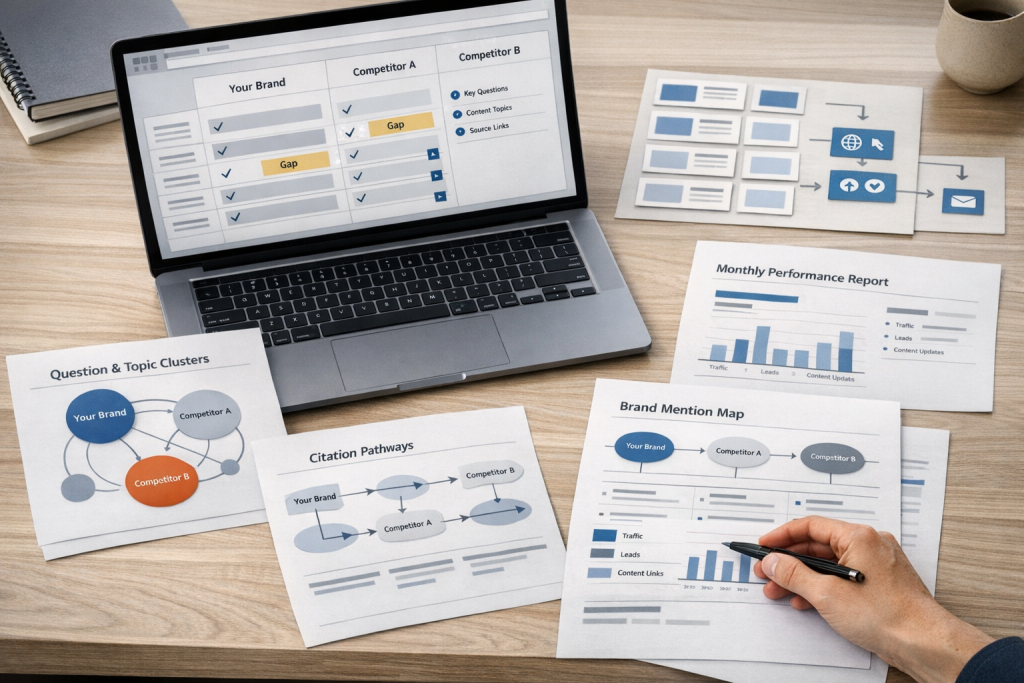
How Product Marketers Can Track Competitor Mentions in ChatGPT and Perplexity Comparisons
Product marketers can track competitor mentions in ChatGPT and Perplexity by building a consistent set of buyer-intent prompts, running them on a regular schedule across both platforms, recording the full response data for each query, and calculating competitive metrics like AI share of voice and competitor displacement. The goal is not just to confirm that a competitor appears — it is to understand which buyer questions trigger their recommendations, what narrative the AI constructs around them, and which external sources are driving that narrative.
This matters now because your existing keyword rankings, review-site presence, and product pages are not enough. When a buyer asks ChatGPT or Perplexity to compare solutions in your category, those systems generate their own answer — often pulling from sources and framing you cannot see in a traditional SERP report. If your competitors show up in those answers and you do not, you have a visibility gap that no amount of Google ranking will close.
This guide walks through the full process: how to construct the right prompts, what data to capture, which metrics to calculate, how to interpret what you find, and how to connect the results to content and positioning decisions that actually improve your chances of appearing.
Why AI Comparison Queries Are the Highest-Stakes Moment for Product Marketers
When a buyer types “best project management tools for remote teams” or “alternatives to [Competitor X]” into ChatGPT or Perplexity, they are not browsing. They are actively evaluating. These comparison-style prompts sit at the narrowest part of the consideration funnel — and AI systems are now generating structured, opinionated answers to them.
Traditional competitive intelligence covers analyst reports, G2 reviews, keyword share of voice, and social mentions. What it usually does not cover is whether AI-generated answers are recommending your competitors, describing your product accurately, or leaving your brand out of the conversation entirely.
That gap is the problem. And for most product marketing teams, it is invisible — because nobody is systematically checking.
Step 1: Build a Buyer-Prompt Library Focused on Competitive Queries
Tracking starts with knowing what to ask. You need a fixed, stable set of prompts that reflect the real questions your buyers use when evaluating solutions. Not hypothetical questions — actual buyer language.
The Six Prompt Categories Product Marketers Need
- Category and head-term queries: “Best [category] software for [use case]” or “Top [category] tools in 2025”
- Problem-based queries: “How do I solve [specific pain point] for my team?”
- Direct comparison queries: “[Product A] vs [Product B]” or “Compare [Product A] and [Product B] for [use case]”
- Alternative and switching queries: “Best alternatives to [Competitor]” or “What should I use instead of [Competitor]?”
- Negative and downside queries: “Problems with [Competitor]” or “Why do people leave [Competitor]?”
- Recommendation queries: “What [category] tool would you recommend for a [company size/type]?”
Comparison and alternative queries are the highest priority. These are the prompts where AI systems generate the most direct, opinionated brand-by-brand answers — and where your absence is most visible to a buyer who is ready to make a decision.
How to Source Prompts From Real Buyer Behavior
The biggest mistake teams make is guessing what buyers ask. Instead, pull prompts from sources where buyer language is already recorded:
- Sales call transcripts: Look for the exact phrasing prospects use when they describe what they are comparing or what problem they are trying to solve.
- Customer support conversations: Questions about features, integrations, and limitations often mirror the comparison queries buyers ask before purchasing.
- Google Search Console data: Filter for queries that contain competitor names, “vs,” “alternative,” “compare,” or “best.”
- Review site questions: G2, Capterra, and TrustRadius discussion threads surface the language real evaluators use.
- Post-purchase attribution responses: When buyers mention searching or asking an AI assistant before they found you, ask what they actually typed.
How Many Prompts, and How to Prioritize
Start with 30 to 50 prompts. Weight the set toward comparison and alternative queries — these are where competitive visibility matters most. Keep the prompt set stable over time so you can measure trends rather than chasing one-off snapshots.
Add prompts only when your product launches a new feature, a new competitor enters the market, or you discover a buyer question pattern you were not tracking. If you change too many prompts at once, you lose the ability to compare results across periods.
Key takeaway: A prompt library built from real buyer language is the foundation of useful competitive tracking. Without it, you are checking random queries and drawing unreliable conclusions.
Step 2: Record the Full Response, Not Just Whether You Appear
The most common mistake in AI competitive tracking is treating it as a binary check: did my brand show up or not. That gives you almost nothing to act on. What matters is the full picture of the response — who appeared, in what order, with what framing, and based on what sources.
The Eight Data Points to Capture for Every Prompt-Engine Combination
| Data Point | What to Record | Why It Matters |
|---|---|---|
| Brand mentioned | Yes or No | Baseline presence signal |
| Recommended | Yes or No | Being mentioned is not the same as being recommended |
| Position | Where in the response the brand appears (first, second, listed, footnote) | Earlier mentions carry stronger implied endorsement |
| Competitors named | Every other brand mentioned in the same response | Shows who you are being compared against |
| Framing and narrative | How the AI describes each brand (e.g., “best for enterprise,” “most affordable,” “limited integrations”) | Reveals how AI systems are positioning you and your competitors |
| Sentiment and accuracy | Whether the description is positive, neutral, negative, or factually wrong | Inaccurate descriptions create a correctable problem |
| Sources and citations | Any links, references, or sources the AI exposes | Tells you what content is driving the recommendation |
| Date and model | When you ran the query and which AI model version responded | AI answers change over time — you need a timestamp to track trends |
Record this for every prompt across every AI platform you are tracking. A spreadsheet works for the first few cycles. If the volume grows beyond what a single person can manage consistently, that is a signal you need a more systematic approach.
How ChatGPT and Perplexity Differ in What You Can Capture
This distinction matters because these platforms do not expose the same information, and treating them identically creates blind spots.
Perplexity shows its citations explicitly. Every answer includes numbered source links that you can click through to see exactly which web pages informed the response. This makes Perplexity’s citation structure something like a visible backlink graph for AI-generated answers. If a competitor appears in a Perplexity comparison, you can often trace the recommendation directly to a specific review article, forum thread, or documentation page.
ChatGPT is less transparent about sourcing. In standard mode, it does not always show which sources informed the response. When using ChatGPT’s search mode, it will sometimes display source links — but the connection between a specific source and a specific claim in the response is harder to trace than in Perplexity.
The practical implication: Perplexity data gives you more actionable source intelligence. ChatGPT data gives you a broader signal about brand perception in the model’s training and retrieval. You need both, and you need to interpret them differently.
Key takeaway: A presence-only check wastes your time. The eight-point data capture is what turns raw AI responses into competitive intelligence you can actually use.
Step 3: Calculate the Six Competitive KPIs That Actually Matter
Once you have response data from multiple prompt cycles, you can calculate metrics that go beyond individual observations and start showing patterns. Here are the six that product marketers should track — each with a formula and a plain explanation of what it reveals.
- Mention rate = prompts where your brand appears ÷ total relevant prompts. Tells you how often AI systems acknowledge your existence in your category.
- Recommendation rate = prompts where your brand is explicitly recommended ÷ total relevant prompts. Tells you how often AI systems actively endorse you, not just list you.
- AI share of voice = your brand’s total mentions across all tracked prompts ÷ combined brand mentions for every competitor in the same prompt set. Shows your relative presence in AI-generated answers compared to the competitive field.
- Average position = sum of your position rank across all mentions ÷ number of mentions. Tells you whether you tend to appear first, second, or buried at the bottom of AI-generated lists.
- Competitor displacement = prompts where a specific competitor appears and your brand does not. Tells you exactly where you are losing ground and to whom.
- Citation share = number of unique source pages citing your brand in AI answers ÷ total unique source pages cited across all brands. Tells you how well your content ecosystem supports AI recommendations compared to competitors.
The Diagnostic Logic: What Metric Combinations Actually Tell You
Individual metrics are useful. Combinations of metrics are where the real insight lives.
- High mention rate, low recommendation rate: AI systems know you exist but are not choosing you. This usually means the AI is pulling from sources that describe your product without endorsing it — or that competitors have stronger signals on the dimensions buyers care about.
- High competitor displacement on comparison queries: Your messaging gap is showing up in AI answers. The buyer is asking a direct comparison question, and the AI is answering with your competitor’s narrative, not yours.
- Low citation share despite strong owned content: Your own website and blog may not be the content that AI systems are pulling from. Third-party sources — review sites, analyst reports, forums, technical publications — may be driving recommendations more than anything you publish directly.
- Mention rate increasing but average position declining: You are appearing in more responses, but further down the list. This can happen when new competitors enter the space or when existing competitors improve their source coverage.
Key takeaway: AI share of voice is the headline metric, but the diagnostic combinations tell you what is actually happening and where to focus your response.
Step 4: Choose a Tracking Approach That Matches Your Resources
There is no single right way to run this process. The right approach depends on how many prompts you are tracking, how many AI platforms you are monitoring, and how much time your team can realistically dedicate.
Manual Tracking
Best for initial baselines and teams with fewer than 50 prompts. Use a dedicated browser profile (to avoid personalization effects), run your prompts on a consistent schedule, and log results to a structured spreadsheet using the eight-point framework from Step 2.
Manual tracking works well for establishing your first baseline. The limitation is that it does not scale, and it is tedious enough that consistency drops off after a few weeks unless someone is specifically accountable for it.
API and Automation Approaches
If your team has technical resources, you can use AI platform APIs to run prompts programmatically and log responses automatically. This reduces the manual burden and improves consistency, but it requires development time to set up and maintain — and API access, pricing, and terms vary across platforms.
Dedicated AI Visibility Platforms
A growing category of tools is emerging to handle AI visibility tracking at scale. When evaluating platforms, look for the ability to run prompts across multiple AI engines, capture full response data (not just binary mention checks), track trends over time against a stable prompt set, and compare your visibility against specific competitors.
Full-Service Execution
For teams that do not want to manage another dashboard, another tool, or another internal workflow, a full-service partner can handle the entire process — from prompt research and competitive monitoring to content creation, publishing, and reporting. This is the approach CiteHarbor provides: the audit, the tracking, the content, the publishing, and the monthly performance snapshot, delivered as a managed service rather than a software platform you have to operate.
Key takeaway: Start manual to build intuition and establish a baseline. Then decide whether to scale through automation, software, or a managed service based on what your team can realistically sustain.
Step 5: Analyze Competitor Gaps and Trace the Sources Behind Them
The most valuable data in your tracking system is not where you appear. It is where your competitors appear and you do not. These competitor displacement prompts are your highest-priority gaps — and understanding why they exist is what turns monitoring into strategy.
Identifying Your Highest-Priority Gaps
Filter your tracking data for prompts where at least one competitor is mentioned or recommended and your brand is absent. Then sort those prompts by business impact: comparison queries and recommendation queries are more urgent than general category queries, because the buyer’s intent is more specific and closer to a decision.
Tracing the Sources Behind Competitor Recommendations
When a competitor appears in an AI-generated comparison, something is driving that recommendation. In Perplexity, you can often see the cited sources directly. In ChatGPT, you may need to run the same query in search mode and examine any source links that appear, or look at the competitor’s broader web presence for clues.
Common sources that drive AI recommendations include:
- Review site profiles and comparison pages on G2, Capterra, and TrustRadius
- Technical blog posts and integration documentation
- Industry analyst reports and market guides
- Forum discussions on Reddit, Stack Overflow, and niche community sites
- News coverage and product announcement articles
- Competitor-published comparison pages and “vs” content
This is a critical insight that many product marketing teams miss: AI systems often pull more heavily from third-party sources than from your owned content. Your own product page may be well-optimized for Google, but if the review sites, forums, and analyst reports in your category do not mention you favorably, AI comparison answers will reflect that gap.
Auditing the Framing and Accuracy of Competitor Mentions
Beyond presence, examine how the AI describes each competitor. What narrative does it construct? “Best for enterprise scalability.” “Most affordable option.” “Strong integrations but steep learning curve.” These framings are not random — they are reflections of the source material the AI system accessed.
When the AI’s description of your own product is inaccurate — and it sometimes will be — trace the inaccuracy to its source. Is it based on an outdated review? A forum thread from three years ago? A competitor’s comparison page? Knowing the source of an inaccuracy is the first step toward correcting it.
Key takeaway: Competitor gaps are not just visibility problems. They are content ecosystem problems. Closing them requires understanding which sources are driving AI recommendations and whether your brand has adequate coverage in those sources.
Step 6: Turn Competitor Mention Data Into Content and Positioning Actions
Tracking without action is just record-keeping. The value of this system is in what you do with the data. Here are the most common scenarios and the corresponding responses.
When a Competitor Wins on a Specific Framing
If a competitor is consistently described as “best for [specific use case]” and your product also serves that use case, trace the framing to its sources. Often, you will find that the competitor has a published guide, a dedicated landing page, or third-party coverage that specifically addresses that use case — and you do not.
The response: create content that directly addresses the same use case with clear, specific, experience-backed detail. Publish it on your own site. Pursue coverage on the third-party sources the AI is already citing. Update your product documentation to reflect the capability.
When a Competitor Appears in Comparison Queries and You Do Not
This is the most common gap. The buyer is explicitly comparing solutions, and your brand is absent from the AI’s answer.
The response: publish well-structured comparison content on your own site. Ensure your product is listed and accurately described on the review sites and directories the AI is citing. Look for content gaps in forums and community sites where buyers discuss your category. Create targeted articles that answer the exact buyer questions your prompt library has identified.
This is the type of work CiteHarbor does for clients — identifying the specific buyer questions where visibility gaps exist, creating content designed to address those gaps, publishing it to the client’s WordPress site, distributing it through social channels, and tracking whether visibility improves over time.
When the AI’s Description of Your Product Is Inaccurate
AI answers are probabilistic. They are generated from patterns in the data the model was trained on or retrieved from the web. Sometimes the description they generate about your product is outdated, misleading, or wrong.
The response follows a specific workflow:
- Identify the inaccurate claim in the AI’s response.
- Trace it to the likely source — review site, forum post, outdated article, or competitor-published content.
- If the source is on a platform you can influence (your own site, a review profile, a partner page), update it with accurate information.
- If the source is a third-party page you cannot directly edit, create owned content that clearly and specifically addresses the inaccuracy with current, verifiable information.
- Monitor the same prompt in future tracking cycles to see whether the AI’s response updates.
Key takeaway: Every competitor gap in your tracking data is a specific, addressable content or positioning problem. The tracking system tells you where to focus. The content response is what has a chance of changing the outcome over time.
Step 7: Build a Repeatable Operating Cadence
One-time audits are useful for establishing a baseline. But AI-generated answers change as models update, as new content is published, and as user behavior evolves. Competitive intelligence from AI tracking is only reliable if it is gathered consistently over time.
Recommended Cadence
- Weekly: Run your core prompt set across ChatGPT and Perplexity. Flag any major changes in competitor mentions, new competitors appearing, or shifts in framing.
- Monthly: Calculate your six KPIs. Analyze competitor narratives and source shifts. Identify the highest-priority gaps for content response. Compare results to the previous month.
- Quarterly: Refresh your prompt set — add new buyer questions, add new competitors if relevant, remove prompts that are no longer strategically important. Review your citation share trends and the third-party source landscape.
- Post-launch: After a product launch, feature release, or major content push, run a before-and-after measurement against a fixed control set of prompts to see whether your visibility shifted.
This cadence is the part that breaks down most often for internal teams. Running prompts, recording data, calculating metrics, analyzing gaps, and connecting findings to content strategy is a meaningful operational commitment. It is not a quarterly project — it is an ongoing intelligence function.
This is one of the primary reasons teams choose to work with a managed service like CiteHarbor. Instead of adding another recurring task to a product marketer’s workload, the entire process — auditing, prompt research, competitive monitoring, content creation, publishing, distribution, and reporting — is handled externally. The client receives a branded monthly performance snapshot instead of managing another dashboard.
A Note on AI Answer Reliability in Competitive Analysis
This system gives you useful competitive signals. It does not give you ground truth about market perception.
AI-generated comparison answers are probabilistic. The same prompt can produce different results at different times, on different days, and across different model versions. Comparison queries in particular have been observed to produce inconsistent and sometimes contradictory results across AI platforms.
What this means in practice:
- Do not treat a single AI response as evidence of a market trend. Look for patterns across multiple prompts and multiple tracking cycles.
- Always trace AI claims to their sources before acting on them. An AI system may describe a competitor favorably based on an outdated article or a single review — that is a data point, not a conclusion.
- Use AI tracking data as a signal to investigate, not as a replacement for direct customer research, win/loss analysis, or traditional competitive intelligence.
- Be especially cautious about accuracy claims — AI descriptions of your competitors’ features, pricing, and capabilities may be wrong. Verify before responding strategically.
The recommended verification workflow: AI answer → cited sources → source verification → marketing action. Never skip the verification step.
Key takeaway: AI competitive tracking is a valuable intelligence layer, not a definitive scorecard. Use it alongside your existing competitive intelligence program, not as a replacement for it.
What AI Share of Voice Means for Product Marketing Teams Already Investing in SEO
If your team already invests in keyword rankings, review-site optimization, and content marketing, you are not starting from zero. Much of the content infrastructure that supports traditional search visibility also supports AI visibility — but the gaps between the two are real and growing.
The most common pattern we observe: a SaaS company ranks well for category keywords in Google, has strong review-site profiles, and publishes regular blog content — but when a buyer asks ChatGPT or Perplexity to compare tools in the same category, the company does not appear, or appears with inaccurate framing.
This happens because AI systems pull from a different mix of sources, weight content differently, and construct their own narratives rather than simply ranking pages. Your keyword positions do not automatically translate into AI recommendations. Your blog posts, if they are written to rank for search queries rather than to answer buyer questions with clear, structured, citable information, may not be the kind of content AI systems pull from.
The competitive tracking system described in this guide gives you the data to see exactly where those gaps exist — and a framework for closing them through targeted, buyer-question-focused content rather than more generic blog volume.
Frequently Asked Questions
What is AI share of voice and how do I calculate it?
AI share of voice measures your brand’s visibility in AI-generated answers relative to your competitors. To calculate it, take your brand’s total mention count across all tracked prompts and divide it by the combined mention count for every brand — yours and all competitors — within that same prompt set. A higher score means AI systems surface your brand more consistently than competing options when answering buyer questions in your category.
How often should I run these prompts?
Weekly for core prompt tracking, monthly for full KPI analysis, and quarterly for prompt set review and refresh. After product launches or major content pushes, run a targeted before-and-after comparison. Consistency matters more than frequency — a stable weekly cadence produces better trend data than sporadic deep dives.
Do I need a paid tool, or can I do this manually?
You can start manually with a spreadsheet and a dedicated browser profile. Manual tracking works well for establishing a baseline with 30 to 50 prompts. If you scale beyond that, or if consistency becomes a problem, consider API automation, a dedicated AI visibility platform, or a managed service that handles the tracking for you.
What should I do when a competitor appears in AI answers and I do not?
Trace the competitor’s mention to its likely sources — review sites, documentation, published content, forum discussions. Identify the specific content or coverage gap that explains their presence and your absence. Then create targeted content that addresses the same buyer question, publish it on your own site, and pursue coverage on the third-party sources the AI system cited. Monitor the same prompts in future cycles to track changes.
How is tracking competitor mentions in Perplexity different from ChatGPT?
Perplexity exposes its source citations directly in every answer, which lets you see exactly which web pages informed the recommendation. ChatGPT is less transparent about its sourcing in standard mode, though its search mode sometimes shows links. In practice, Perplexity gives you more actionable source intelligence, while ChatGPT gives you a broader signal about how your brand is perceived across the model’s training and retrieval data.
Does this replace traditional competitive intelligence?
No. AI competitive tracking is an additional intelligence layer, not a replacement. It tells you how AI systems are framing your category and recommending your competitors — information that traditional competitive analysis does not capture. Use it alongside win/loss analysis, customer research, review monitoring, and market analysis for a complete competitive picture.
Moving From Tracking to Action
The system outlined here gives product marketers a clear, repeatable process for understanding how AI platforms describe, recommend, and compare competitors in your category. The value is not in the tracking itself — it is in the content, positioning, and source-coverage decisions the tracking enables.
For teams that want to run this process internally, the framework in this guide is designed to be immediately actionable. Start with a buyer-prompt library, run your first baseline, capture the full response data, and calculate your initial KPIs. You will know within two or three cycles where your gaps are and what to do about them.
For teams that would rather not manage another workflow — the prompt research, the competitive monitoring, the content creation, the publishing, the distribution, the tracking, and the monthly reporting — CiteHarbor handles the entire process as a managed service. No dashboard to log into. No new tool to learn. No additional internal management burden.