Can ChatGPT Citations Generate Qualified Leads for a Service Business?
Being cited in ChatGPT can generate qualified leads for a service business, but results depend on the buyer query, the strength of your online presence, and your website’s ability to convert visitors. This article explains why AI citations can work, how to measure them, and how to improve your chances of being cited.
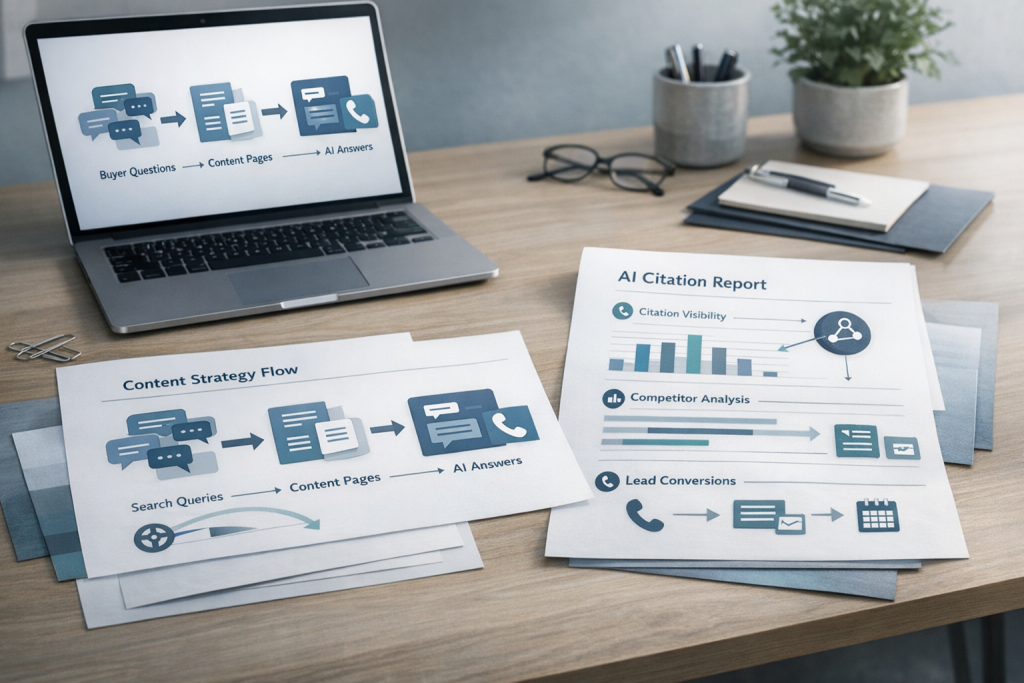
Can ChatGPT Citations Generate Qualified Leads for a Service Business?
Yes, being cited in ChatGPT can generate qualified leads for a service business — but the quality and volume of those leads depends on three conditions that most content about AI visibility glosses over. First, the type of buyer query your business appears in matters more than the citation itself. Second, your existing online presence has to give AI systems enough credible information to work with. Third, your website still has to convert the person who arrives. When all three conditions are solid, ChatGPT citations can become one of the most efficient sources of high-intent inquiries a service business receives. When any one is weak, the citation may produce curiosity clicks instead of qualified prospects.
This article explains the mechanism behind why AI citations produce leads, what separates citations that convert from those that do not, how to measure whether ChatGPT is actually sending you business, and what you can do to improve your chances of being cited in the first place.
Why ChatGPT Citations Produce Unusually Qualified Leads
Not all traffic sources are equal. A click from a display ad, a click from a broad Google search, and a mention inside a ChatGPT response represent fundamentally different buyer states. Understanding why AI citations tend to skew toward higher lead quality means looking at the buyer’s mindset at the moment they encounter your business.
The Buyer Is Already in Decision Mode
When someone types a query like “best commercial HVAC contractor for retrofitting older office buildings in Denver” into ChatGPT, they are not browsing. They have a specific problem, a specific context, and they want a direct recommendation. This is closer to asking a trusted colleague for a referral than it is to scanning a search results page. The intent behind these queries tends to be narrower and further along in the buying process than a typical Google search.
For service businesses, this is significant. A buyer who arrives at your website because an AI system named your company in response to a specific service question has already been filtered. They know roughly what they need. They are evaluating whether you are the right fit — not whether they need the service at all.
AI Recommendations Carry Implicit Trust
When ChatGPT or a similar AI tool presents a business by name in response to a service question, many buyers treat that mention as a form of endorsement. The AI system reads like a neutral third party — one that does not appear to have a financial incentive to favor one provider over another. Whether or not that perception is fully accurate, it shapes how buyers behave. An AI-generated recommendation can compress the evaluation process and lower the skepticism a prospect would otherwise bring to a cold website visit.
This does not mean every citation converts. It means the starting position is stronger. The prospect arrives carrying a degree of pre-established credibility that paid ads and even organic search results do not reliably provide.
Niche Specificity Favors Smaller Service Businesses
One of the more practical advantages of AI citation for service businesses is that specificity works in your favor. A large national brand may dominate broad queries, but AI systems frequently surface smaller, specialized businesses when the buyer’s question is specific enough. A query like “family law attorney in Phoenix who handles high-net-worth divorce cases” or “roofing company experienced with flat commercial roofs in coastal climates” can surface a regional firm that would struggle to outrank national directories in traditional search results.
For service businesses operating in defined markets or specialties, this is where AI visibility creates an opening that conventional SEO may not.
What Determines Whether a Citation Actually Converts to a Lead
Being cited is the starting point, not the finish line. The difference between a citation that generates a phone call and one that generates nothing comes down to three factors.
The Query Matters More Than the Citation Itself
A citation in response to “best general contractor” is worth considerably less than a citation in response to “commercial kitchen remodel contractor experienced with restaurant build-outs in Los Angeles.” The second query describes a buyer with a defined project, a specific need, and a geographic constraint. That buyer is close to hiring someone. The first query could belong to a student writing a paper.
The quality of the lead is determined primarily by the specificity and intent of the query that triggered the citation, not by the citation alone. This is why understanding exactly what your prospective clients are asking AI tools — buyer-question research — matters more than simply getting mentioned in as many responses as possible.
Your Online Presence Has to Give AI Systems Something to Work With
AI systems do not recommend businesses at random. They draw on information from across the web: your website content, third-party review platforms, directory listings, industry publications, and any other sources where your business is mentioned. If your online presence is thin, inconsistent, or vague about what you actually do, AI systems have less material to draw from and less reason to surface your business with confidence.
A strong online presence for AI visibility looks like this:
- Your website clearly describes the specific services you offer, the markets or geographies you serve, and the types of clients you work with
- Third-party review platforms contain recent, detailed reviews that mention specific services
- Your business information — name, address, phone number, service descriptions — is consistent across directories, your Google Business Profile, and your own website
- Industry-relevant content on your site answers the kinds of questions your buyers actually ask
A weak online presence looks like a website with generic service descriptions, outdated directory listings, few or no reviews, and no content that addresses buyer questions in any depth. AI systems working from that foundation are less likely to surface your business — and if they do, the citation may lack the specificity that makes a prospect trust it.
Your Website Still Has to Close the Deal
This is the gap most AI visibility content ignores entirely. A ChatGPT citation gets a prospect to your door. Your website has to let them in.
If a buyer receives an AI-generated recommendation for your business, clicks through to your site, and finds a slow-loading page with no clear contact information, no evidence that you handle their type of project, and no reason to trust you — that citation was wasted. Conversion readiness is a separate variable from citation visibility, and it deserves separate attention.
Practical conversion readiness for AI-referred visitors includes:
- A clear, fast-loading website that works well on mobile
- Specific service pages that confirm what the AI citation implied — that you handle the type of work the buyer needs
- Visible contact methods: phone, form, or scheduling tool, not buried under multiple layers of navigation
- Trust signals on the page: reviews, credentials, project examples, or client logos
- A clear reason to reach out now, rather than a wall of generic text that leaves the buyer uncertain
If your citation presence is strong but your website is not ready to convert a warm lead, both problems need to be solved together.
AI Citations Work Best as a Lead Amplifier, Not a Standalone Channel
The most accurate way to think about ChatGPT citations is as a lead amplifier rather than a standalone lead generation channel. For service businesses already investing in Google Ads, SEO, or content marketing, AI visibility adds a second layer of discovery. It reaches buyers who are using AI tools instead of — or alongside — traditional search engines. It reinforces your brand’s credibility when a prospect who found you through a Google search then encounters your business recommended in ChatGPT as well.
What AI citations do not do, at least not yet for most service businesses, is replace your existing marketing channels. A business that pauses Google Ads and relies entirely on ChatGPT mentions is taking a risk that the current state of AI-search behavior does not support. The stronger position is to treat AI citation visibility as a compounding investment that works alongside your other marketing efforts — not as a substitute for them.
For growth-oriented businesses that already have a marketing foundation in place, this is actually good news. Building AI visibility does not require abandoning what is already working. It extends the reach of your existing investments into a channel where more buyers are beginning their search.
How to Know If ChatGPT Is Actually Sending You Leads
Measurement is the most under-discussed part of AI visibility. Most content on this topic assumes that citations automatically produce leads. In practice, you need to verify whether citations are actually generating business inquiries — and that requires a combination of direct and indirect signals.
Direct Attribution Signals
The simplest direct signal is asking. Adding a source question to your contact form or intake process — with an option specifically for AI tools — gives you a straightforward data point. It will not capture every referral, but over time it reveals whether AI-referred prospects represent a meaningful share of your pipeline.
You can also examine referral traffic in your analytics. Some AI-generated answers include clickable links to your website, and visits from those sources can be tracked. That said, not every AI citation produces a clickable link — some simply mention your business by name, and the buyer then searches for you directly.
Indirect Signals Worth Monitoring
A rise in branded search volume — people searching for your business name directly — can indicate that buyers are encountering your name in AI answers and then looking you up. Similarly, a rise in direct website traffic can suggest that your brand is being surfaced in contexts where no direct link is provided.
Neither signal is conclusive on its own. But when branded search and direct traffic climb alongside improved AI citation visibility, the pattern is worth taking seriously.
Ongoing Citation Tracking
Beyond measuring inbound leads, it helps to track where your business is actually appearing. Regularly querying major AI tools — ChatGPT, Gemini, Claude, Perplexity — with the kinds of questions your buyers ask gives you a working baseline. Over time, you can see whether your visibility is improving, holding steady, or slipping.
This is one of the areas where the workload adds up quickly for businesses managing AI visibility internally. Tracking citation presence across multiple AI platforms, monitoring competitors, and connecting those observations to content and business outcomes is a recurring operational task — not a one-time project.
What Service Businesses Can Do to Improve Their Chances of Being Cited
There is no switch you can flip to force an AI system to recommend your business. But there are clear, practical steps that improve your chances — and they align closely with the signals AI systems appear to rely on when deciding which businesses to surface.
Make Your Service Offering Unambiguous Online
AI systems struggle with vague. If your website says “we provide solutions for your needs” instead of “we install and maintain commercial HVAC systems for office buildings, retail spaces, and restaurants in the greater Los Angeles area”, the AI has far less to work with. Be specific about what you do, who you do it for, and where you operate. Use the language your buyers use, not internal jargon.
Build Third-Party Validation That AI Systems Can Cross-Reference
AI tools do not rely solely on your website. They pull information from review platforms, directories, industry publications, and other third-party sources. A business with strong, specific reviews on Google, detailed profiles on relevant directories, and mentions in industry content gives AI systems multiple confirming signals. A business that exists only on its own website gives AI systems a single source — and single-source recommendations carry more uncertainty for the AI system and less confidence for the buyer.
Structure Content So AI Can Extract and Use It
Content that answers specific buyer questions clearly — with descriptive headings and concise explanations — is easier for AI systems to parse and use. This does not mean writing in a robotic style. It means organizing your content around the actual questions your buyers ask, using headings that reflect those questions, and leading each section with a direct answer before adding supporting detail.
FAQ sections on service pages, clear definitions of your specialties, and articles that address the specific problems your buyers face all contribute to a content foundation that AI systems can draw from.
Keep Business Information Consistent Everywhere
When your Google Business Profile says one thing, your website says another, and your directory listings say something else, AI systems are left reconciling conflicting information. Consistency across all public-facing sources — name, address, phone number, service descriptions, service areas — reduces ambiguity and makes it easier for AI systems to represent your business accurately.
Where AI Citations Tend to Produce the Strongest Leads
Not every service business will see the same results from AI citation visibility. Some categories are naturally better positioned based on how buyers use AI tools to find services.
Local home services — HVAC, roofing, plumbing, electrical, remodeling — tend to benefit because buyers frequently ask AI tools for recommendations with specific geographic and project-type constraints. These queries are high-intent by nature.
Professional services — law firms, accounting firms, financial advisors, consultants — benefit because buyers in these categories often ask AI tools to help them evaluate and compare providers. The considered nature of these purchases means the buyer is doing genuine research, not impulse shopping.
B2B service providers and SaaS companies benefit when their buyers use AI tools as research assistants during vendor evaluation. A marketing director asking ChatGPT to compare approaches to a specific business problem may encounter your firm as a recommended option.
Multi-location businesses and regional brands — medical groups, franchise operators, dental practices — benefit from the geographic specificity of AI queries and the opportunity to build visibility across multiple local markets at once.
In each of these categories, the common thread is a buyer who uses an AI tool to narrow their options before making contact. The more considered the purchase, the more valuable the citation tends to be.
Key Terms Worth Understanding
AI citation: When an AI system like ChatGPT, Gemini, Claude, or Perplexity mentions or recommends a specific business by name in response to a user query. This is distinct from a traditional search result listing. The AI system is synthesizing information and presenting your business as part of a generated answer — not simply returning a list of links.
Answer Engine Optimization (AEO): The practice of structuring your content and online presence so that AI-powered answer engines can find, understand, and cite your business when responding to relevant queries.
Generative Engine Optimization (GEO): A broader term for optimizing content to appear in responses from generative AI systems — including ChatGPT, Gemini, Perplexity, and Google’s AI Overview — rather than only traditional search engines.
High-intent query: A search or AI prompt that signals the user is actively looking to hire, purchase, or engage a service provider, rather than casually researching a topic. High-intent queries typically include specific service types, geographic constraints, or project details.
Frequently Asked Questions
Does this work for local service businesses or only national brands?
Local service businesses are often well-positioned for AI citations because buyer queries in local service categories tend to be specific and high-intent. A query like “plumber in Austin who can repipe a 1960s ranch house” is exactly the kind of specific, localized request where a specialized local business can be surfaced ahead of a national directory.
How long does it take before a service business starts appearing in ChatGPT responses?
There is no fixed timeline. AI systems refresh their knowledge and web-access capabilities on their own schedules, and the pace at which improved content or a stronger online presence translates into citation visibility varies. What holds true consistently is that businesses with a clearer, more thoroughly validated online presence tend to be cited sooner and more often. Building that presence is an ongoing effort, not a one-time task.
Can AI citations replace Google Ads or SEO?
Not at this stage, and framing it as a replacement misses the point. AI citation visibility works best as an additional discovery layer that compounds alongside existing marketing investments. Businesses already running Google Ads or investing in SEO can extend their reach by also appearing in AI-generated answers — capturing buyers who use AI tools as their primary or secondary research method.
How do I check whether my business is being cited in ChatGPT right now?
The simplest approach is to query the major AI tools — ChatGPT, Gemini, Claude, Perplexity — using the kinds of questions your buyers ask. Try variations: different service types, different geographies, different problem descriptions. Note where your business appears, where competitors appear, and where no specific business is mentioned at all. This gives you a working baseline. Doing it systematically and tracking it over time takes more structure, but the initial check takes only a few minutes.
Can any agency guarantee a ChatGPT recommendation?
No. No agency controls how AI systems generate their responses. Any promise of guaranteed citations, guaranteed AI recommendations, or guaranteed placement in AI-generated answers should be treated with skepticism. A responsible approach focuses on improving the conditions that make citation more likely — clearer content, stronger third-party validation, better coverage of buyer questions, consistent business information — and then tracks visibility over time to gauge whether things are moving in the right direction.
How should ChatGPT visibility be monitored over time?
Effective monitoring means regularly checking your citation presence across major AI platforms, tracking which buyer questions surface your business versus competitors, and connecting those observations to your actual lead flow. Checking monthly gives you enough frequency to spot meaningful trends without creating unsustainable overhead. Consistency matters most — a single check tells you where you stand today, but repeated tracking over time shows whether your visibility is genuinely improving.
What This Means for Your Business
ChatGPT citations can generate qualified leads for a service business. The mechanism is real: buyers are using AI tools to find and evaluate service providers, and the recommendations they receive carry implicit trust that traditional search results often do not. But the value of any individual citation depends on query specificity, the strength of your online presence, and whether your website is ready to convert the visitor who arrives.
For businesses already investing in marketing, AI visibility is not a gamble on an unproven channel. It is a practical extension of the work you are already doing — making your services findable where your buyers are actually looking. The businesses that benefit most are the ones that treat AI citation visibility as an ongoing operational priority rather than a one-time project.
The challenge is that researching buyer questions, creating content that AI systems can extract and cite, publishing and distributing that content, tracking citation visibility across multiple AI platforms, monitoring competitors, and reporting on progress is a real workload. For most service businesses, layering that onto an already-full marketing operation is not realistic.
That is the problem CiteHarbor was built to solve. CiteHarbor handles the entire AI visibility workflow — from initial auditing and buyer-question research through article creation, WordPress publishing, social distribution, competitor citation monitoring, and branded monthly performance snapshots — so your team gets the visibility benefit without the management burden. No dashboards to log into. No freelancers to manage. No content calendar to maintain.