AI Visibility Software vs. Done-for-You Agency: A Practical Decision Guide for Growth Teams
Choosing between AI visibility software and a done-for-you agency depends on whether your team can act on the data or needs execution support. This guide breaks down the real workload, hidden costs, and decision factors for growth teams.
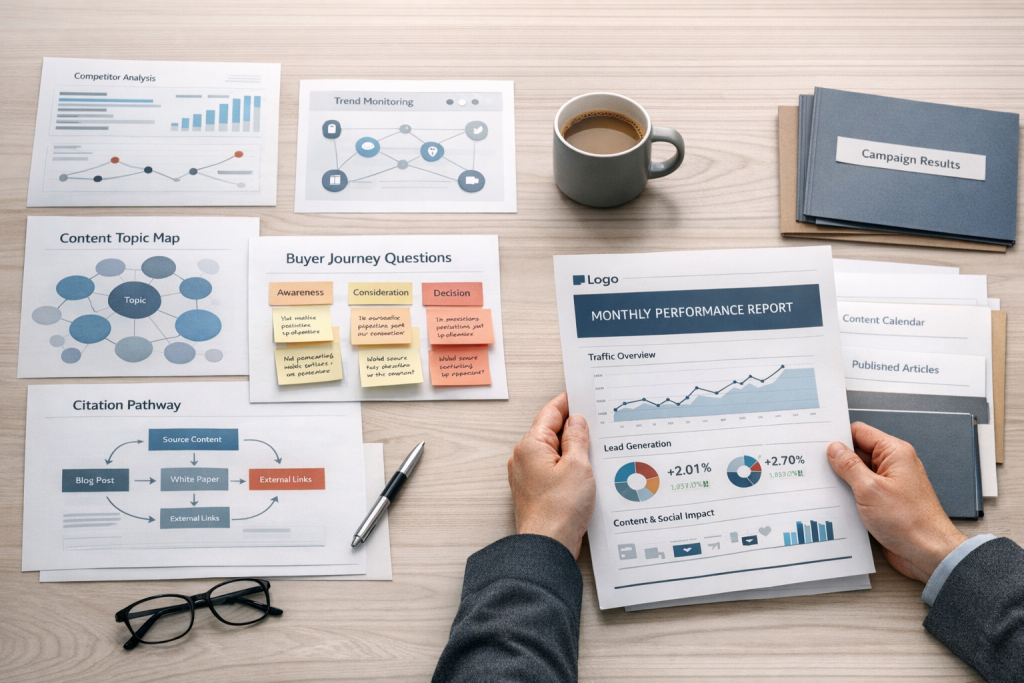
AI Visibility Software vs. Done-for-You Agency: A Practical Decision Guide for Growth Teams
The choice between an AI visibility software platform and a done-for-you agency comes down to a single operational question: does your team have the capacity to act on what the data surfaces, or do you need someone to handle that work for you? Software delivers dashboards and monitoring. An agency delivers execution — the research, content creation, publishing, distribution, tracking, and reporting — without adding a new workflow to your team’s plate.
If your organization already has a content strategist with hands-on AI search experience, a functioning publishing workflow, and genuine bandwidth for a new channel, a software platform can be a worthwhile investment. If your team is already stretched across paid search, SEO, and day-to-day operations — and no one internally has worked through how AI engines decide what to cite — a managed agency removes the bottleneck that software alone cannot address.
This guide explains what each option actually requires at the execution level, surfaces the hidden costs that most comparison articles skip over, and gives you a concrete framework for identifying which path fits your organization’s real situation.
What AI Visibility Work Actually Involves
AI visibility describes whether and how your brand surfaces when buyers use AI search engines — ChatGPT, Google Gemini, Claude, Perplexity — to find recommendations, compare providers, or get answers in your category. When a prospective customer asks an AI engine something like best HVAC company in Phoenix or top wealth management firms for business owners, the system generates a response that may name specific brands, link to specific pages, or leave your business out entirely.
The work involved in improving where your brand lands in those responses is sometimes called Generative Engine Optimization, or GEO. It shares some DNA with traditional SEO, but the execution differs in ways that matter significantly when you are deciding who should do it.
How AI Search Engines Decide What to Cite
AI search engines draw on crawled web content to construct their answers. The exact mechanics differ by platform, but the underlying pattern holds across most: the system pulls content from indexed sources, weighs relevance and authority signals, and assembles a response that may include citations, links, or brand mentions. This retrieval-and-generation process is what determines whether your brand appears or gets passed over.
For your business, the practical implications are straightforward: the AI engine has to find your content, make sense of what it says, conclude that it is relevant and credible, and decide it belongs in the answer. That means your content needs to exist, be crawlable, be clearly organized, directly address the questions buyers are actually asking, and carry enough authority to compete with other sources covering the same ground.
Why Traditional SEO Skills Only Partially Transfer
A strong Google ranking does not automatically carry over into AI citations. Businesses with well-developed SEO programs regularly discover they are absent from AI-generated recommendations in their own category. The reasons vary: the content may not be structured in a way that supports clean extraction, it may not speak directly to the queries AI systems are processing, or it may lack the kind of concise, clearly framed explanations that AI engines tend to pull into responses.
AI visibility work calls for a different approach to content research, a different structural logic, and a different measurement framework than traditional SEO. This is the first factor that reshapes the software-versus-agency calculation. The people doing the work need to understand not just how buyers search, but how AI systems retrieve, evaluate, and assemble answers from across the web.
What an AI Visibility Software Platform Actually Does
AI visibility software platforms are fundamentally monitoring and measurement tools. They let you observe how your brand appears across AI search engines, run prompt tests to see which sources get cited, measure your share of voice against competitors, and follow changes through a dashboard over time.
Monitoring and Tracking Across AI Platforms
Most platforms offer multi-engine tracking in some form. You can observe whether your brand is mentioned, cited, or linked in responses from ChatGPT, Gemini, Perplexity, and sometimes Claude or Google AI Overview. Some platforms let you configure recurring prompt tests that simulate buyer queries and log what appears in the results over time.
Prompt Testing and Share-of-Voice Measurement
Prompt testing involves querying AI engines with the kinds of questions your buyers would realistically ask, then recording which brands show up in the response. Share-of-voice measurement tracks how frequently your brand appears relative to competitors across a defined set of queries. Both features are useful for establishing a baseline and identifying where the gaps are largest.
What the Data Tells You and What It Does Not Do for You
This is where the distinction becomes consequential. A software platform can show you that your brand is absent when someone asks an AI engine for the leading provider in your category. It can show you which competitors are appearing instead. It can show you which queries are producing the most significant visibility gaps.
What it cannot do is close those gaps. The platform does not investigate why competitors are being cited and you are not. It does not develop the content designed to address those buyer questions. It does not optimize your existing pages for AI extractability. It does not publish anything to your website, push content through social channels, or follow up to see whether new content changes your citation patterns. Every one of those steps is execution work, and it falls entirely on your team.
What a Done-for-You AI Visibility Agency Actually Does
A done-for-you agency takes on the execution that software leaves in your hands. The agency manages research, strategy, content creation, publishing, distribution, tracking, and reporting as a coordinated monthly process. Your team reviews deliverables and weighs in on direction rather than managing workflows, coordinating freelancers, or maintaining publishing calendars.
Audits, Buyer-Question Research, and Content Strategy
The engagement begins with an AI visibility audit: a structured review of where your brand currently appears, where it is absent, which buyer questions are driving the largest gaps, and which competitors are being cited in the spaces you are missing. The audit produces a documented baseline rather than an educated guess.
From there, the agency conducts buyer-question research to map the specific queries your target customers are directing at AI engines. These are not repurposed keyword lists. They are the actual questions that generate AI-driven recommendations in your category. The content strategy is built around systematically closing those specific gaps.
Content Creation, Publishing, and Distribution
A full-service agency produces the articles designed to address those buyer questions, publishes them directly to your WordPress site, and distributes them through your social channels. The content lives on your domain, builds your owned content library, and is structured for AI readability from the outset.
This is the step most organizations underestimate. Producing a single article that is genuinely useful, logically structured, clearly responsive to a buyer question, and formatted for AI extraction involves research, writing, editing, schema markup, internal linking, and publishing coordination. Sustaining that output month after month is a meaningful operational commitment.
Ongoing Tracking, Competitive Intelligence, and Reporting
Once content is live, the agency monitors citation patterns across major AI platforms, tracks how competitors appear in the same query spaces, and delivers performance reporting on a regular schedule. At CiteHarbor, that reporting arrives as a branded PDF sent directly to the client — not another dashboard requiring a login and independent interpretation.
That difference is worth naming clearly. A dashboard requires someone on your team to open it, work out what the data means, decide what to do about it, and then actually do it. A managed reporting process delivers the interpretation and the recommended next steps together, in a format that does not require any of that internal effort.
The Execution Gap: The Real Decision Driver
Most comparisons of software versus agency frame the decision around price, control, or headcount. Those factors matter, but they are not the central issue. The central issue is the execution gap: the distance between having AI visibility data in front of you and actually doing something productive with it.
What Acting on AI Visibility Data Actually Requires
Imagine your monitoring platform reveals that your brand is absent from AI responses for the ten buyer questions that matter most in your category. Turning that finding into improved visibility requires someone on your team to:
- Diagnose why competitors are appearing and your brand is not
- Map the specific buyer questions and the content patterns AI engines are drawing from
- Build a content strategy that targets those gaps with original, well-structured material
- Write or commission each article with AI extractability as a design requirement
- Publish each article with proper formatting, schema markup, and internal linking in place
- Push the content through social channels to generate additional authority signals
- Track whether the published content shifts your citation patterns over the following weeks
- Revise the strategy based on what is and is not producing movement
- Repeat the entire cycle every month as buyer questions evolve and competitors continue publishing
That is not a one-time project. It is a recurring operational workflow that requires AI search expertise, content strategy capability, publishing infrastructure, and sustained attention across every cycle.
Why Most Teams Underestimate the Ongoing Workload
Organizations that already manage paid search, SEO, email, and social media understand what it feels like when marketing workflows pile up. Each new channel brings another set of dashboards, another reporting rhythm, another decision loop, and another cluster of tasks competing for the same finite team bandwidth.
AI visibility is not an exception to that pattern. When a team is already at capacity, adding a software platform produces more data without producing more ability to act on it. The platform becomes another browser tab that stays open but rarely gets used, another login that slides toward the bottom of the priority list, another source of information that generates awareness of problems without generating solutions to them.
That is not a knock on software platforms. They are legitimate tools. But a tool sitting unused does not move the needle.
When Software Is the Right Choice
Software platforms are well suited to organizations that already have the internal infrastructure to convert what the platform surfaces into action.
The Team Profile That Benefits Most from Software
- You have a dedicated content strategist or SEO lead with real bandwidth to take on a new channel
- That person already understands how AI search engines retrieve and cite content, or has the time and motivation to develop that understanding
- Your team has a dependable content production process in place — writing, editing, publishing, and distribution are not current bottlenecks
- You want direct, real-time control over prompt testing, query selection, and competitive monitoring
- Your content volume is high enough that self-managed monitoring is more efficient than outsourcing the tracking component
What You Need in Place Before Software Pays Off
A software platform generates value when the team using it can close the full loop: observe the data, interpret it accurately, develop a response plan, carry out that plan, and measure what happened. If any part of that loop is broken, the platform becomes an expensive source of insights that never get acted on.
Before committing to a platform, take an honest look at whether your team has the AI search expertise to interpret what the data means, the content production capacity to respond to what it shows, and the operational discipline to keep the workflow running month after month alongside everything else already on the calendar.
When a Done-for-You Agency Is the Right Choice
A managed agency is the right fit when the execution gap is real and the team cannot close it with what is currently available internally.
The Team Profile That Benefits Most from an Agency
- Your team is already running multiple marketing channels and does not have room for another workflow
- No one internally has worked directly with AI search behavior, citation patterns, or GEO content strategy
- Past content investments produced blog posts that got no traction and delivered results no one could explain or measure
- You want AI visibility to move forward without acquiring another dashboard, another freelancer relationship, or another recurring meeting
- Your business competes in a local or professional-services category where AI-generated recommendations have a direct influence on which providers buyers contact
- You want performance reporting delivered to your inbox rather than a login you need to remember to check
What to Look for When Evaluating an AI Visibility Agency
Not every agency advertising AI visibility services actually performs the full scope of execution. When you are evaluating options, ask pointed questions about what the workflow actually includes:
- Does the agency begin with a documented AI visibility audit that establishes a clear baseline?
- Does the agency conduct buyer-question research specific to your category and geographic market?
- Does the agency produce original content built for AI citation, or repackage generic SEO blog posts?
- Does the agency manage WordPress publishing and social distribution, or hand drafts back to your team to handle?
- Does the agency track citation patterns across multiple AI platforms on a monthly basis?
- Does the agency monitor how competitors appear in AI responses in your space?
- Does the agency deliver clear performance reports, or expect you to pull data from yet another dashboard?
The gap between a monitoring service and a full-service agency is the gap between being told what is broken and having someone fix it.
The Hybrid Path: Using Both Together
Some organizations run a software platform alongside a managed agency, and that combination can work well when the conditions support it.
How Software and Agency Work Complement Each Other
A platform can supply real-time prompt testing and competitive alerts that fill in the space between an agency’s monthly reporting cycles. The agency handles strategic interpretation, content production, and execution, while the platform gives the internal team a way to stay connected to the data without being responsible for acting on it. This arrangement works best when the internal team is engaged enough to review what the platform surfaces but does not need to own the response.
How to Phase the Transition If You Want to Build Internal Capability
Some teams begin with a done-for-you agency to establish a documented baseline, build an initial content library, and develop a working understanding of what the AI visibility workflow actually demands. As internal expertise grows over time, parts of the workflow can shift in-house, with software taking over the ongoing monitoring function. That phased approach limits the risk of investing in a platform before the team has the knowledge to use it well.
A Practical Decision Framework
Use this framework to assess which path fits your organization’s real situation. Answer each factor honestly. The goal is not to validate a conclusion you have already reached — it is to see clearly where your team actually stands.
| Factor | Software Platform May Fit | Done-for-You Agency May Fit |
|---|---|---|
| Internal AI search expertise | At least one team member has working knowledge of AI citation behavior and GEO content strategy | No one on the team has direct experience with AI visibility work |
| Content production capacity | The team can reliably produce, edit, and publish two or more optimized articles per month | Content production is already a bottleneck or depends on inconsistent freelance arrangements |
| Operational bandwidth | The team has genuine capacity to absorb a new marketing workflow | The team is at or near capacity across existing channels |
| Dashboard tolerance | The team actively consults existing analytics and reporting tools | Current dashboards are underused or rarely opened |
| Reporting preference | The team prefers direct data access and real-time monitoring | The team prefers interpreted reports delivered on a predictable schedule |
| Previous content investments | Past content programs produced measurable outcomes and developed internal capability | Past content investments felt like unclear spend with little to show for them |
When most of your answers land in the right column, the execution gap is your primary constraint. A managed agency addresses that constraint directly. When most answers land in the left column, a software platform equips your capable team with the data it needs to move independently.
What CiteHarbor Does Differently
CiteHarbor is built for the right column. The entire service is designed to remove the management overhead of AI visibility so that growth teams, business owners, and marketing leaders can build AI-search presence without acquiring another dashboard, another content calendar, or another internal workflow to maintain.
Here is what that looks like in practice:
- AI visibility audits document where your brand currently appears across ChatGPT, Gemini, Claude, Perplexity, and Google AI Overview — and where it is absent
- Buyer-question research identifies the specific queries your customers are directing at AI engines in your category
- Targeted article creation produces content built to address those buyer questions with structure designed for AI readability
- WordPress publishing and social distribution are handled entirely by CiteHarbor, so content goes live and reaches your audience without requiring your team to manage the process
- Monthly citation tracking monitors your brand’s presence across major AI platforms against a documented baseline
- Competitor citation monitoring shows how your brand’s visibility compares to others operating in your market
- Branded PDF performance snapshots deliver clear monthly reporting with no login required
The result is a managed monthly execution process. Your team reviews direction and approves content. CiteHarbor handles everything else.
Frequently Asked Questions
What is AI visibility and why does it matter for my business?
AI visibility is whether your brand appears when prospective customers ask AI search engines like ChatGPT, Gemini, Claude, or Perplexity for recommendations in your category. As more buyers turn to AI tools to research providers, weigh options, and reach decisions, the brands that surface in those responses gain a meaningful advantage in the discovery process. AI visibility matters because it represents a growing layer of buyer discovery that traditional SEO and paid search do not fully reach.
What does an AI visibility software platform actually track?
Most platforms monitor brand mentions and citations across AI search engines, allow you to test specific prompts and queries, measure share of voice relative to competitors, and surface trends through a dashboard over time. The platform provides data and observation. It does not perform the content strategy, writing, publishing, or distribution work required to improve what the data reveals.
How much internal time does AI visibility require if we use software?
Plan for a substantial ongoing commitment. Beyond time spent in the platform itself, turning the data into results requires buyer-question research, content strategy, content production, publishing, distribution, and follow-up measurement. For most teams, that adds up to several hours of skilled work each week, sustained month after month. Without that capacity in place, the data accumulates without producing any change.
Can we start with software and switch to an agency later?
Yes. Some organizations begin with a monitoring platform to get a read on their current AI visibility position, then bring in a managed agency once the execution workload proves larger than internal resources can absorb. The key consideration is that time spent observing without acting is time during which competitors may be actively building their own AI-search presence.
What should we look for when evaluating an AI visibility agency?
Look for an agency that covers the full execution scope, not just the monitoring layer. Ask whether the agency conducts audits, researches buyer questions, creates original content, publishes directly to your website, handles social distribution, tracks citations monthly, monitors competitors, and delivers clear reports. If the agency hands you a dashboard and expects your team to manage what comes next, you are purchasing software with a service label — not done-for-you execution.
How long does it take to see changes in AI visibility?
AI visibility builds through sustained, compounding effort rather than single interventions. Content must be published, crawled, indexed, and then retrieved by AI systems as they process relevant queries. How quickly that happens depends on your category, the level of competition, and the current state of your content. What matters most is establishing a documented baseline and tracking movement against it over time, rather than expecting any single article to produce immediate shifts.
Is AI visibility different from traditional SEO?
It overlaps with SEO but operates differently. Strong fundamentals — crawlability, content quality, site structure, domain authority — still carry weight. But AI search engines construct answers through a retrieval-and-generation process that differs from how traditional search engines rank and display results. AI visibility work requires content structured for extraction, buyer questions mapped against AI query behavior, and measurement across multiple AI platforms rather than Google rankings alone.
How to Move Forward
The choice between software and agency is not theoretical. It depends on whether your team can realistically close the gap between knowing where your brand is absent and doing the work required to change that. If the honest answer is that your team lacks the bandwidth, the specialized expertise, or the appetite for another operational workflow, a managed partner removes that constraint entirely.
CiteHarbor manages AI visibility auditing, buyer-question research, article creation, WordPress publishing, social distribution, citation tracking, competitor monitoring, and monthly performance snapshots. No dashboards to log into. No freelancers to coordinate. No content calendar to maintain.