How GEO Helps B2B SaaS Companies Build Category Association in AI Search
Learn how Generative Engine Optimization helps B2B SaaS companies build category association in AI search through entity relationships, definitional content, and third-party validation. The article outlines the core mechanisms, limitations, and a practical phased approach for marketing teams.
How GEO Helps B2B SaaS Companies Build Category Association in AI Search
Generative Engine Optimization can help a B2B SaaS company become associated with a new category — but the mechanism is not what most marketing teams picture. GEO does not create categories. It builds the information infrastructure that teaches AI systems what a category is, which problems it solves, and which companies belong at its center. That distinction shapes everything about how the work actually gets done.
If you are a product marketing leader, CMO, or demand generation director at a B2B SaaS company working to define or enter an emerging category, this article explains how GEO-driven category association works, which content strategies support it, what its real limitations are, and what a grounded execution path looks like.
Why Traditional SEO Cannot Build Category Association for a New Space
No search volume means no keyword signal
Traditional SEO is built on existing demand. The workflow is familiar: find keywords with volume, produce content that matches search intent, and compete for page-one placement. When a category is new or still forming, that demand simply does not exist. There are no established keywords, no meaningful comparison queries, and no high-volume searches tied to the category name that Google can match against your pages.
This is the structural problem product marketing teams run into when they apply conventional SEO logic to category creation. The terms your category will eventually own carry no traffic yet, so ranking for them produces nothing in the near term. And ranking for adjacent, higher-volume terms does not establish the specific connection between your brand and the emerging category you are trying to define.
AI systems form category associations through a different process than search ranking
Search algorithms evaluate individual pages against specific queries. AI systems operate differently: they develop a working understanding of relationships between entities — companies, products, problems, industries, and categories — and draw on those relationships when generating answers.
When a buyer asks ChatGPT, Gemini, Perplexity, or Claude something along the lines of what the best tools are for a given problem, or how to approach a challenge your category addresses, the AI system does not return a ranked list of pages. It produces a synthesized answer drawn from patterns across many sources. If your brand has not contributed to those patterns — through consistent, structured, independently validated content — the AI system has no basis for connecting your company to the category.
This is where GEO becomes relevant. It is not a replacement for traditional SEO. It is a separate discipline built for a different kind of discovery.
What GEO Actually Does for Category Association
It constructs the entity relationships AI systems use to understand markets
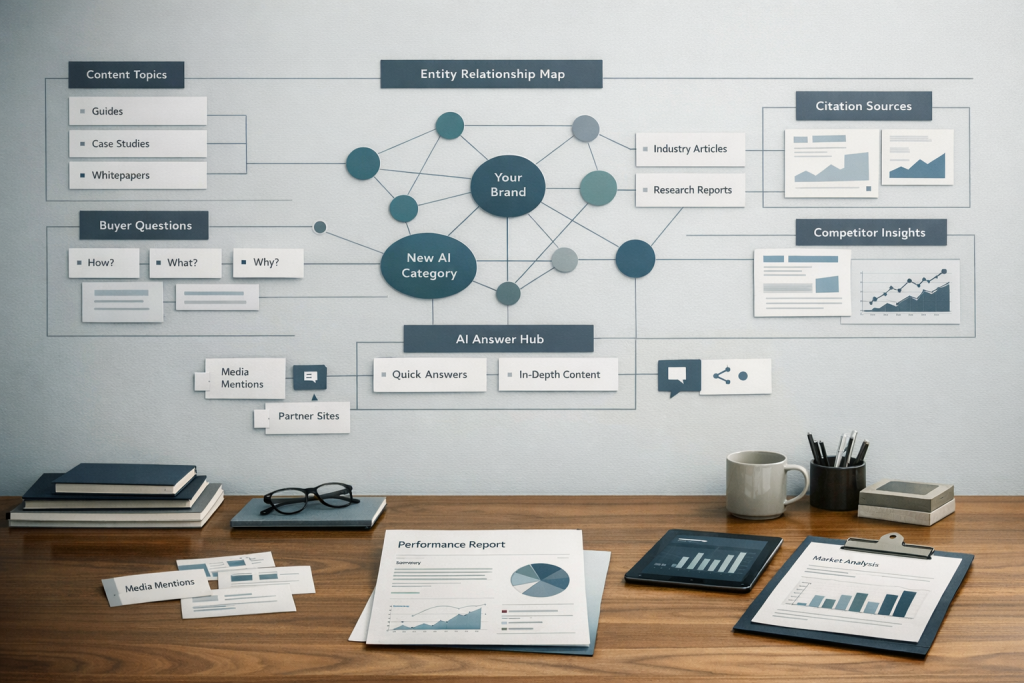
AI systems develop their picture of a market through entity relationships — the connections between your company, your product, the problem it addresses, the category it occupies, the audience it serves, and the alternatives a buyer might weigh. When those relationships are expressed clearly and consistently across your owned content, AI systems can begin to map them.
GEO-driven category association is the deliberate work of building those entity relationships so AI systems learn to connect your brand with the category you are defining. This is not about gaming an algorithm. It is about creating the informational conditions under which an AI system can accurately represent your company’s position in the market.
It produces the definitional content AI systems draw on when describing a new space
When a category is still forming, AI systems need sources to learn from. Publishing clear, well-organized content that defines the category, explains the problems it addresses, describes how solutions in the space function, and situates your company within that context gives AI systems the raw material they draw on when generating answers about the category.
This is what separates GEO for category association from conventional content marketing. The objective is not simply to attract readers. It is to produce content that AI systems can learn from, extract from, and surface when answering buyer questions about your space.
It builds the cross-source agreement that AI systems treat as validation
AI systems do not rely on a single source. Before treating an association as credible, they look for agreement across multiple independent sources. If only your own blog places your company in a particular category, that signal is thin. If industry publications, community discussions, third-party reviews, and partner content all describe your company in the context of that category, the signal carries far more weight.
GEO includes the work of earning those independent mentions and co-citations. This is distinct from link building in the traditional SEO sense. It is about accumulating the cross-source evidence that AI systems read as market-level confirmation of your category position.
The Five Mechanisms of GEO-Driven Category Association
Category association through GEO is not a single tactic. It is a set of coordinated mechanisms that reinforce each other over time. Here is how they fit together for a B2B SaaS company entering or defining a new space.
1. Definitional content publishing
Publish content that establishes what the category is, where its boundaries sit, which problems it addresses, and how it differs from adjacent categories. This content should use consistent terminology, explain the category in language that both buyers and AI systems can parse, and position your company as a knowledgeable participant in the space — not merely a vendor, but a source that understands the category well enough to explain it clearly.
Definitional content serves as the foundation because AI systems need sources to learn from. When your company is the clearest and most consistent source of category-defining material, you become a more likely reference when AI systems generate answers about the space.
2. Entity consistency across every surface
Every piece of content your company publishes — blog posts, product pages, social media, press mentions, guest articles — should describe the relationship between your brand, your product, the category, and the underlying problem in a consistent way. Inconsistent descriptions create conflicting signals that weaken the entity relationship you are working to establish.
Entity consistency means applying the same category terminology, the same problem framing, and the same positioning language across your website, your social channels, your distribution platforms, and any external content that carries your brand. This is not rigid repetition for its own sake. It is coherent, aligned messaging that AI systems can recognize as a stable and reliable pattern.
3. Third-party co-citation
Co-citation occurs when independent sources reference your brand alongside the category term or alongside other recognized companies in the space. AI systems treat these independent mentions as evidence that the association reflects market reality rather than self-promotion.
Earning co-citations requires work beyond your owned content: contributing to industry conversations, publishing original research that others find worth referencing, participating in community discussions, and building relationships with analysts, reviewers, and publishers who cover adjacent topics. This is the most demanding mechanism to execute because it depends on external validation rather than internal content production.
4. Comparison and alternative content
Buyers exploring emerging categories often search by symptom or pain point rather than by category name. They ask how to solve a specific problem or what alternatives exist to a current approach. These are the queries where category association takes shape.
Producing content that addresses these comparison and alternative questions — with genuine substance, not surface-level coverage — places your brand within the decision landscape that AI systems synthesize from. When an AI system generates an answer about approaches or alternatives for a given problem, your content becomes a candidate for inclusion if it clearly addresses the question and frames your category as a relevant solution path.
5. Proprietary frameworks and original data
AI systems give more weight to content that contributes original value than to content that restates what is already widely available. Proprietary frameworks, original research, named methodologies, and unique data points produce content that AI systems are more inclined to reference because the information exists nowhere else.
For a B2B SaaS company building category association, this might mean publishing your own analysis of the problem your category addresses, developing a named framework for evaluating solutions in the space, or sharing aggregated and compliant data about the conditions driving category adoption. This kind of original content becomes a standing reference point that AI systems return to when answering related questions.
What GEO Cannot Do — The Honest Limitations
GEO is a meaningful mechanism for category association, but it has real boundaries. Understanding those boundaries is essential for setting honest expectations and building a program that delivers genuine value rather than unfounded optimism.
GEO cannot manufacture market demand
If the problem your category addresses is not real or pressing enough to prompt buyers to look for solutions, no volume of GEO content will generate demand. GEO extends and amplifies an existing market education effort. It does not substitute for a genuine buyer need.
GEO cannot substitute for a real customer problem
Category association through AI systems requires that the category itself is legitimate — meaning it addresses a distinct, recognizable problem that buyers actually experience. If the category is primarily a marketing construct without a corresponding buyer pain point, AI systems will not find enough cross-source evidence to validate the association, because the broader market will not be producing content about the problem in the first place.
GEO cannot displace a much stronger existing signal footprint overnight
If a competitor has spent years publishing category-defining content, has accumulated extensive third-party validation, and maintains a deep library of structured and consistent material, a new GEO program will not overtake that position in a matter of weeks or months. Category association through GEO compounds over time. How quickly signals accumulate depends on the competitive landscape, the depth of your content program, and the pace at which you earn external validation.
No agency, including CiteHarbor, can guarantee specific AI citation outcomes, recommendation placements, or a defined timeline for category association. What a well-executed GEO program can do is systematically build the content conditions that improve your brand’s likelihood of appearing when AI systems answer questions about your space.
A Phased Approach to GEO-Driven Category Association
Category association is not a single campaign. It is a staged process that deepens and broadens over time. Here is a realistic phased approach for a B2B SaaS company.
Phase 1: Establish the concept through owned content
The first phase is focused on your owned content — your website, your blog, your product pages, and your social channels. The objective is to build a clear, consistent, well-structured body of content that defines the category, explains the problems it addresses, and positions your company within the space.
- Publish a category-defining article that explains the space in plain, accessible language
- Create supporting articles that address the buyer questions tied to the category’s core problems
- Ensure product pages, about pages, and service descriptions all use consistent category terminology
- Implement structured data — Article schema, FAQ schema where appropriate — to help search engines and AI systems interpret the content
- Build internal links between category content to establish a clear topical cluster
This phase creates the informational foundation that AI systems can begin drawing from. Without it, there is nothing for AI systems to extract or reference.
Phase 2: Seed external validation
The second phase moves beyond owned content to develop the cross-source agreement that AI systems use as validation.
- Publish original research, proprietary data, or named frameworks that third parties may find worth referencing
- Contribute to industry publications, podcasts, or community discussions where your category is relevant
- Build relationships with reviewers, analysts, or independent publishers who cover adjacent topics
- Monitor whether your content is being cited or referenced by external sources
- Distribute content through social channels to expand its reach across the web
This phase is slower and harder than Phase 1 because it depends on external parties choosing to reference your content and your brand. It is also essential, because AI systems assign more weight to independent mentions than to self-published claims.
Phase 3: Monitor, measure, and adjust
The third phase is ongoing: observing how AI systems respond to your category-defining content and refining the program based on what you see.
- Query AI systems regularly using the buyer questions your content targets, and document how your brand, category, and competitors appear in the responses
- Track shifts in which brands AI systems mention when answering category-level questions over time
- Identify gaps where your content is not being surfaced and develop targeted content to fill them
- Refresh existing content when market conditions, best practices, or competitor positioning change
- Note whether AI systems are adopting the category terminology you have defined in their response language
This phase turns GEO from a content project into a living visibility program. Without ongoing monitoring, there is no way to know whether the effort is producing results or where adjustments are needed.
How to Know If It Is Working
Measuring GEO-driven category association requires different signals than traditional SEO performance. The indicators that matter are not rankings or organic traffic in isolation — they are observable changes in how AI systems describe your brand, your category, and your competitors.
Here are the signals worth tracking:
- Brand mention presence: Is your brand appearing in AI-generated answers to category-relevant buyer questions? This is the most direct indicator of association.
- Category terminology adoption: Are AI systems using the category language you have defined, or defaulting to different terminology? When your framing is adopted, your definitional content is having an effect.
- Competitor framing: How are AI systems describing your competitors within the same category? Are they being included, excluded, or positioned differently than your brand?
- Buyer-question coverage: Are your articles being surfaced as sources when AI systems answer the specific buyer questions your content was built to address?
- Citation consistency: Is your brand appearing across multiple AI platforms, or only in one? Broader presence reflects stronger cross-source signals.
These are not vanity metrics. They are observable indicators of whether the information infrastructure you are building is reaching the systems that shape how buyers discover and evaluate solutions in your space.
How AI Share of Voice Differs from Keyword Ranking
B2B SaaS teams accustomed to traditional SEO tend to think about visibility through the lens of keyword rankings — a position for this term, a position for that one. AI visibility does not work that way.
In AI-generated answers, there is no ranked list of links. There is a synthesized response that may name specific brands, reference specific sources, or describe a category without mentioning any particular company at all. Your brand either appears in the answer or it does not. And when it does appear, the framing matters — are you described as a recognized player, an alternative worth considering, an illustrative example, or a passing mention?
This is why tracking AI citation patterns is a fundamentally different discipline from monitoring keyword rankings. It requires querying AI systems directly, recording the responses, observing how they shift over time, and comparing your brand’s presence against competitors across multiple AI platforms.
For most B2B SaaS marketing teams, this monitoring work adds to an already full operational load alongside existing SEO, content, and demand generation responsibilities. It requires consistent execution over time, not periodic spot-checks.
What This Means for Teams Managing This Without Dedicated Resources
The strategic case for GEO-driven category association becomes clear to most B2B SaaS marketing leaders once they understand how AI search is reshaping buyer discovery. The harder question is always execution.
A serious GEO program for category association requires ongoing buyer-question research to understand what AI systems are being asked about your space. It requires consistent content creation — not generic posts, but targeted articles built to answer specific buyer questions in a form that AI systems can extract and surface. It requires publishing and distribution to ensure that content reaches the places AI systems draw from. It requires competitive monitoring to understand how your brand’s AI visibility compares to others in the category. And it requires regular tracking and reporting to know whether the program is producing results and where to adjust.
That is a substantial operational commitment. Many B2B SaaS teams already managing dashboard fatigue, tool sprawl, and the demands of their existing marketing programs find it difficult to sustain this kind of effort internally — particularly when it calls for a different skill set than traditional SEO or content marketing.
This is why CiteHarbor operates as a full-service AI visibility partner rather than a software dashboard. CiteHarbor manages the complete workflow: initial AI visibility auditing, buyer-question research, targeted content creation, WordPress publishing, social media distribution, competitor citation monitoring, and branded monthly performance snapshots delivered as a PDF — not another login to manage. Your team does not need to adopt a new platform, bring on a new contractor, or develop a new internal capability. The research, content, publishing, distribution, tracking, and reporting are handled by one partner.
For B2B SaaS companies that recognize the strategic importance of category association in AI search but cannot absorb another operational burden, this is the model that removes the management overhead from AI visibility.
Frequently Asked Questions
What does Generative Engine Optimization actually do for a B2B SaaS company?
GEO is the practice of creating and structuring content so that AI-powered search systems — including ChatGPT, Google Gemini, Perplexity, and Claude — can understand, extract, and potentially surface it when generating answers to buyer questions. For a B2B SaaS company, this means building content that speaks directly to what your buyers are asking AI systems, organized in a way those systems can parse and draw from. The objective is to strengthen your brand’s presence in AI-generated answers, which is increasingly where B2B buyers begin evaluating solutions.
How is GEO different from traditional SEO for category creation?
Traditional SEO targets existing search demand through keyword optimization and ranking improvements. GEO targets AI-generated answers by developing the entity relationships, content consistency, and cross-source validation that AI systems use to form associations between brands, problems, and categories. For category creation specifically, GEO addresses the structural gap that traditional SEO cannot: when a category is new, there is no keyword volume to rank for. GEO builds the informational conditions that teach AI systems what the category is and which companies belong in it.
How long does it take for GEO to influence how AI systems describe a brand?
There is no guaranteed timeline. Observable shifts depend on the competitive landscape, the depth and consistency of your content program, the pace at which you earn external validation, and how frequently AI systems incorporate new information about your space. Most B2B SaaS teams should plan for a sustained program measured in months before seeing meaningful changes in how AI systems describe their brand within a category context.
What happens if a company does nothing and lets AI systems define the category without them?
AI systems will form a category definition from whatever signals are available in their training data and accessible web content. If your company has not contributed to that signal pool — through consistent, structured, well-distributed content — the resulting definition will reflect your competitors’ framing, generic descriptions, or incomplete information. The risk is not that AI systems will describe your company negatively. The risk is that they will not describe your company at all when buyers ask about the category.
Which product-comparison prompts should SaaS teams track?
Focus on the buyer questions that correspond to your category’s core decision points. These typically include questions about the best tools for a given problem or category, how your category compares to adjacent approaches, what to look for when evaluating solutions in the space, and what options exist for a specific pain point. Document how AI systems respond to these prompts, which brands they mention, and how those responses evolve over time. This monitoring is one of the most direct ways to assess whether your GEO program is producing category association.
Can GEO work for a company repositioning into an existing category, not just creating a new one?
Yes. The same mechanisms apply. The difference is that a repositioning effort must work against associations AI systems have already formed. If AI systems currently place your company in a different category, your GEO content must consistently reframe the brand-to-category relationship across enough sources and over enough time for those existing associations to shift. This typically requires more content, more external validation, and more patience than establishing a position in a category where no prior associations exist.
Conclusion
GEO can help a B2B SaaS company become associated with a new category — but only when you understand what GEO actually is and what it is not. It is not a shortcut. It is not a ranking tactic adapted for AI systems. It is the deliberate work of building the information infrastructure that teaches AI systems what your category is, which problems it addresses, and why your company belongs in the conversation.
That work requires buyer-question research, targeted content creation, consistent publishing and distribution, competitive monitoring, and ongoing tracking across multiple AI platforms. It is real operational work, and its effects compound over time.
If your team is ready to build AI category association but needs a partner who handles the research, content, publishing, distribution, tracking, and reporting without adding another dashboard or workflow to manage, start your 2-week free trial — no credit card required.