How to Track Perplexity Citations and Brand Mentions Over Time
Learn how to measure Perplexity brand mentions and citations over time using fixed prompts, weekly tracking, and practical visibility metrics. This guide is built for marketing and SEO teams that need a repeatable way to monitor AI-search visibility and turn the data into content decisions.
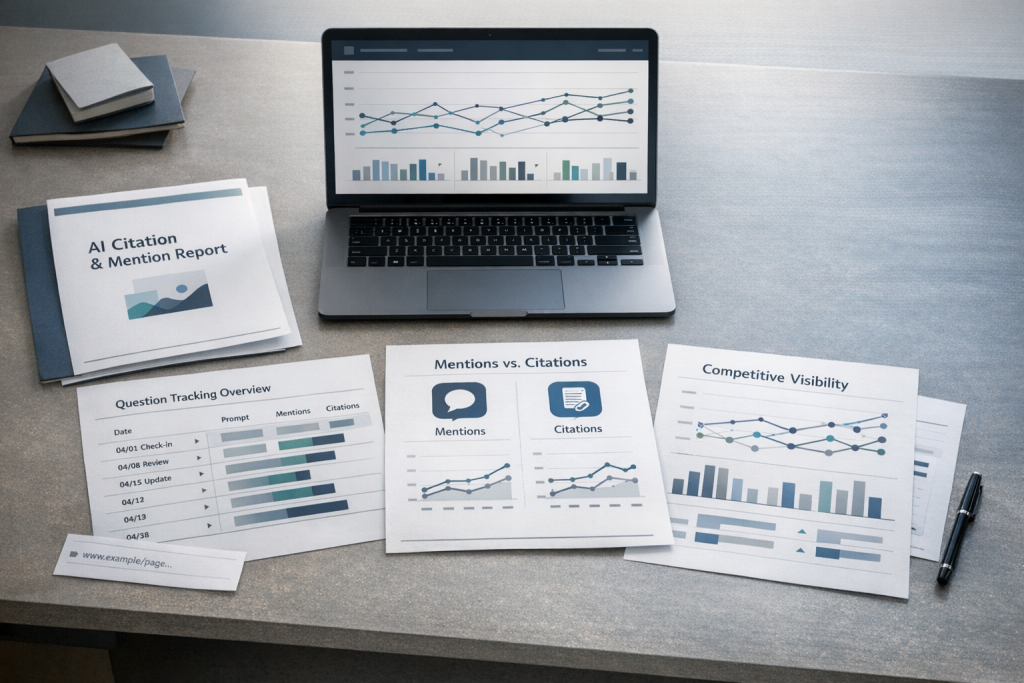
How to Track Perplexity Citations and Brand Mentions Over Time
Perplexity does not offer a brand dashboard. There is no native analytics view showing how often your company is cited, which pages are referenced, or whether your visibility is improving. If you want to know whether Perplexity is mentioning or citing your brand in its answers, you need to build a tracking system yourself — or have someone build and maintain it for you.
Tracking Perplexity citations is not like monitoring keyword rankings in Google. There is no stable position to hold, no fixed result page, and no rank number to report. What you are actually doing is running a repeating measurement experiment: querying Perplexity with a fixed set of prompts on a consistent schedule, recording what it says about your brand and your competitors, and calculating whether your visibility is moving in the right direction over time.
This article explains the full methodology — how to build a prompt set, what to record on every run, which metrics actually show trends, and how to turn tracking data into content decisions. It is written for marketing leaders, SEO directors, content strategists, and B2B product marketers who already understand that AI-search discovery matters and need a practical way to measure it.
Why Perplexity Tracking Is Different From Traditional Rank Tracking
What Perplexity actually does when it answers a question
Perplexity retrieves information from the web, synthesizes it into a conversational answer, and attaches source citations — typically as numbered inline references and a list of source cards below the answer. The answer is generated fresh each time, drawing from whatever sources the system finds most relevant at the moment of the query.
This means the answer to the same question can change from day to day, or even from session to session. Different phrasing of a similar question can produce different source citations. A brand that appears in today’s answer may not appear in tomorrow’s, and vice versa.
Why the same prompt can produce different results on different runs
Traditional search rankings update, but they tend to be relatively stable over short periods. Perplexity answers are more variable because the system is performing real-time retrieval and synthesis, not returning a cached index. The web content it finds, the way it interprets the query, and the sources it selects can all shift between runs.
This variability is exactly why tracking requires repeated measurement over time, not a single snapshot. One query on one day tells you almost nothing. Twenty queries repeated weekly for eight weeks starts to reveal actual patterns.
What you are actually measuring: mentions, citations, and position
When you track your brand in Perplexity, you are measuring three distinct things:
- Brand mention: your brand name appears in the generated answer text, but Perplexity may not link to your website as a source.
- Brand citation: your domain URL appears in the source card list — meaning Perplexity explicitly retrieved and referenced your content.
- Citation position: where your citation appears in the source card list. The first three source cards receive more visibility than cards further down the list.
These are not the same thing. A mention without a citation means Perplexity knows your brand exists but did not use your content as a source. A citation means your actual page was retrieved and referenced. Collapsing these into a single “visibility score” hides the information you need to make decisions.
The Core Distinction: Brand Mentions vs. Brand Citations
What a brand mention means in a Perplexity answer
A brand mention occurs when Perplexity names your company in the text of its answer — for example, “Companies like [Your Brand] offer this type of service.” This indicates that your brand appears in enough web content for the system to associate it with the topic. But a mention alone does not mean Perplexity trusts or uses your content directly.
What a brand citation means and why it is more valuable
A brand citation occurs when Perplexity includes a URL from your domain in its source card list. This is a stronger signal. It means the system retrieved your content, found it relevant enough to use, and linked to it as a supporting source for its answer. Citations are the measurable unit of AI-search visibility in Perplexity.
Why collapsing these into one visibility score hides useful information
| Signal | What it tells you | What it does not tell you |
|---|---|---|
| Brand mention (no citation) | Perplexity associates your brand with the topic | Whether your actual content is being used as a source |
| Brand citation (URL in source cards) | Your content was retrieved and referenced | Whether the answer text prominently features your brand name |
| Citation in top 3 source cards | Your content is among the most prominently referenced sources | Whether users actually click through to your page |
If you only track a combined visibility number, you cannot tell whether your brand is being named but not cited, cited but buried, or prominently cited but declining over time. Each of these situations requires a different response.
Step One: Build Your Tracking Prompt Set
How many prompts you need and what types to include
Start with 20 to 30 prompts. You can expand later, but a smaller, well-constructed set is more useful than a large, unfocused one. The goal is to cover the buyer questions that matter most to your business, not to test every possible query.
Prompt categories that capture different stages of buyer research
A strong prompt set includes four types:
- Category questions: broad queries about your service category. Example: “What are the best options for [your service type] in [your market]?”
- Comparison questions: queries where a buyer is evaluating options. Example: “How do I choose between [option A approach] and [option B approach]?”
- Use-case questions: specific problem or workflow queries. Example: “How do I solve [specific problem your service addresses]?”
- Brand-specific questions: queries that include your brand name or a close competitor category. Example: “What does [your brand] do?” or “Who offers [your specific service]?”
The mix matters. Category and comparison questions show whether Perplexity considers your brand relevant in the broader market. Use-case questions show whether your content addresses the specific problems buyers are searching for. Brand-specific questions show whether Perplexity has enough information about you to answer confidently.
Where to find real prompts your buyers are already using
Start with what you already know:
- Google Search Console queries that drive traffic to your site
- Questions your sales team hears repeatedly
- Questions that appear in your customer support tickets or intake forms
- People Also Ask questions from Google SERPs in your category
- Queries you are already targeting in your SEO or content strategy
Translate these into natural-language prompts. Perplexity responds to conversational phrasing, so a short keyword phrase becomes a full question a real buyer would type. The more natural the prompt, the more representative the results.
Why prompt wording must stay stable across tracking runs
If you change the wording of your prompts between runs, you cannot tell whether differences in the results come from Perplexity’s behavior or from your prompt changes. Lock your prompt set for at least four to six weeks before revising it. When you do revise, add new prompts rather than replacing old ones, so you maintain continuity in your historical data.
Step Two: What to Record on Every Run
The seven data points that matter
For each prompt on each run, record:
- Date: when the prompt was run
- Prompt text: the exact query used
- Brand mentioned: yes or no — did your brand name appear in the answer text?
- Brand cited: yes or no — did a URL from your domain appear in the source cards?
- Cited URL: the specific page URL that was cited, if any
- Citation position: where your source appeared in the source card list (1st, 2nd, 3rd, etc.)
- Competitors cited: which competitor domains appeared in the source cards for that same prompt
Optional but useful additions: the sentiment of how your brand was described (positive, neutral, negative), and whether third-party pages about your brand appeared in the citations even if your own domain did not.
A practical spreadsheet column structure
At its simplest, your tracking sheet looks like this:
Date | Prompt | Brand Mentioned | Brand Cited | Cited URL | Citation Position | Competitor 1 Cited | Competitor 2 Cited | Notes
Each row is one prompt on one date. Over time, this creates a dataset you can filter and analyze by prompt, by date range, or by competitor.
How often to run your prompt set
Weekly is the minimum viable cadence for meaningful tracking. Monthly runs are too infrequent to detect trends. Daily runs produce more data but require more time or automation to manage.
For most B2B teams, a weekly cadence for the full prompt set — with a monthly summary report — strikes the right balance between data quality and operational effort.
Step Three: Calculate the Metrics That Show Trends
Mention rate
Formula: prompts where your brand was mentioned ÷ total prompts run
This tells you how often Perplexity names your brand when answering questions in your category. A mention rate of 40% means your brand appeared in the answer text for 40% of your tracked prompts. Track this number weekly to see whether it is stable, rising, or falling.
Citation rate
Formula: prompts where your domain URL was cited ÷ total prompts run
This is the stronger signal. A citation rate of 25% means Perplexity retrieved and linked to your content for one in four tracked prompts. Citation rate matters more than mention rate because it reflects whether your actual pages are being used as sources, not just whether your brand name is recognized.
Share of voice
Formula: your total citations across all prompts ÷ total citations for all tracked brands across all prompts
Share of voice shows your citation presence relative to competitors. If Perplexity cited ten different domains across your prompt set in a given week, and your domain accounted for three of those citations, your share of voice is 30%. This is a competitive metric — it tells you whether you are gaining or losing ground relative to the market.
Citation velocity: the leading indicator most teams miss
Citation velocity is the rate of change in your citation rate over a defined period. If your citation rate moved from 20% to 28% over six weeks, your citation velocity is positive. If it dropped from 28% to 22%, it is negative.
Citation velocity matters because it is a leading indicator. A single week’s citation rate can fluctuate due to Perplexity’s retrieval variability. But a consistent directional trend over four to eight weeks tells you something meaningful about whether your content strategy is working.
What a meaningful trend looks like versus normal variation
Expect some week-to-week variability. A citation rate that moves from 25% to 22% to 27% over three weeks is not a trend — it is noise. A citation rate that moves from 25% to 28% to 31% to 34% over four consecutive weeks is a trend worth paying attention to.
Look for directional consistency across multiple weeks before drawing conclusions. And compare trends across prompt categories — if your citation rate is rising for use-case questions but falling for comparison questions, that tells you something specific about where your content is strong and where it has gaps.
Step Four: Interpret What the Data Is Telling You
What it means when a competitor is cited instead of you
When Perplexity cites a competitor’s page for a prompt where your brand is absent, it usually means one of two things: the competitor has published content that more directly answers that specific question, or the competitor’s page has stronger authority signals for that topic — more backlinks, more mentions across the web, or more structured coverage of the subject.
This is not a ranking failure. It is a content and authority gap that your tracking data has made visible. Without tracking, you would not know the gap existed.
What the specific cited URLs reveal about content and authority gaps
The most actionable data point in your tracking sheet is the Cited URL column — not yours, but the competitors’. Look at which specific pages Perplexity is pulling from. Are they detailed guides? Comparison pages? FAQ pages? Service pages with strong topical depth?
The answer tells you what type of content Perplexity trusts for that question. If a competitor’s “how to choose” guide is consistently cited for comparison prompts, and you have no equivalent page, that is a clear content gap you can address.
How to connect tracking data to content decisions
Citation tracking is not an end in itself. The purpose of the data is to answer three strategic questions:
- Where are we visible? Which buyer questions already produce citations or mentions for our brand?
- Where are we invisible? Which buyer questions produce zero citations and zero mentions — and are competitors filling that space?
- What content would close the gap? For the prompts where we are absent, what kind of content would need to exist on our domain to be a credible source?
These three questions connect tracking directly to content strategy. Instead of publishing articles based on a content calendar, you are publishing articles designed to close specific AI-visibility gaps that your tracking data has identified.
When Manual Tracking Stops Being Practical
The scale threshold where manual tracking breaks down
Manual tracking works well for a focused prompt set of 20 to 30 queries run once a week. That is roughly 30 minutes to an hour of work per week, depending on how thorough your recording process is.
Once you scale beyond 50 prompts, add multiple AI platforms (Perplexity, ChatGPT, Gemini, Claude), or want to track at a daily cadence, manual tracking becomes a significant operational burden. The data entry alone can consume hours, and inconsistencies in how different team members record data make trend analysis unreliable.
What to look for in a systematic tracking approach
Whether you use an internal system, a dedicated tool, or a managed service, the approach should meet these requirements:
- Runs a fixed prompt set on a consistent schedule
- Records the full answer text, not just a summary score
- Captures exact cited URLs, not just domain-level data
- Tracks competitor citations alongside your own
- Preserves historical data so you can analyze trends over months
- Distinguishes between mentions and citations
- Produces reports you can share with stakeholders without additional processing
Any system that gives you only an aggregate score without the underlying prompt-level data is hiding the information you need most.
The management overhead most teams underestimate
Even with a good tool, someone has to maintain the prompt set, review the data, interpret the trends, decide which content gaps to address, create the content, publish it, distribute it, and then re-measure. The tracking itself is only the first step in a longer workflow.
This is where many teams stall. They set up tracking, collect data for a few weeks, and then the data sits unused because no one has time to turn it into content decisions and execution. The measurement is only valuable if it feeds a content and publishing process.
What to Report and How Often
Five headline numbers for stakeholder reporting
A monthly stakeholder report should include:
- Overall mention rate — this period vs. last period
- Overall citation rate — this period vs. last period
- Share of voice — your brand vs. tracked competitors
- Citation velocity — directional trend over the trailing four to eight weeks
- Number of unique pages cited — which of your pages are being used as sources
The most actionable view: prompts with the biggest changes
Beyond the headline numbers, the highest-value section of any report is a list of the prompts where your citation status changed the most — either gained or lost. These are the prompts where something shifted, and they point directly to content opportunities or emerging competitive threats.
A prompt where you were cited last month but are no longer cited this month may indicate that a competitor published stronger content. A prompt where you were absent but now appear may indicate that recent content is starting to be retrieved.
Connecting Perplexity tracking to broader AI visibility measurement
Perplexity is one AI-search environment among several. ChatGPT, Gemini, Claude, and Google AI Overview each have their own retrieval patterns, source preferences, and citation behaviors. A brand that is visible in Perplexity may not be visible in ChatGPT, and vice versa.
For a complete picture of AI-search visibility, Perplexity tracking should be one component of a broader monitoring program that covers the major platforms where your buyers might ask questions.
How CiteHarbor Handles This for Clients
CiteHarbor exists because most marketing teams recognize that AI citation tracking matters but do not have the bandwidth to build, maintain, and act on a tracking system consistently.
CiteHarbor handles the full workflow: initial AI visibility auditing across ChatGPT, Perplexity, Gemini, Claude, and Google AI Overview; buyer-question research to build the right prompt sets; targeted article creation designed to close content gaps the tracking reveals; WordPress publishing and social distribution; ongoing citation tracking and competitor monitoring; and branded monthly PDF performance snapshots delivered to the client.
The client does not manage a dashboard, run prompts manually, maintain spreadsheets, or coordinate between tools. The research, content creation, publishing, tracking, and reporting happen as a managed service.
This matters because the tracking itself is only useful if it leads to action. A spreadsheet full of citation data does not improve visibility. Content that addresses the gaps the data revealed — published consistently, distributed properly, and measured against baseline — is what moves the numbers over time.
Frequently Asked Questions
What is the difference between a brand mention and a brand citation in Perplexity?
A brand mention means your company name appears in the generated answer text. A brand citation means a URL from your domain appears in the source card list. A citation is a stronger signal because it means Perplexity retrieved and referenced your actual content. You can be mentioned without being cited, and you can be cited without being prominently mentioned in the answer text.
How often should I run Perplexity tracking prompts?
Weekly is the minimum viable cadence for detecting meaningful trends. Running prompts less frequently than weekly makes it difficult to distinguish real changes from normal variation in Perplexity’s answers.
What prompts should I use to track my brand in Perplexity?
Build a set of 20 to 30 prompts that cover category questions, comparison questions, use-case questions, and brand-specific questions. Base them on the actual questions your buyers ask — pull from Google Search Console data, sales conversations, and customer inquiries. Phrase them in natural, conversational language.
Can I track Perplexity referral traffic in Google Analytics?
Yes. If Perplexity cites your page and a user clicks through, that visit appears in GA4 as referral traffic from perplexity.ai. This is a complementary signal to citation tracking — it tells you whether citations are producing actual site visits. However, referral traffic data alone does not tell you how often you are cited or where you appear relative to competitors.
How long does it take to see changes in Perplexity citation patterns?
Expect to track for at least four to eight weeks before drawing conclusions about trends. Perplexity’s answers have natural variability, so short-term changes may be noise rather than signal. Content-driven improvements — where new articles start appearing in citations — typically take weeks to months to become visible in tracking data, depending on how quickly the content is indexed and retrieved.
Does Perplexity require a separate strategy from other AI engines?
Perplexity has its own retrieval system and source preferences, which means the same content may be cited differently across Perplexity, ChatGPT, Gemini, and Claude. The core approach remains consistent across platforms: produce direct, well-structured content that addresses specific buyer questions with enough depth to be worth citing. But the prompts where you appear, the pages that get pulled, and the competitive dynamics can vary significantly from one platform to the next. Tracking each platform on its own terms gives you a clearer picture than treating AI-search visibility as a single uniform metric.
Conclusion: Tracking Is the Starting Point, Not the End
Knowing whether Perplexity cites your brand is useful. Knowing which buyer questions produce citations, which produce gaps, and how those patterns change over time is actionable. The methodology outlined here — fixed prompt sets, consistent cadence, structured recording, calculated metrics, and trend interpretation — gives you a system for turning AI-search opacity into something measurable.
The harder part is what comes after tracking: creating the content that closes the gaps, publishing it consistently, distributing it across the right channels, and re-measuring to confirm the approach is working. That is the full loop — and it is the part most teams struggle to sustain alongside everything else on their plate.
If you want a baseline AI visibility audit across Perplexity, ChatGPT, Gemini, Claude, and Google AI Overview — without managing the tracking, content creation, publishing, or reporting yourself — start your 2-week free trial. No credit card required.