What Sources Does Perplexity Use When Recommending Businesses or Software?
Learn how Perplexity selects sources when recommending businesses or software, from web pages and review platforms to forums, official documentation, and premium data partners. This article explains how query type and focus modes shape what gets cited.
What Sources Does Perplexity Use When Recommending Businesses or Software?
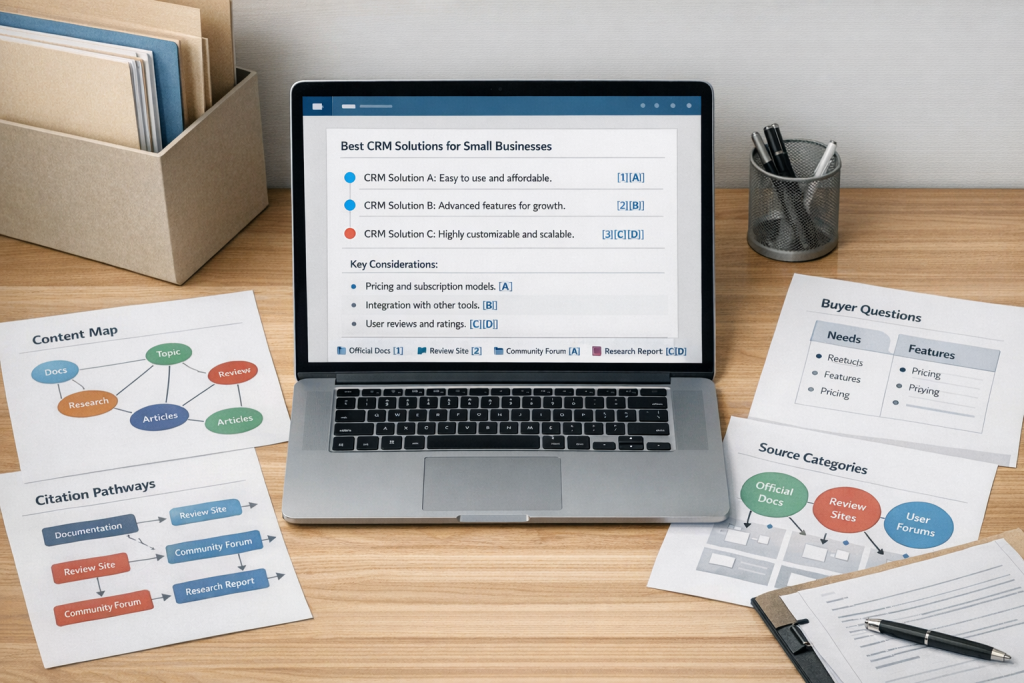
Perplexity does not maintain a fixed directory of approved businesses or software products. Every query triggers a live retrieval process that assembles answers from a shifting combination of web content, review platforms, official documentation, community discussions, and — for Pro and Enterprise subscribers — licensed premium data partners. Which sources appear in any given answer depends on the nature of the question, how specific the query is, and what the retrieval system judges most relevant at that moment.
This article breaks down each source category Perplexity draws from, explains how the type of query changes the source mix, covers the focus modes that let users steer the source pool, and addresses what all of this means for businesses and software vendors trying to understand their visibility inside AI-generated answers.
How Perplexity Retrieves Sources for Every Query
Perplexity functions as an answer engine rather than a traditional search engine. A user submits a question and receives a synthesized response with inline citations — not a ranked list of links to click through. The system retrieves content from across the web in real time, uses that content to construct a direct answer, and links each claim back to the source it came from so the reader can verify the information.
The technical approach behind this is retrieval-augmented generation, commonly abbreviated as RAG. The practical meaning: the underlying language model does not depend solely on what it learned during training. For each query, it searches the web, pulls content from the pages it considers most relevant, and uses that retrieved material to shape the response. The answer is generated fresh for every query, and the sources cited can shift depending on what has been recently published, what is currently accessible, and how closely a given page matches the question being asked.
This is why two people asking slightly different versions of the same question may receive answers that cite entirely different sources. The retrieval is live and query-specific, not drawn from a fixed cache.
Key point: Inline citations in Perplexity answers are not cosmetic. They are the system’s way of showing which pages it retrieved, evaluated, and used as the basis for specific parts of its response. Every cited link represents a page that cleared the retrieval system’s relevance threshold for that particular query.
The Core Source Categories Perplexity Draws From
Perplexity does not work from a single approved source list. It draws from several distinct content categories, and which categories dominate any given answer depends on the query. Understanding these categories is foundational to understanding why some pages appear in AI recommendations and others do not.
General Web Content and High-Authority Publications
Most queries begin with the open web. That includes news outlets, industry publications, editorially produced roundups, authoritative long-form guides, and well-established domain properties. The retrieval system appears to favor pages with substantive, information-dense content over pages that are primarily promotional or structurally thin.
Observed patterns suggest that pages with clear organization, specific factual claims, and demonstrated topical authority are retrieved and cited more consistently. Pages built around aggressive sales language, minimal original content, or keyword stuffing tend to be filtered out or passed over in favor of more substantive alternatives.
Software Review and Comparison Platforms
When a query asks Perplexity to recommend software — whether project management tools, CRM platforms, accounting software, or any other category — the system frequently draws from dedicated review and comparison platforms. G2, Capterra, and TrustRadius are among the most commonly observed sources in this category.
These platforms surface because they consolidate structured user reviews, feature-by-feature comparisons, pricing data, and category rankings in one place. For a retrieval system assembling a software recommendation, that kind of organized, comparative content is directly useful.
What gets cited from these platforms is often not the homepage. Perplexity regularly pulls from specific category pages, individual product profiles, head-to-head comparison pages, and review summaries — whichever page most closely matches the specifics of what was asked.
Official Vendor and Company Sources
Perplexity frequently cites official company pages when a query concerns a specific product or business. Product pages, pricing pages, documentation hubs, help centers, about pages, and press releases all fall into this category.
These pages tend to appear most often when the query is narrow and product-specific — asking what a particular company offers or how a specific feature works — rather than when the query is a broad category comparison. For wide-open questions like “best CRM for small businesses,” Perplexity tends to lean on third-party sources. For targeted product questions, it is more likely to go directly to the vendor’s own content.
The practical implication: if a company’s official product documentation is outdated, poorly organized, or structured in ways that make it difficult for crawlers to process, Perplexity may cite an older version of that content, fall back on a third-party description, or bypass the company entirely.
Community Discussions and Forums
Reddit threads, Quora answers, developer forums, and niche industry communities appear regularly in Perplexity citations — particularly for queries with a sentiment or experience dimension. Questions like “what do real users think of this product,” “is this tool actually worth the price,” or “best service provider in this city” frequently surface community discussions as primary or supporting sources.
The system appears to favor community content when the nature of the query signals that the user is looking for authentic user experience rather than vendor-produced claims. Brands with a genuine presence in relevant communities — through organic user conversations, not manufactured posts — give Perplexity more source material to draw from when those experience-oriented queries come in.
The inverse holds as well. A brand with no meaningful footprint in community discussions may find that Perplexity simply has less to work with when users ask experience-oriented questions about that category.
Premium Licensed Data Partners
Perplexity Pro and Enterprise subscribers receive answers that can draw on premium licensed data sources unavailable on the open web. These are professional-grade databases that Perplexity has established partnerships with to deepen the quality of its answers for business, financial, and market-research queries.
The confirmed premium partners and what each brings to the source pool:
- PitchBook: Private-market intelligence covering firmographics, funding rounds, investor profiles, and deal activity. Most relevant for queries about startups, venture-backed companies, and private market dynamics.
- CB Insights: Startup tracking, market mapping, competitive landscape analysis, and industry trend data. Most relevant for enterprise strategy and market research queries.
- Statista: Global statistics, market sizing figures, industry forecasts, and consumer research data. Most relevant for queries requiring quantified market information.
- IBISWorld: Industry research reports and market condition analysis. Most relevant for queries about specific industry verticals and sector-level dynamics.
- Dun & Bradstreet: Business credit data, company profiles, B2B firmographic records, and commercial risk assessment. Most relevant for queries about business credibility, supplier vetting, and company background research.
- Guidepoint: Expert network access and primary research. Most relevant for specialized queries that benefit from practitioner-level perspective.
- Wiley: Academic and professional journals, business and STEM reference material. Most relevant for queries that call for peer-reviewed or scholarly sourcing.
These premium sources surface most often in B2B enterprise queries, competitive intelligence requests, market sizing questions, and financial research. A standard free-tier user will not see answers informed by these databases, which means the source mix for the same question can differ substantially depending on the user’s subscription level.
How Query Type Changes the Source Mix
One of the most consequential and least-discussed aspects of Perplexity’s source behavior is that the source mix shifts noticeably based on what kind of question is being asked. A local business query, a software comparison query, and a B2B enterprise research query each tend to draw from different source categories in different proportions.
Local Business Queries
When someone asks Perplexity for the best HVAC company in a specific city or top-rated legal representation nearby, the system tends to draw from local review platforms, Google Business Profile data, Yelp, industry-specific directories, and community discussions. A business’s own website may appear, but the answer is typically anchored by third-party credibility signals — ratings, reviews, and local directory presence.
Software Comparison Queries
A query asking for the best project management software for a team of a specific size shifts the source mix toward software review platforms like G2, Capterra, and TrustRadius, along with editorial roundups from technology publications and official vendor documentation. Community discussions from Reddit or developer forums may also appear, particularly when the query includes a preference or constraint that review platforms do not address directly.
B2B Enterprise Research Queries
A query about leading cybersecurity vendors for mid-market financial services companies tends to pull from industry analyst reports, premium data partners for Pro subscribers, business publications, and authoritative editorial content. Review platforms may still appear, but the source mix tilts toward more specialized, deeper content. This is the query type where premium data partners like PitchBook, CB Insights, and IBISWorld are most likely to be part of the answer.
The practical takeaway: A business trying to understand its Perplexity visibility needs to think carefully about what kind of query a potential buyer would actually submit — and then assess whether the brand has relevant, accessible content in the source categories that Perplexity draws from for that specific query type.
Focus Modes and How They Control Source Selection
Perplexity gives users the ability to narrow the source pool for any query through focus modes. Selecting a focus mode changes which content categories the retrieval system prioritizes when assembling an answer.
The available focus modes include:
- Web: The default setting. Retrieves from the full range of publicly accessible web sources.
- Academic: Prioritizes peer-reviewed research, scholarly journals, and academic databases.
- Social: Prioritizes social media platforms and publicly available social content.
- Reddit: Narrows retrieval specifically to Reddit threads and community discussions.
- YouTube: Prioritizes video content hosted on YouTube.
- Writing: Shifts the model toward text generation rather than source retrieval and citation.
Focus modes matter because they hand the user direct control over what kind of source shapes the answer. Someone searching in Reddit mode for the best accounting software for freelancers will receive an answer built entirely from Reddit discussions. That means the products mentioned will be those that appear organically in Reddit conversations — not necessarily those with the strongest review platform profiles or the most polished marketing pages.
Perplexity also offers a Deep Research mode that expands the scope of retrieval. Deep Research runs a more thorough search process, drawing from a wider range of sources and producing longer, more detailed answers. For business and software recommendation queries, Deep Research mode tends to surface a broader source range — including premium data partners, academic content, and niche industry publications that might not appear in a standard query.
What Makes a Source More Likely to Appear in Perplexity’s Answers
No one outside Perplexity has visibility into exactly how its retrieval system scores and selects sources. But consistent patterns observed across a large number of queries point to characteristics that pages cited frequently tend to share.
- Direct relevance to the query: Pages that address the specific question being asked — rather than a loosely adjacent topic — are cited more consistently. Precision outperforms breadth.
- Recency: For topics where information changes regularly, such as software features, pricing, or company details, more recently updated pages appear to be favored over older content.
- Crawler accessibility: Perplexity operates its own web crawler. A page that blocks that crawler or is not rendered in accessible HTML cannot be retrieved or cited, regardless of how strong the content is.
- Information density: Pages with detailed, fact-rich content are cited more often than pages with thin content, boilerplate copy, or language that reads primarily as promotional.
- Topical authority signals: Domain authority, editorial credibility, and demonstrated expertise on the specific subject appear to influence source selection — though authority here means credibility on the particular topic, not simply overall domain strength.
- Cross-source corroboration: When a claim appears consistently across multiple sources, Perplexity appears more likely to include that claim in its answer and cite the pages supporting it.
These are patterns derived from observation, not confirmed internal rules. Perplexity’s retrieval logic is proprietary. But the patterns are consistent enough across repeated queries to serve as a practical working framework.
An important distinction: Being crawled by Perplexity’s crawler is not the same as being cited in a Perplexity answer. A page can exist in the index without ever appearing as a cited source. Citation requires that the page be retrievable and evaluated as one of the most relevant, credible options for a specific query at the moment it is submitted.
What This Means for Businesses and Software Vendors
If Perplexity draws from review platforms, community discussions, official documentation, editorial publications, and premium data partners — and the mix shifts by query type — then a business that wants to understand its AI-search visibility needs to think across all of those surfaces, not only its own website.
Here is what that looks like in practice:
- Review platform presence is part of the visibility equation. When software buyers ask Perplexity for recommendations and the system draws from G2 and Capterra, a current and well-maintained profile on those platforms directly affects whether a brand appears in the answer.
- Community footprint shapes what Perplexity has to work with. When Perplexity surfaces Reddit threads and forum discussions for experience-oriented queries, brands with genuine community presence give the system more source material to draw from on their behalf.
- Official documentation needs to be accessible and current. If a company’s product pages, help center, or pricing page is outdated, blocked from crawlers, or organized in ways that are difficult to parse, Perplexity may skip it in favor of third-party descriptions of that same product.
- Content built around real buyer questions performs differently than generic blog content. A page that directly addresses a specific question a buyer would ask — with clear structure, specific claims, and supporting evidence — is better positioned to match the retrieval logic than a broad awareness piece written to fill a publishing schedule.
- Premium data coverage matters for enterprise-facing brands. When Perplexity Pro users receive answers informed by PitchBook, CB Insights, or Dun & Bradstreet, enterprise-facing companies should understand whether they have a presence in those databases at all.
None of this is a guarantee. No business can compel Perplexity to cite a specific page or include a specific brand in a recommendation. But understanding which source categories the system draws from — and evaluating whether a brand has relevant, accessible, credible content across those categories — is the foundation of any practical AI visibility strategy.
This is the work CiteHarbor does for clients. We audit where a brand currently appears — and where it is absent — across AI-search environments including Perplexity, ChatGPT, Gemini, Claude, and Google AI Overview. We research the buyer questions that drive recommendations in the client’s category. We produce content designed to address those questions with the structure, specificity, and depth that AI retrieval systems tend to surface. And we manage the full execution — publishing to WordPress, distributing to social channels, tracking citations monthly, monitoring competitor visibility, and delivering branded performance snapshots — so the client does not need to manage another platform or another workflow.
The goal is not to manipulate any AI engine. The goal is to ensure the brand has useful, findable, well-structured content in the places where AI systems are already looking.
Frequently Asked Questions
Does Perplexity use Google or Bing to find sources?
Yes. Perplexity uses multiple search APIs, including Google and Bing, alongside its own proprietary web crawler. Results from these inputs are combined to assemble the source pool for each query. The system is not limited to the index of any single search engine.
Does Perplexity use reliable sources?
Perplexity applies filtering logic that appears to favor information-dense, objective, high-authority content over thin or heavily promotional pages. The inline citation system adds a transparency layer — every cited source is linked directly in the answer so the reader can evaluate it independently. That said, no retrieval system is infallible, and readers should assess cited sources on their own merits.
What is the difference between Perplexity’s free and premium sources?
Free-tier answers draw from publicly available web content — websites, review platforms, forums, news outlets, and editorial publications. Pro and Enterprise subscribers receive answers that can draw on licensed premium data partners including PitchBook, CB Insights, Statista, IBISWorld, Dun & Bradstreet, Guidepoint, and Wiley. These premium sources add depth for business, financial, and market-research queries that the open web alone cannot fully support.
Can businesses influence whether Perplexity recommends them?
No business can compel a citation. However, businesses can improve their chances of being retrievable by maintaining current, well-structured content across the source categories Perplexity draws from — including their own website, relevant review platforms, community discussions, and industry publications. The objective is to be present, accessible, and genuinely useful in the places where Perplexity’s retrieval system looks for information.
Should Perplexity have its own prompt and content plan separate from SEO?
Not necessarily a fully separate plan, but a deliberate extension of existing content strategy. The qualities that make a page useful to Perplexity’s retrieval system — clear structure, direct answers to real questions, substantive depth, crawler accessibility — overlap meaningfully with sound SEO practice. The difference is one of emphasis: AI retrieval systems tend to favor concise, extractable answers and well-organized sections, while traditional SEO may reward broader content approaches. Most businesses are better served by building AI visibility thinking into their existing content workflow rather than treating it as a separate program to manage.
Why does Perplexity cite third-party pages instead of the company’s own website?
Perplexity’s retrieval system selects sources based on relevance, credibility, and content quality for each specific query. For broad recommendation queries, the system often favors third-party sources like review platforms and editorial roundups because they offer comparative context that a single vendor’s website is not positioned to provide. For specific product queries, a vendor’s own pages are more likely to be cited. When a company’s website is consistently bypassed, it often points to issues with content structure, crawler accessibility, content depth, or the degree to which the page directly addresses the query being asked.
Understanding Perplexity’s Sources Is the First Step
Perplexity’s source behavior is not arbitrary, but it is dynamic. The system retrieves content in real time from a broad and shifting pool that includes web sources, review platforms, community discussions, official documentation, and premium data partners. The source mix changes based on query type, user subscription tier, and focus mode selection.
For businesses and software vendors, the practical question is not how to manipulate the system. It is whether the brand has useful, well-structured, accessible content in the places where Perplexity’s retrieval system is already looking — and whether that content directly addresses the questions buyers are actually submitting.
If you are not sure where your brand currently stands in AI-search environments, CiteHarbor can help you find out. We run visibility audits across Perplexity, ChatGPT, Gemini, Claude, and Google AI Overview, research the buyer questions that matter in your category, and manage the full content and distribution workflow so you do not have to.