Why Perplexity Cites Third-Party Websites Instead of Your Company’s Own Pages
Wondering why Perplexity cites review sites or industry publications instead of your own website? This article explains the technical, content, and credibility factors behind citation selection and how marketing teams can improve AI visibility.
Why Perplexity Cites Third-Party Websites Instead of Your Company’s Own Pages
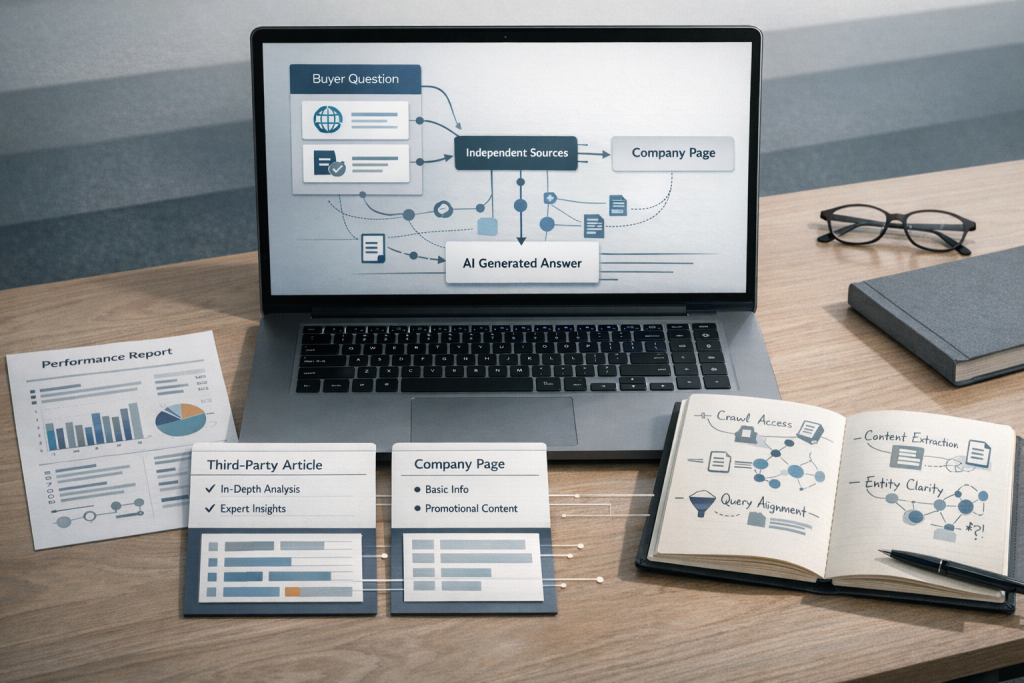
Perplexity is not broken when it surfaces a review site, an industry publication, or a competitor’s blog ahead of your company page. It is doing precisely what it was designed to do: locate, cross-reference, and synthesize the most explicit, independently supported, and structurally accessible content available at that moment. Your page frequently falls short on at least one of those criteria, and this article explains where the gaps tend to appear and what you can do to close them.
If you are a marketing leader, SEO director, or B2B product marketer who has queried your category in Perplexity and watched a third-party source occupy the space where your brand belongs, this is the explanation you have been looking for. We will walk through how Perplexity’s retrieval process actually functions, the five most common reasons your pages get passed over, a diagnostic sequence for identifying which reason applies to your situation, and the practical steps that improve your likelihood of being cited — without overstating what any content change can guarantee.
How Perplexity Actually Decides What to Cite
It Is a Real-Time Synthesis Engine, Not a Directory
Perplexity does not keep a fixed list of approved websites to rotate through when answering questions. Each time a user submits a query, the system runs a live web search, pulls a set of candidate pages, evaluates them against the question, and assembles an answer drawing from whichever sources best support a clear, verifiable response.
This means citation is earned per query, not assigned per brand. Your company might be cited for one question about your category and completely absent from another, depending on what Perplexity retrieves, how closely your content matches the specific question, and whether competing pages do a better job of delivering the answer in a format the system can parse and use.
Think of it less like a business directory and more like a research analyst who pulls fresh sources for every question they field. That analyst is not interested in who owns the information — they want the page that answers the question most directly and the sources that can cross-confirm each other.
Owning the Company Does Not Make Your Page the Default Source
This is where most businesses run into frustration. You know your company, your product, and your service better than anyone. It seems logical that your page should be the primary reference. But Perplexity is not asking which organization has the deepest knowledge of a given brand. It is asking which retrievable pages answer a specific question most explicitly, and which sources lower the probability that the generated answer is wrong.
That second consideration — reducing the risk of an inaccurate answer — is the critical one. AI systems that generate responses from live web sources face a persistent challenge: they can produce confident-sounding answers that contain factual errors. To manage that risk, systems like Perplexity favor sources that offer independent confirmation, explicit factual statements, and structured content that can be parsed without ambiguity. Your company page, regardless of how authoritative your team knows it to be, may not satisfy those criteria as well as a carefully structured third-party review or an industry publication that states and compares category facts directly.
Five Reasons a Third-Party Page Gets Cited Instead of Yours
When we conduct AI visibility audits for clients at CiteHarbor, the same five causes consistently appear behind third-party citations displacing a brand’s own pages. Most businesses are dealing with more than one of these at the same time.
1. Your Pages Are Harder to Retrieve
Before Perplexity can cite your page, its crawler — called PerplexityBot — must be able to reach it. If your robots.txt file blocks PerplexityBot directly, or if it uses broad disallow rules that sweep in AI crawlers, your pages are invisible to the system regardless of their quality. No level of content excellence matters if the crawler cannot access the page in the first place.
Beyond robots.txt, technical obstacles that prevent retrieval include:
- Pages that depend heavily on JavaScript rendering, which some AI crawlers cannot fully process
- Slow server response times that cause the crawler to time out or deprioritize the page
- Login walls, paywalls, or interstitial screens that block the crawler from reaching the primary content
- Noindex tags added for traditional SEO purposes that also instruct AI crawlers to skip the page
A third-party site covering the same topic with a fast, crawlable, publicly accessible page will be retrieved while yours sits behind a technical barrier you may not realize exists.
2. Your Content Is Harder to Extract
Perplexity does not read your page the way a human visitor does. It parses the page for explicit, structured statements it can use to construct an answer. When your page relies on vague marketing language, long narrative blocks without clear factual claims, or promotional framing that sidesteps direct statements, the system has little it can actually use.
Consider the difference between two ways of presenting the same information:
| Typical Company Page | Third-Party Review Site |
|---|---|
| “We deliver industry-leading solutions that help businesses reach their full potential.” | “Company X offers three pricing tiers starting at $49/month, with automated reporting, API access, and a 14-day free trial included.” |
| “Our experienced team brings deep expertise to every client engagement.” | “Company X launched in 2018 and currently serves approximately 2,000 B2B clients across the manufacturing and logistics sectors.” |
The third-party page states concrete, verifiable facts. The company page makes claims that are difficult to confirm and nearly impossible for an AI system to quote within a synthesized answer. Perplexity selects the page that gives it something specific to work with.
We refer to this as synthesis ease — the degree of effort an AI system must expend to convert your content into a usable answer component. Pages with high synthesis ease lead with explicit statements, use clear definitions, employ structured headings, and put the answer before the explanation. Pages with low synthesis ease bury their substance inside promotional language or unstructured narrative.
3. Your Claims Are Not Independently Corroborated
When your company page states that you are the strongest option in your category, that is an unverified first-party assertion. When an industry publication or comparison platform states that your company ranked highest in a specific evaluation among a defined set of providers, that is an independently sourced claim.
Perplexity — like most AI synthesis systems — favors sources that reduce the likelihood of generating an inaccurate answer. Independent corroboration is one of the clearest signals available for that purpose. When multiple third-party pages agree on a fact, that fact becomes safer for the system to include in its answer. When only your company page makes a claim and no external source confirms it, the system treats that claim as less reliable — regardless of whether it is accurate.
This is not a design flaw. It is a reasonable response to the challenge of generating reliable answers from a noisy, uneven web. The practical consequence is that businesses without a meaningful layer of third-party coverage — reviews, directory entries, press mentions, comparison articles, industry references — are structurally at a disadvantage in AI-generated answers.
4. The Query Type Favors Independent Sources
Not all queries are evaluated the same way when Perplexity selects sources. This distinction matters more than most businesses recognize.
Factual queries ask for specific information: what a company does, where it is located, when it was founded. For these, your own website is a strong candidate because you are the primary source of accurate information about your business.
Evaluative queries ask for judgment: which provider is best for a given use case, whether a particular tool is worth the cost. For these, Perplexity actively favors independent sources because the question calls for an assessment that a company page cannot credibly supply about itself. No one expects a vendor’s website to recommend a competing product for a particular buyer’s situation.
Explanatory queries ask for understanding: how a process works, why a particular outcome occurs. For these, Perplexity looks for pages that explain a concept clearly and directly, regardless of who published them. A well-structured post from an industry practitioner can outperform a company’s own knowledge base if it is more explicit and easier to parse.
For B2B services, professional services, and SaaS products, the majority of high-value buyer queries tend to be evaluative. If that describes your category, your own pages are structurally less likely to be cited — not because of anything you did wrong, but because of how the system handles that query type by design. Recognizing which query types matter most in your space reshapes the strategy considerably.
5. Your Entity Signals Are Unclear
Perplexity needs to establish what your company is, what it does, where it operates, what it offers, and how it connects to other entities in your category. If your website does not state these things plainly, the system cannot confidently associate your pages with the relevant queries.
Entity clarity means your site consistently and explicitly identifies:
- Your company name, in the exact form it should appear in citations
- Your primary products or services, described in plain, specific language
- Your geographic service area, where applicable
- Your industry or category, stated outright rather than implied through context
- Your relationships to other entities — platforms, partners, certifications, industry associations
When these signals are vague, inconsistent, or scattered across pages without clear structure, Perplexity may fail to recognize your site as the authoritative source for queries about your own brand. A third-party directory that lists your company name, category, location, and service description in a structured format can become the source Perplexity uses to answer a question about your own business.
A Practical Diagnostic: Which Reason Applies to You?
Most businesses dealing with poor Perplexity citation have more than one issue in play, but identifying the right starting point saves time and prevents effort spent on fixes that do not address the actual problem. Work through these questions in sequence:
- Can PerplexityBot access your pages? Review your robots.txt file. If it names PerplexityBot in a disallow rule, or if broad disallow rules effectively block AI crawlers from your content, that is the first thing to correct. Nothing downstream improves until your pages are actually retrievable.
- Does your content make explicit, factual claims? Open your most important product or service pages and read the first two paragraphs. If they consist primarily of phrases like “world-class,” “industry-leading,” or “trusted by businesses everywhere” without any specific facts attached, your content has a synthesis ease problem.
- Do external sources corroborate what you claim? Search for your company name on review platforms, industry directories, and comparison sites relevant to your category. If you find sparse or no third-party coverage, you have a corroboration gap that makes it harder for AI systems to cite you with confidence.
- What query types dominate your category? Submit the top five questions your buyers ask before selecting a provider directly to Perplexity. If most of those queries are evaluative rather than factual, your strategy needs to emphasize building third-party presence and creating content that addresses evaluative questions with genuine substance.
- Does your site clearly state what your business is and does? Check whether your homepage, about page, and primary service pages explicitly name your company, describe your services in concrete terms, and identify your category and service area. If that information is implied rather than stated, you have an entity clarity problem.
This diagnostic does not require specialized tools. It requires an honest read of your own content. At CiteHarbor, when we begin an AI visibility audit for a new client, these are among the first things we examine — alongside a broader analysis of which buyer questions the brand surfaces for, which questions return competitors instead, and where the most significant citation gaps exist across ChatGPT, Perplexity, Gemini, Claude, and Google AI Overview.
What You Can Actually Do About It
Fix Crawl Access First
This is the most mechanical step and the one with the most direct cause-and-effect relationship. Check your robots.txt file and confirm that PerplexityBot is not listed in a disallow rule. If you previously added broad AI-crawler restrictions — a step many businesses took during early uncertainty about AI training data — you may have inadvertently made your brand invisible to AI search systems entirely.
While reviewing crawl access, also confirm that your most important pages load quickly, deliver their content in standard HTML rather than depending on JavaScript execution, and are not blocked by interstitials or login prompts that prevent crawlers from reaching the core content.
Rewrite for Extractability, Not Just Readability
Your pages still need to work for human readers — that requirement does not change. But they also need to be usable by AI systems that are parsing for extractable facts. In practice, this means:
- Opening each section with a direct statement rather than building toward a point
- Swapping vague claims for specific, verifiable facts wherever possible
- Writing headings that describe what the section actually contains
- Defining your services and products in concrete terms rather than aspirational language
- Presenting comparison or feature information in formats that are easy to scan — concise paragraphs, labeled lists, tables where they genuinely clarify
The objective is not mechanical writing. It is writing that is clear enough for machines to parse and quote accurately. Content that meets that bar also tends to serve the human reader who wants a direct answer without working through several paragraphs of preamble to find it.
Build the External Corroboration Layer
If your company has limited third-party presence online, improving your own website in isolation will not close the citation gap. You need independent sources that confirm your existence, describe your offerings, and ideally evaluate your performance.
What that looks like depends on your industry:
- For B2B SaaS: software review platforms, integration partner directories, comparison coverage in industry publications
- For professional services: industry association directories, business directories, mentions in trade media
- For local and regional businesses: Google Business Profile, industry-specific directories, local media coverage, review aggregators
The goal is not to engineer fake reviews or purchase placements. The goal is to ensure that when an AI system looks across the web for information about your company, it finds consistent, factual descriptions from multiple independent sources. That distributed consistency is what gives AI systems the confidence to cite you.
Clarify Your Entity Signals On-Site
Ensure your website states, in crawlable HTML, the essential facts about your business. This includes implementing Organization schema, Article schema, and other structured data types where they apply accurately. But structured data alone is insufficient — the visible page text must also clearly and consistently communicate who you are, what you do, and where you operate.
A straightforward test: if someone with no prior knowledge of your company read your homepage and your top three service pages, could they write a two-sentence description that includes your company name, your category, your primary service, and your service area? If not, your entity signals need attention.
What You Cannot Control — and Why That Matters
Even after addressing every issue above, there are aspects of Perplexity’s citation behavior that remain outside any business’s control. Source selection involves live retrieval, cross-referencing across multiple pages, and synthesis decisions that are not fully transparent or repeatable. The same query submitted on different days can return different cited sources.
Certain query types — particularly evaluative and comparative questions — will consistently favor independent sources as a matter of design. That is not a problem to solve; it is how AI synthesis systems protect the accuracy of their answers. Accepting that reality shifts the question from how to force a specific citation outcome to how to ensure your brand is visible, accurately described, and well-supported across the sources Perplexity is likely to retrieve.
That second question leads to a more durable practice — one built around genuine content quality and broad third-party presence rather than a single round of technical fixes.
The Difference Between Being Indexed and Being Cited
A point that frequently gets missed in discussions of this topic: being accessible to a crawler and being cited in an answer are not the same thing. Your pages can be fully open to PerplexityBot, technically reachable, and still never appear as a cited source.
Indexing means the system is aware your page exists and can pull it as a candidate. Citation means the system chose your page — from among all the candidates it retrieved — as a source worth referencing in a specific answer. The distance between those two outcomes is where content quality, structural clarity, corroboration, and query-type alignment do their work.
This distinction matters because many businesses stop at the technical layer. They verify that their robots.txt is clean, their pages load without errors, and their site is accessible — then treat the problem as solved. But technical access is the entry point, not the destination. The real question is whether your content, once retrieved, gives Perplexity a reason to select it over every other candidate in that retrieval set.
Why This Requires a Different Approach Than Traditional SEO
If your current SEO program centers on keyword rankings, link acquisition, and a steady publishing cadence, it may not address AI citation visibility at all. Traditional SEO and AI citation optimization share some common ground — crawlability, site structure, content quality — but diverge in ways that matter.
Key differences:
- Traditional SEO optimizes for ranking position. AI citation visibility is about whether your content gets selected as a source in a synthesized answer — a fundamentally different kind of selection decision.
- Traditional SEO targets keyword terms. AI citation visibility depends on whether your content directly answers the specific questions buyers are directing at AI systems, in language those systems can extract and use.
- Traditional SEO tracks traffic and rankings. AI citation visibility requires monitoring which AI platforms reference your brand, for which queries, and how that compares to competitors — data that most SEO dashboards do not capture.
- Traditional SEO content can be promotional. AI systems consistently favor content that is explanatory, factual, and independently verifiable over content that reads as marketing copy.
This does not make traditional SEO irrelevant. It means AI citation visibility is a parallel discipline with its own research requirements, its own content approach, and its own measurement framework. Businesses that treat it as an extension of their existing SEO retainer will keep finding third-party sites cited in their place.
How CiteHarbor Approaches This Problem
At CiteHarbor, we built our entire service around the reality this article describes. We do not hand you a dashboard and leave you to figure out AI visibility on your own. We manage the full process.
That begins with an AI visibility audit across ChatGPT, Perplexity, Gemini, Claude, and Google AI Overview — establishing where your brand currently appears, where it is absent, which buyer questions produce the largest gaps, and which competitors are being surfaced instead. This baseline gives you a clear picture of where things stand before any content work begins.
From there, we conduct buyer-question research — not keyword research in the conventional sense, but a structured analysis of the actual questions your prospective customers are submitting to AI systems when they are comparing providers, evaluating options, or trying to understand a problem your business addresses. Those questions drive every piece of content we create.
We then produce targeted content built to answer those buyer questions using the kind of explicit, structured, extractable writing that AI systems can parse and cite. Every article is published directly to your WordPress site and distributed through your social channels. You do not manage freelancers, track drafts in a project management tool, or log into a separate platform.
Each month, you receive a branded PDF performance snapshot showing how your AI visibility has shifted against baseline, which queries now surface your brand, and how your competitors are trending. No dashboard to maintain. No additional software to adopt.
The objective is not to manipulate AI systems into citing you. It is to build a content library on your own digital properties that earns citation — because it answers real buyer questions more clearly and completely than the alternatives currently being retrieved.
Frequently Asked Questions
Does owning my company page guarantee Perplexity will cite it?
No. Perplexity selects sources based on retrievability, content clarity, and independent corroboration — not on who owns the brand. Your page competes as one candidate among many and must earn citation by being more explicit, more structured, and more verifiable than other pages retrieved for that specific query.
Can I force Perplexity to cite my website?
No. There is no mechanism for directing Perplexity to cite a specific page. You can improve your likelihood of being cited by ensuring your pages are crawlable, clearly structured, factually grounded, and externally corroborated — but citation decisions are made by the system in real time and are not fully predictable or controllable.
Why does Perplexity cite a review site instead of my product page?
Review sites typically contain explicit factual claims, structured comparisons, and independent assessments — all of which are easier for AI systems to extract and verify than promotional product copy. For evaluative queries in particular, Perplexity favors sources that offer independent judgment rather than first-party marketing.
What is PerplexityBot and how do I check if it can access my site?
PerplexityBot is Perplexity’s web crawler. It respects the robots.txt protocol to determine which pages it may access. You can review your robots.txt file — typically located at yourdomain.com/robots.txt — to check whether PerplexityBot is explicitly blocked or whether broad disallow rules are preventing it from crawling your content.
Does my robots.txt affect Perplexity citations?
Yes. If your robots.txt blocks PerplexityBot, your pages cannot be retrieved or cited. Some businesses added broad AI-crawler restrictions during early uncertainty around training data usage and unintentionally removed themselves from AI search visibility as a result. Reviewing and correcting your robots.txt is one of the highest-impact technical steps available to you.
Why does Perplexity cite my competitor but not me?
The most frequent causes are that your competitor’s content is more explicitly structured, more accessible to crawlers, or better supported by third-party sources. It may also be that their content addresses the specific buyer questions Perplexity retrieves for, while your content covers different ground or uses language that is harder to extract. An AI visibility audit can pinpoint the specific gaps in your situation.
Does Perplexity require a separate strategy from other AI search platforms?
The underlying principles — crawl access, content clarity, explicit claims, independent corroboration, and entity signals — apply across all major AI search environments. That said, each platform operates its own crawler, its own retrieval logic, and its own source-selection behavior. A thorough AI visibility practice tracks and optimizes across platforms rather than treating any single one as the complete picture.
What to Do Next
If your brand is being passed over in Perplexity answers while third-party sites and competitors appear in your place, the cause almost certainly traces back to one or more of the five factors covered here: crawl access, content extractability, independent corroboration, query-type alignment, or entity clarity. The first move is an accurate diagnosis — identifying which of these factors is actually driving your situation before committing to changes that may not address the real problem.
CiteHarbor’s initial AI visibility audit is designed to answer exactly that question. We assess your brand’s current citation presence across ChatGPT, Perplexity, Gemini, Claude, and Google AI Overview, surface the buyer questions where you are absent, and show you where competitors are appearing instead. From there, we manage the content, publishing, distribution, and ongoing tracking — giving you a clear picture of where you stand and a handled path forward without adding another platform to your workflow.