What a Full-Service AI Visibility Agency Actually Manages for You — And How to Tell If One Is Really Executing
Learn what a full-service AI visibility agency should handle across research, writing, WordPress publishing, social distribution, and reporting—and how to tell whether an agency is truly executing or just advising.
What a Full-Service AI Visibility Agency Actually Manages for You — And How to Tell If One Is Really Executing
Yes — a full-service AI visibility agency can manage research, writing, WordPress publishing, and social distribution for you, end to end, without requiring you to operate another platform or manage another set of freelancers. But the more important question is whether the agency you are evaluating actually does all of that work, or whether it hands you a dashboard and a set of recommendations and calls it done.
That distinction — between an agency that executes and one that advises — is what separates a genuine hands-off engagement from another tool subscription dressed up as a service. This article walks through what each stage of the workflow actually involves, what good execution looks like at every step, what you should retain control over, and how to evaluate whether an agency is doing the work or delegating it back to you.
If you are a business owner, marketing director, VP of Marketing, or a lean team already investing in SEO or paid ads, and you are trying to figure out whether AI-search visibility is worth adding to your plate — or whether someone else can carry it — this is the decision guide you need before signing anything.
The Distinction That Matters Most: Execution Versus Advisory
Most agencies in the AI visibility space fall into one of two models. Understanding which one you are evaluating saves you months of misaligned expectations.
Advisory model: The agency runs an audit, delivers a report, and tells you what to do. You still need writers, a publishing workflow, a social calendar, someone to manage WordPress, and a way to track whether any of it is working. The agency may offer a dashboard where you can monitor recommendations, but the execution stays on your team.
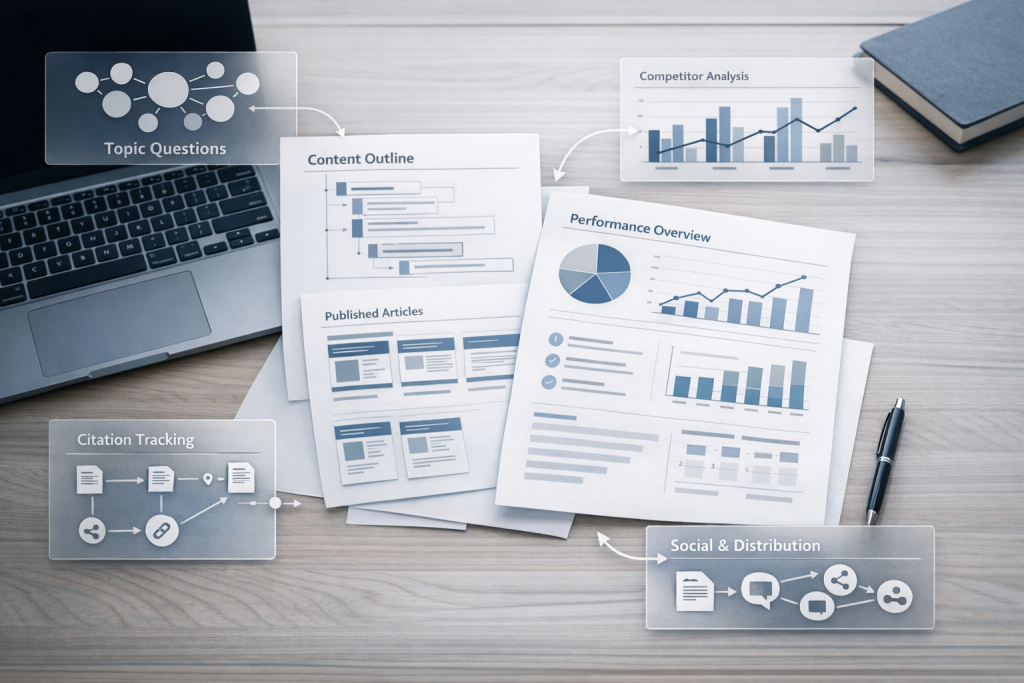
Execution model: The agency performs the audit, conducts the research, creates the content, publishes it to your WordPress site, distributes it across your social channels, tracks AI citation patterns over time, monitors your competitors, and sends you a branded performance snapshot. You review, approve when needed, and stay focused on running your business.
The difference is not subtle. One model adds a new workflow to your operations. The other removes one. If your team is already stretched across Google Ads management, SEO reporting, content calendars, and lead follow-up, the execution model is designed to eliminate the management tax of AI visibility — not add to it.
CiteHarbor operates as a full-service execution partner. The research, content creation, WordPress publishing, social distribution, citation tracking, competitor monitoring, and monthly reporting are handled for you. There is no dashboard to log into, no prompt library to manage, and no content calendar to maintain on your side.
Stage One: Research — What an Agency Should Actually Be Doing
Research is where most AI visibility programs succeed or fail, and it looks nothing like traditional keyword research. A full-service agency handling this stage is not pulling a list of search volumes from a tool and handing you topics. It is mapping the specific questions your buyers are asking AI engines — ChatGPT, Google Gemini, Claude, Perplexity, and Google AI Overviews — and identifying where your brand appears, where it is absent, and where competitors are being cited instead.
Buyer-Question Mapping and AI Citation Gap Analysis
The research starts with identifying what your target buyers actually ask when they use AI search tools. These are not always the same queries they type into Google. Someone searching Google might enter a short, location-based phrase. The same person prompting an AI tool is likely to ask a longer, more specific question that reflects where they are in a buying decision — naming the city, describing the situation, and asking for a recommendation in a single sentence. The language is more conversational, more specific, and more decision-oriented.
A strong agency maps these buyer questions systematically, then checks whether your brand appears in the AI-generated answers. The gap between where you should appear and where you actually appear is your AI citation gap. That gap is the foundation for everything that follows — every article, every publishing decision, and every distribution choice should trace back to closing specific gaps that matter to your buyers.
Competitor Citation Monitoring
Research also includes tracking which competitors are being cited in AI answers for the questions your buyers ask. This is not about publicly naming or attacking competitors. It is about understanding the landscape. If several competitors consistently appear in AI-generated recommendations for your core service category and your brand does not, that is a visibility signal your content strategy needs to address.
CiteHarbor monitors competitor citations across major AI environments as part of the ongoing engagement, not as a one-time snapshot. The competitive landscape in AI search shifts as new content is published and as AI models update their training data and retrieval sources.
What Weak Research Looks Like
Weak research at this stage looks like a generic keyword list, a one-time audit PDF that sits in a shared drive, or a set of topic suggestions pulled from a content tool without any AI-search validation. If the agency cannot show you which specific buyer questions your brand is missing from, the research is not deep enough to drive a useful content program.
Summary: The research stage should produce a clear map of buyer questions, a baseline of where your brand currently appears across AI engines, a picture of where competitors are being cited, and a prioritized list of visibility gaps that content can address.
Stage Two: Writing — Brand Voice, GEO Optimization, and Human Review
Writing for AI visibility is not the same as writing a traditional SEO blog post. The goal is not to rank for a keyword and collect clicks. The goal is to create content that is clear, authoritative, and structured well enough that AI systems can understand it, extract useful information from it, and reference it when answering buyer questions.
What GEO-Optimized Writing Actually Means
Generative Engine Optimization — GEO — is the practice of structuring content and authority signals so that AI systems are more likely to surface and cite your brand. In practical terms, GEO-optimized writing means:
- Opening each article with a direct, clear answer to the question it addresses
- Using precise, descriptive headings that match the way buyers phrase their questions
- Defining important terms in standalone sentences that can be extracted independently
- Keeping claims specific and supportable rather than vague and aspirational
- Separating facts from opinions and recommendations clearly
- Writing each section so it can be understood on its own, without requiring the reader to have read the previous section
This is different from traditional SEO writing, which often focuses on keyword density, word count targets, and internal link structures designed primarily to pass ranking signals. GEO writing focuses on making each piece of content genuinely useful and independently extractable.
Brand Voice Alignment and Editorial Standards
One of the most common concerns from business owners and marketing leaders considering a full-service agency is whether the content will sound like their brand. This concern is legitimate. A wealth management firm, a B2B SaaS company, and a multi-location roofing business have very different audiences, very different levels of technical complexity, and very different trust thresholds.
A strong execution agency maintains brand voice guidelines for each client. At CiteHarbor, content is created to match the client’s tone, industry terminology, and audience expectations — not produced from a generic template that could apply to any business in any category.
Human Editorial Review in an AI-Assisted Workflow
AI tools can accelerate parts of the writing process — outlining, summarizing source material, drafting sections, and rewriting for clarity. But AI-assisted drafting is not the same as AI-generated publishing. Every article must be reviewed for factual accuracy, unsupported claims, logical gaps, and style consistency before it goes live.
CiteHarbor applies a quality assurance process to every piece of content before publication. Articles are evaluated for accuracy, brand alignment, compliance with industry-specific guidelines, and structural readiness for both search engines and AI systems. Content that does not clear this review does not get published.
What Weak Writing Execution Looks Like
Weak writing at this stage looks like high-volume blog production with no clear connection to buyer questions. It looks like articles that lead with hollow throat-clearing and close with a generic call to action without ever making a specific, useful point. It looks like content that checks an SEO box but adds nothing a reader could not find in the first three Google results. If you have been paying for blog posts that no one reads and that do not support any measurable visibility goal, you have experienced weak writing execution.
Summary: The writing stage should produce articles that are directly tied to buyer questions, optimized for AI extractability, aligned with your brand voice, and reviewed by a human editor before publication.
Stage Three: WordPress Publishing — CMS Integration and Consistent Execution
WordPress publishing as a managed service means the agency handles formatting, metadata, internal linking, image placement, and scheduling — not just uploading a Google Doc and asking you to finish it.
How an Agency Connects to Your WordPress Site
A full-service agency typically connects to your WordPress site through secure access — either via the WordPress REST API or through a managed user account with appropriate permissions. The client retains ownership of the site, the hosting account, and all administrative controls. The agency operates as a contributor or editor, not as the site owner.
Before granting CMS access, verify that the agency uses secure authentication, that permissions are scoped appropriately, and that you can revoke access at any time. This is standard practice for any managed WordPress engagement.
What Publishing Execution Includes Beyond Uploading a Draft
Uploading a draft is the smallest part of WordPress publishing. A complete publishing execution includes:
- Formatting the article with proper heading hierarchy, paragraph spacing, and visual structure
- Writing and applying meta titles and meta descriptions that are descriptive, accurate, and unique
- Setting up internal links to related articles and relevant service pages
- Adding and formatting images with appropriate alt text
- Applying structured data where it is accurate and appropriate — such as Article schema or FAQ schema when the page genuinely contains a FAQ section
- Scheduling publication according to the content calendar
- Verifying that the page is crawlable, indexable, and free of technical errors
If an agency sends you a finished draft and asks you to handle WordPress formatting, metadata, internal linking, and scheduling, that is an advisory engagement — not a publishing service.
What to Verify Before Granting CMS Access
Before granting any agency access to your WordPress site, confirm these practical details:
- The agency uses a dedicated user account, not your personal admin login
- Permissions are limited to what the agency needs — editor or author role, not administrator
- You can revoke access instantly if the engagement ends
- The agency does not install plugins, change themes, or modify site settings without explicit approval
- All published content remains your property on your domain
CiteHarbor publishes directly to each client’s WordPress site as part of the standard engagement. The content lives on your domain, under your brand, building your owned content library over time.
Summary: WordPress publishing as a managed service means the agency handles every step from formatting through metadata, internal linking, and scheduling — not just drafting content and handing it off for you to publish.
Stage Four: Social Distribution — Repurposing, Scheduling, and Citation Signals
Social distribution is not a bonus add-on. It is a functional part of how AI systems discover and evaluate content sources.
Why Social Distribution Matters for AI Visibility
AI systems do not only pull from indexed web pages. The content ecosystem that surrounds a brand — including LinkedIn posts, X threads, and discussions on platforms like Reddit — influences what AI models recognize as relevant, authoritative, and current. When a piece of content is published on your WordPress site and then distributed across social channels in platform-appropriate formats, it creates multiple touchpoints that AI systems can encounter.
This does not mean social posts directly cause AI citations. No one can guarantee that mechanism. But a brand that publishes useful content and distributes it consistently across owned channels is building a broader content footprint than a brand that publishes to WordPress and stops there.
What Repurposing Looks Like Across Platforms
A single long-form article can be repurposed into multiple social assets: a LinkedIn post built around the central insight, a tighter post for X focused on a specific finding or recommendation, and formatted excerpts for other relevant platforms. The repurposing should match each platform’s format and audience expectations — not simply duplicate the same text across every channel.
Verify Whether Social Distribution Is Standard or an Add-On
This is a practical point worth confirming before you sign with any agency. Some agencies include social distribution as part of their core service. Others treat it as a separate engagement or an upsell. Ask directly, and get a clear answer about what platforms are covered, how many posts per article, and whether scheduling and formatting are handled for you.
At CiteHarbor, social media distribution is part of the standard full-service engagement. Content is repurposed and posted to the client’s social channels without requiring the client to manage a separate social calendar or posting tool.
Summary: Social distribution extends the reach and discoverability of your content across platforms that AI systems reference. Verify that distribution is included in any full-service engagement — do not assume it is standard.
Stage Five: Measurement and Iteration — The Stage Most Agencies Skip
If an agency publishes content and never tells you what happened, the engagement is incomplete. Measurement and iteration are what turn a content program into a compounding visibility strategy instead of a series of isolated blog posts.
What AI Citation Tracking Looks Like in Practice
AI citation tracking is different from traditional rank tracking. Traditional SEO tools tell you where a page ranks for a specific keyword in Google. AI citation tracking monitors whether your brand is being mentioned, cited, or recommended in AI-generated answers across platforms like ChatGPT, Perplexity, Google Gemini, Claude, and Google AI Overviews.
This tracking establishes a baseline — where your brand appears today — and then measures changes over time as new content is published and distributed. It does not predict what AI systems will do next. It tells you what is observable now and how visibility is shifting relative to your starting point.
Branded Reporting and What It Should Tell You
A useful report does not require you to log into a dashboard. It should arrive as a clear, readable document — CiteHarbor sends branded PDF performance snapshots — and it should answer these questions without requiring you to interpret raw data:
- Where does your brand currently appear in AI-generated answers?
- Which buyer questions are you being cited for?
- Where are competitors appearing that you are not?
- What content was published and distributed this period?
- What changed compared to the previous period?
If your current reporting requires you to open a dashboard, filter data, and draw your own conclusions, that is a software experience — not a managed service.
How Measurement Feeds Back Into Research
The most important function of measurement is not proving past performance. It is shaping the next cycle. When tracking reveals that a competitor is being cited for a buyer question you have not addressed, that finding goes back into the research stage and becomes the next content priority. When a published article begins appearing in AI answers for related questions, that signal tells the team which content angles are gaining traction.
This feedback loop — research, writing, publishing, distribution, measurement, and back to research — is what makes a content program compound instead of plateau. Without it, you are publishing articles into a void.
Summary: Measurement should track AI citation patterns, compare them against baseline and competitors, and feed findings back into the next content cycle. If your agency does not close this loop, it is producing content but not running a strategy.
What You Retain Control Over
Handing off execution does not mean handing off judgment. In a well-structured full-service engagement, you retain control over the things that only you can provide:
- Brand direction and strategic priorities. You decide which services, markets, and audiences matter most. The agency translates those priorities into buyer-question research and content plans.
- Factual accuracy and subject-matter expertise. You are the expert in your business. If an article covers a technical process, a regulatory nuance, or a client-facing claim, your review ensures accuracy.
- Approval workflows. If your organization requires content approval before publication — common in legal, medical, financial, and regulated industries — the agency should accommodate that process without friction.
- Relationships and original insights. The agency can structure and distribute your expertise, but it cannot replace your direct knowledge of your clients, your market, and your competitive position.
The goal of a hands-off engagement is not to remove you from the process entirely. It is to remove the operational burden — the WordPress formatting, the social scheduling, the dashboard monitoring, the content calendar management — so that your involvement is limited to strategic input and quality review, not daily execution.
How to Evaluate Whether an Agency Is Executing or Just Advising
Before signing with any AI visibility agency, ask these questions. The answers will tell you whether you are hiring an execution partner or subscribing to another advisory tool.
- Who writes the content? If the agency sends you topic recommendations and expects your team to produce the articles, that is advisory. If the agency writes, edits, and delivers publish-ready content, that is execution.
- Who publishes to WordPress? If the agency sends you a Google Doc or a draft file and you handle CMS formatting, metadata, and scheduling, that is advisory. If the agency publishes directly to your site with proper formatting, metadata, and internal links, that is execution.
- Who manages social distribution? If the agency tells you to repurpose articles into social posts, that is advisory. If the agency creates platform-specific content and posts it to your channels, that is execution.
- How is reporting delivered? If the agency gives you login credentials to a dashboard, that is a software model. If the agency sends you a clear, branded report that answers your questions without requiring you to interpret data, that is a managed service.
- Is AI citation tracking included? If the agency tracks traditional search rankings but not AI citation patterns across ChatGPT, Gemini, Claude, and Perplexity, it is running a traditional SEO program — not an AI visibility program.
- Does competitor monitoring happen ongoing or once? A one-time competitor audit is a project. Ongoing competitor citation monitoring is a strategy.
- What happens after the content is published? If the engagement ends at publication, there is no feedback loop. If measurement findings shape the next cycle of research and content, the program compounds over time.
These are not trick questions. They are operational questions that reveal whether you are about to reduce your workload or add to it.
When Software Alone Might Be Enough — And When It Is Not
Software platforms have a place in AI visibility. If your team has a dedicated content strategist, a reliable writer or writing team, someone who manages WordPress publishing daily, a social media manager, and a person who can interpret AI citation data and translate it into content decisions — a software subscription might give you the data layer you need.
But if your team is already stretched, if your marketing leader is managing paid ads and SEO alongside everything else, or if you have tried content programs before and they stalled because no one had time to execute consistently — software adds a dashboard to your list of open tabs without reducing your workload.
The question is not whether a software platform can track AI visibility. Several can. The question is whether your team has the capacity to act on what the platform shows you — week after week, month after month — without the execution falling behind.
CiteHarbor was built for teams that want the outcomes of an AI visibility program without the operational overhead of running one. The research, content, publishing, distribution, tracking, and reporting are handled as a managed service. You get a monthly performance snapshot, not a login.
Frequently Asked Questions
What does an AI visibility agency actually do?
An AI visibility agency works to get your brand surfaced in AI-generated answers across tools like ChatGPT, Google Gemini, Claude, Perplexity, and Google AI Overviews. A full-service agency manages the complete workflow: establishing where your brand currently stands, mapping the questions your buyers are asking, producing targeted content, publishing it to your website, distributing it across social channels, tracking citation patterns, and reporting what changed.
Is WordPress publishing something an agency can handle remotely?
Yes. A full-service agency connects to your WordPress site through secure access — typically via the REST API or a managed user account — and handles formatting, metadata, internal linking, image placement, and scheduling. You retain ownership of the site and can revoke access at any time.
Does social distribution come standard or is it an add-on?
This varies by agency. Some include social distribution as part of their core service; others treat it as a separate engagement. Ask directly before signing. At CiteHarbor, social distribution is part of the standard full-service engagement.
What is the difference between AI visibility and traditional SEO?
Traditional SEO focuses on earning page rankings in Google search results. AI visibility is concerned with whether your brand is named, cited, or recommended when someone asks an AI tool a question — on platforms like ChatGPT, Gemini, Claude, Perplexity, or Google AI Overviews. The two disciplines overlap but are not interchangeable. A strong search ranking does not automatically translate into presence in AI-generated answers.
What is GEO and why does it matter?
GEO stands for Generative Engine Optimization. It is the practice of creating content and building authority signals so that AI systems are more likely to surface and cite your brand when answering questions in your category. GEO matters because a growing number of buyers are using AI tools to research providers, compare options, and make decisions — and brands that do not appear in those answers are invisible to that segment of buyers.
How long before this kind of engagement produces observable results?
There is no guaranteed timeline. AI citation patterns depend on multiple factors outside any agency’s control, including how AI models update their training data and retrieval sources, how competitive your category is, and how much existing content and authority your brand has. A realistic expectation is that a full-service program builds visibility over months through consistent execution, not overnight through a single article. Any agency that promises a specific timeline for AI citations should be evaluated carefully.
What do I need to provide to get started?
Typically, you provide WordPress access, social channel access, brand guidelines if they exist, and enough context about your business, services, and target audience for the agency to conduct meaningful research. The agency handles the rest.
Conclusion: The Question Is Not Whether This Is Possible — It Is Whether Your Current Setup Is Actually Doing It
A full-service AI visibility agency can manage research, writing, WordPress publishing, and social distribution for you. That capability exists. The harder question — and the one worth spending time on — is whether the agency you are evaluating is genuinely executing or simply advising.
If your team is managing too many dashboards, if your current content program does not connect to buyer questions, if your blog posts are not supporting any measurable visibility goal, or if you have noticed that competitors appear in AI-generated answers while your brand does not — the issue is not a lack of tools. It is a lack of execution capacity.
CiteHarbor handles the AI visibility workflow from research through reporting so your team does not have to. No dashboard to manage. No content calendar to maintain. No publishing or distribution to coordinate. Just a clear baseline, consistent execution, and a monthly performance snapshot that tells you where things stand.