How to Find Content Gaps Where Competitors Are Cited by AI but Your Company Is Not
Learn how to find AI citation gaps by testing real buyer questions across major AI engines, tracking who gets cited, and diagnosing why your brand is missing. This guide is built for marketing and SEO leaders who want a practical process for improving AI-search visibility.
How to Find Content Gaps Where Competitors Are Cited by AI but Your Company Is Not
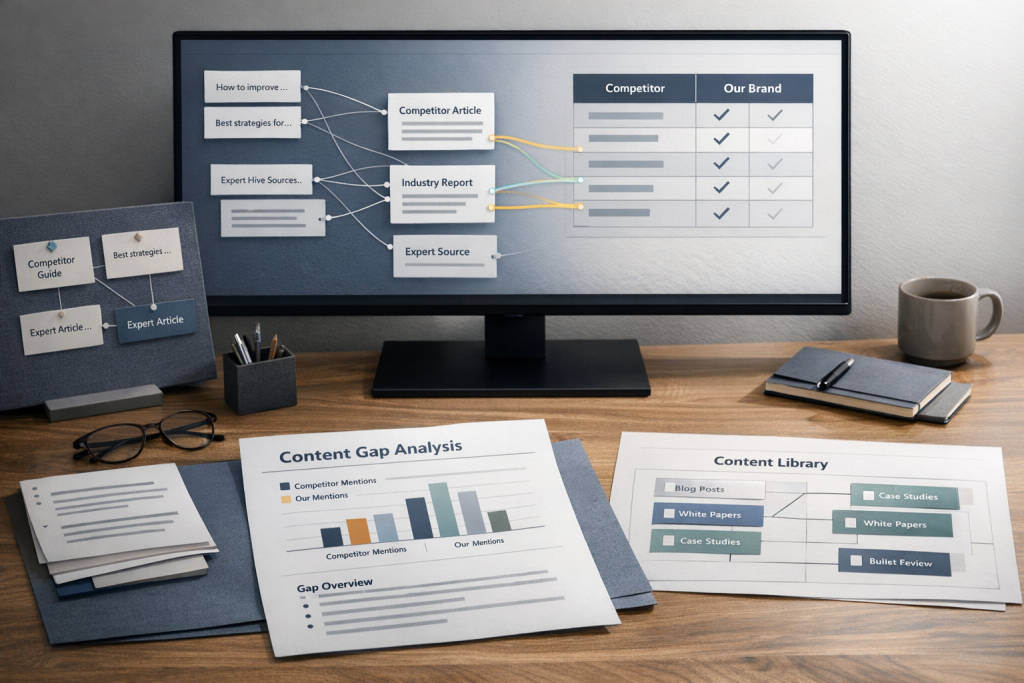
To find where AI engines cite competitors instead of you, run the buyer questions your customers actually ask through ChatGPT, Perplexity, Google Gemini, Claude, and Google AI Overviews — then document which companies appear, which sources get cited, and where your brand is absent. This process is called competitor-citation gap analysis, and it reveals something traditional keyword research cannot: the specific questions where AI-generated answers recommend your competitors while omitting your company entirely.
This matters most if you are a content director, SEO lead, product marketer, CMO, or business owner who already invests in content or SEO but suspects that investment is not translating into AI-search visibility. The gap between ranking on Google and being cited by an AI assistant is real, observable, and increasingly relevant to how your buyers discover providers.
This guide walks through the full process: how to build a prompt set that reflects actual buyer behavior, how to audit citation presence across AI engines, how to diagnose why a competitor earns the citation, and how to close the gap with content that offers something AI systems can actually use.
What an AI Citation Gap Is and Why It Differs from a Keyword Gap
A keyword gap is a search term your competitor ranks for on Google that you do not. An AI citation gap is a buyer question where an AI engine names, recommends, or sources your competitor — and does not do the same for you.
These are not the same problem, and they do not have the same solution.
Keyword gaps are about page-level ranking for specific queries. AI citation gaps are about whether your content, your brand, or your expertise appears in a synthesized AI-generated answer that may draw from dozens of sources across the web. A company can rank on page one of Google for a term and still be completely absent from the AI-generated answer to the same question. The reverse also happens: a company with modest search rankings can appear in AI answers because its content directly and clearly answers the buyer’s question in a way the AI system can extract and use.
Understanding this distinction changes the way you audit, diagnose, and respond. If you treat AI citation gaps like keyword gaps — chasing rankings and optimizing title tags — you will likely miss the actual problem.
Mentioned versus Cited: A Critical Distinction
When an AI engine generates an answer, it can interact with your brand in two meaningfully different ways:
- Mentioned: The AI names your company in its response, usually as one option among several. Your brand appears in the text, but the AI does not link to or source your content as evidence for its answer.
- Cited: The AI uses your content as a source. Your website URL appears in the citations, footnotes, or source list attached to the answer. The AI treats your page as a credible reference that supports what it is telling the reader.
This distinction matters because the remediation strategy is different. If you are mentioned but not cited, the AI system recognizes your brand but does not find your content useful enough to source. If you are neither mentioned nor cited, you have a deeper visibility problem — the AI system may not associate your brand with the topic at all.
When you audit citation gaps, track both. A company that is mentioned but never cited faces a content quality or structure challenge. A company that is completely absent faces a broader authority and coverage challenge.
Step One: Build a Prompt Universe That Reflects How Buyers Actually Ask AI
The foundation of any AI citation gap analysis is the set of questions you test. If you test the wrong questions, you will either miss your real gaps or waste effort on queries that do not influence buyer decisions.
Most teams start by typing their company name or product category into ChatGPT and scanning the result. That is a branded check, not a gap analysis. Branded queries tell you whether AI knows you exist. They do not tell you whether AI recommends you when a buyer asks a real purchase-intent question without mentioning your name.
Why Keywords Are Not the Right Starting Point
Traditional keyword research tools surface search terms based on Google query volume. Those terms may not reflect how people phrase questions to an AI assistant. A buyer who types “best HVAC company Los Angeles” into Google might ask ChatGPT something more conversational: “I need a reliable HVAC company in the San Fernando Valley that handles commercial buildings — who should I call?” The underlying intent is the same, but the phrasing, specificity, and context differ.
Start with buyer questions, not keywords. Think about what your customers actually need to decide, compare, evaluate, or accomplish before they choose a provider.
Eight Prompt Types That Matter
A useful prompt universe covers a range of buyer question types. Not every type will apply to every business, but testing across categories ensures you are not blind to gaps in specific parts of the buyer journey.
- Category prompts: “What are the best [your category] companies in [your market]?”
- Problem prompts: “How do I solve [problem your service addresses]?”
- Comparison prompts: “What is the difference between [your approach] and [alternative approach]?”
- Alternatives prompts: “What are alternatives to [competitor or incumbent solution]?”
- Recommendation prompts: “Who would you recommend for [specific use case]?”
- Evaluation prompts: “What should I look for when choosing a [your category] provider?”
- Implementation prompts: “How do I [task your product or service enables]?”
- Industry-specific prompts: “What [your category] solutions work best for [specific industry or vertical]?”
For each type, write three to five specific versions using natural language. Aim for 30 to 50 total prompts. Prioritize unaided discovery prompts — questions that do not include your brand name — because those reveal whether AI recommends you organically based on what it knows about your company and content.
How to Generate Prompts Efficiently
Talk to your sales team. Review the questions prospects ask on discovery calls. Read customer support tickets. Pull the sub-questions that surface in Google search results beneath your core topics. Browse relevant Reddit threads and community forums where your buyers talk through their decisions. These sources surface the real language buyers use — language your content should reflect.
Step Two: Run Prompts Across Multiple AI Engines and Document What You Find
AI engines do not agree with each other. The same buyer question, asked the same way, can produce different cited sources in ChatGPT, Perplexity, Gemini, Claude, and Google AI Overviews. This is not a bug — it reflects different training data, different retrieval systems, and different citation behaviors across platforms.
Testing across multiple engines is not optional if you want an accurate picture of your citation gaps. A company might be consistently cited by Perplexity but completely absent from ChatGPT answers to the same question. That is actionable information, but you will never see it if you only test one engine.
What to Capture for Each Response
For every prompt you run on every engine, log the following in a spreadsheet or structured document:
| Field | What to Record |
|---|---|
| Prompt text | The exact question you asked |
| AI engine | ChatGPT, Perplexity, Gemini, Claude, or Google AI Overview |
| Competitors mentioned | Which competitor brands appear in the response text |
| Competitors cited | Which competitor URLs appear in source links or footnotes |
| Your brand mentioned | Yes or no |
| Your site cited | Yes or no, and which URL if applicable |
| Third-party sources cited | Review sites, directories, forums, or publications that appear |
| Date tested | AI responses can change over time — timestamps matter |
This log becomes the raw data for your gap analysis. Without it, you are working from impressions instead of evidence.
Why Engine-by-Engine Variation Matters Strategically
If a competitor appears consistently across all engines, their content and authority signals are strong and broadly recognized. If they appear only in one or two engines, the gap may be narrower — perhaps driven by a single well-structured page that one engine’s retrieval system favors.
Similarly, if your brand appears in Perplexity but not ChatGPT, the issue may not be content quality. It could be a retrieval or crawlability difference between platforms. This kind of diagnostic detail changes your response strategy.
Step Three: Calculate Your Citation Gap by Prompt Cluster
Individual prompt results are useful but noisy. AI responses can vary between sessions, and a single prompt is not a reliable indicator on its own. To get a clearer signal, group your prompts into clusters based on topic or buyer-journey stage, then aggregate the results.
How to Build Prompt Clusters
Group prompts that address the same underlying buyer question or decision point. For example, three slightly different phrasings of “who is the best provider in my category” should be treated as one cluster. Five prompts about “how to evaluate vendors” form another cluster.
For each cluster, count how many times each competitor is mentioned and cited across all prompts and engines, and do the same for your brand. The result is a citation frequency by cluster — and the difference between your competitor’s frequency and yours is your citation gap for that cluster.
A Simple Example
| Prompt Cluster | Competitor A Citations | Competitor B Citations | Your Citations | Citation Gap |
|---|---|---|---|---|
| Best providers in category | 8 | 6 | 1 | High |
| How to evaluate vendors | 4 | 5 | 4 | Low |
| Common implementation problems | 7 | 3 | 0 | Critical |
| Alternatives to incumbent solution | 5 | 2 | 0 | Critical |
This kind of structured view immediately shows where to focus. Clusters with zero citations and high competitor presence represent your most significant gaps.
Why the Biggest Gap Is Not Always the Highest Priority
A large citation gap on a prompt cluster that your buyers rarely ask is less urgent than a moderate gap on a high-intent purchase question. Prioritize gaps based on three factors:
- Customer value: How directly does this question relate to a buying decision?
- Competitor citation frequency: How consistently are competitors appearing here?
- Feasibility: Can you realistically create content that addresses this question better than what currently exists?
Focus first on high-value, high-gap, high-feasibility clusters. That is where content investment is most likely to move the needle.
Step Four: Diagnose Why the Competitor Is Being Cited
Finding the gap is step one. Understanding why the gap exists is where most teams stop too early. The default assumption — that competitors simply have more content or more backlinks — is often wrong, or at least incomplete.
AI citation selection appears to be influenced by a combination of factors that do not map neatly to traditional SEO ranking signals. Based on observable patterns, citation gaps tend to fall into four types, and each requires a different response.
The Four Types of AI Citation Gaps
| Gap Type | What It Means | Diagnostic Signal |
|---|---|---|
| Content gap | You do not have any content that addresses the buyer question | No relevant page exists on your site for the topic |
| Information gap | You cover the topic, but your content is missing a specific element the AI answer includes — a comparison, a data point, a concrete example, a price range, a step-by-step process | Your page exists but lacks the specific detail the competitor’s cited page provides |
| Authority gap | Third-party sources — review platforms, industry publications, community forums — establish the competitor as a recognized authority on this topic | The AI cites third-party sources that mention the competitor, not the competitor’s own pages |
| Retrieval gap | Your content addresses the question well, but its structure, format, or technical setup makes it difficult for AI systems to find, parse, or extract | Your content is strong but buried in PDFs, gated behind logins, blocked by robots.txt rules, or structured in a way that resists extraction |
Most teams default to treating every gap as a content gap — they create a new blog post and hope for the best. But if the real issue is an authority gap, a new blog post does nothing. If the real issue is a retrieval gap, the content already exists and just needs structural improvement.
What to Look for When You Inspect a Competitor’s Cited Page
When you identify a page that AI engines consistently cite for a particular buyer question, examine it carefully:
- Does the page answer the specific question directly, usually near the top?
- Does it use clear headings that match the subtopics AI systems include in their answers?
- Does it include specific details — numbers, comparisons, named steps, concrete examples — that make its explanation more precise than generic alternatives?
- Is the content structured in short, self-contained paragraphs that could be extracted and quoted independently?
- Does the page define key terms explicitly rather than assuming the reader already knows them?
- Is the content accessible in clean HTML, not locked in images, JavaScript-rendered widgets, or downloadable files?
These are observable characteristics, not a guaranteed formula. But they appear consistently across content that AI engines choose to cite, and they represent practical qualities you can build into your own content.
Step Five: Close the Gap with Content That Offers Information Gain
Information gain is a useful concept here. It means your content provides something a reader — or an AI system — cannot get from the pages that already exist on the topic. Copying a competitor’s structure and restating the same points in different words is not information gain. It is duplication with a different byline.
Genuine information gain comes from adding clarity, depth, specificity, examples, frameworks, or perspective that the existing content landscape lacks.
How to Respond to Each Gap Type
Content gap — create the missing content. If you have no page addressing the buyer question, build one. Make it the clearest, most specific, most practically useful answer available. Structure it so the core answer appears early, and support it with the detail, examples, and context that make your page worth citing over a generic alternative.
Information gap — add the missing element. If your existing page covers the topic but lacks a specific detail that competitors include, add it. This might be a comparison table, a concrete example, a named framework, a step-by-step process, cost context, or a section addressing a common edge case. Identify exactly what the competitor’s cited page includes that yours does not, and fill that gap precisely.
Authority gap — build third-party presence. If AI engines are citing third-party review sites, directories, industry publications, or community discussions that mention competitors but not you, your content alone will not solve the problem. You need to appear in those third-party ecosystems authentically — through earned media, genuine community participation, industry contributions, and relationship-building with the publications and platforms your buyers trust. This is slower work, but it addresses the root cause.
Retrieval gap — fix structure and accessibility. If your content is strong but AI systems are not finding or extracting it, check the technical fundamentals. Is the page blocked by robots.txt? Is important content rendered only in JavaScript? Is the key information buried deep in the page below filler content? Is the page missing clear headings that match buyer questions? Is the content trapped in a PDF or behind a login? Retrieval gaps are often the easiest to fix once identified.
What AI Systems Appear to Favor in Cited Content
Based on observable citation patterns across major AI engines, content that gets cited tends to share several characteristics:
- A direct answer to the question appears near the top of the page, before context or background
- Headings match the subtopics and sub-questions buyers actually ask
- Important terms are defined clearly, not assumed
- Explanations are specific enough to stand on their own — an AI system can extract a paragraph and it still makes sense without the surrounding content
- The page uses consistent terminology throughout, rather than rotating synonyms for stylistic variety
- Facts, opinions, and recommendations are clearly distinguished from each other
None of this requires writing in a stiff, robotic way. It requires writing clearly, organizing carefully, and making every section genuinely useful to a reader who arrived with a specific question.
Step Six: Track Citation Gaps Over Time
A one-time audit gives you a snapshot. AI citation patterns are not stable. The sources AI engines cite for a given question can shift as new content is published, as AI models are updated, and as third-party sources gain or lose prominence. A competitor that dominates AI answers today may not hold that position in three months — and neither will you, unless you are monitoring.
What to Track on an Ongoing Basis
- AI mention share: How often your brand is named in AI responses to your core buyer questions, relative to competitors
- AI citation share: How often your content is cited as a source, relative to competitors
- Gap-specific tracking: Which prompt clusters still show gaps after you have published new or updated content
- Engine-by-engine trends: Whether your visibility is improving on some platforms but not others
- Third-party citation shifts: Whether AI engines are increasingly citing review sites, forums, or publications instead of direct company content
How Often to Run This Process
A monthly cadence is practical for most B2B companies. Running prompt audits more frequently creates noise without adding signal. Running them less frequently means gaps can widen unnoticed for quarters at a time. Monthly tracking also lets you measure whether content you published or updated in the previous cycle has begun to affect citation presence.
What This Process Actually Requires
The steps above are straightforward to describe and genuinely difficult to execute consistently.
Building a prompt universe requires buyer research. Running prompts across five AI engines and logging results for 30 to 50 questions is time-intensive. Diagnosing gap types requires inspecting competitor pages and third-party sources carefully. Creating content with real information gain — not just filling a calendar — requires research, writing skill, and subject-matter understanding. Publishing to WordPress, distributing to social channels, and repeating the tracking cycle monthly adds ongoing operational load.
For teams already managing SEO programs, paid campaigns, product launches, and sales support, this is often the point where AI visibility work stalls. The initial audit gets done. The tracking spreadsheet gets built. And then it sits untouched because no one has bandwidth to run the process every month.
This is where the choice between doing it in-house and working with a full-service partner becomes practical, not theoretical.
What a Managed Approach Looks Like
CiteHarbor exists specifically to remove the management burden of AI visibility work. Instead of handing you a dashboard and asking you to run the process yourself, CiteHarbor performs the audit, researches your buyer questions, identifies citation gaps, creates targeted content designed to improve your visibility against those gaps, publishes to your WordPress site, distributes to your social channels, monitors competitor citations, and sends you a branded PDF performance snapshot each month.
The result is a clear AI visibility baseline, ongoing tracking against that baseline, a growing library of useful content on your own properties, and monthly reporting — without adding another platform, another login, another workflow, or another vendor to manage.
This does not mean CiteHarbor can guarantee that AI engines will cite your content. No service can make that promise honestly, because AI citation behavior is determined by the AI systems themselves, not by any external agency. What CiteHarbor does is handle the research, content, distribution, and tracking work that gives your brand the strongest possible foundation for being recognized, referenced, and cited in AI-generated answers over time.
Frequently Asked Questions
What is the difference between an AI citation gap and a keyword gap?
A keyword gap is a search term your competitor ranks for on Google that you do not. An AI citation gap is a buyer question where an AI engine names or sources your competitor in its answer while your brand or content is absent. Keyword gaps are about page rankings. AI citation gaps are about whether your content is useful enough — and accessible enough — for AI systems to reference when generating answers.
How many prompts should I test to get a useful picture?
Thirty to fifty prompts across eight to ten buyer-question types is a practical starting point for most B2B companies. Fewer than twenty prompts risks missing important gaps. More than a hundred creates diminishing returns unless your product category is unusually broad.
Which AI engines should I test first?
Start with ChatGPT, Perplexity, and Google AI Overviews, as these are currently the most widely used AI-search environments for buyer research. Add Google Gemini and Claude for a more complete picture. Each engine has different retrieval and citation behaviors, so testing across multiple platforms reveals gaps that single-engine testing misses.
What does it mean if AI mentions my brand but does not cite my website?
It means the AI system recognizes your brand as relevant to the topic but does not find your content useful or accessible enough to source as evidence. This is typically an information gap or a retrieval gap. Your brand has some visibility, but your content is not structured, detailed, or extractable enough to earn the citation. Check whether the AI is citing third-party sources that mention you instead of your own pages.
Why is my competitor cited more often even though I rank higher on Google?
AI citation selection does not map directly to Google search rankings. AI systems evaluate content based on how clearly and directly it answers the question, how well-structured it is for extraction, and how broadly it is referenced across third-party sources. A competitor with lower Google rankings but clearer, more specific, better-structured content on a topic may earn AI citations more consistently than a higher-ranking page that is vague or poorly organized.
How often should I run this kind of audit?
Monthly is the practical cadence for most businesses. AI citation patterns change as models are updated and new content enters the ecosystem. A quarterly audit may miss shifts that happened weeks ago. Monthly tracking provides enough signal to measure whether your content efforts are influencing citation presence without creating unsustainable overhead.
What should I do if AI is citing third-party review sites instead of my own content?
This indicates an authority gap. AI engines are treating third-party sources — review platforms, directories, forums, industry publications — as more credible or relevant on the topic than your direct content. Respond by building authentic presence on those platforms: earn reviews, contribute to relevant publications, participate genuinely in communities your buyers use, and pursue earned media. Simultaneously, strengthen your own content so it offers information gain beyond what those third-party sources provide.
Is this something I can do manually or do I need a tool?
You can run the initial audit manually using a spreadsheet and direct access to AI engines. The process is straightforward but time-intensive — especially when running 30 to 50 prompts across multiple engines and logging results for each. For ongoing monthly tracking, the operational burden grows. Many B2B teams find that the research, content creation, publishing, and monitoring overhead is better handled by a full-service partner than managed internally alongside existing marketing responsibilities.
The Clear Next Step
If you have read this far, you understand that finding AI citation gaps is not a one-time curiosity check — it is a structured, repeatable process that requires buyer-question research, multi-engine testing, diagnostic analysis, content creation, and ongoing tracking. You also understand that the management burden of doing this well is real.
CiteHarbor handles the entire process. Auditing, buyer-question research, content creation, WordPress publishing, social distribution, competitor monitoring, and monthly branded performance snapshots — without requiring you to manage another platform or learn another tool.