What Content Gets Cited by ChatGPT and AI Search Engines — And Why Format Alone Is Not the Answer
AI search engines cite content that offers original evidence, clear structure, and specific answers they cannot generate on their own. This guide explains which content types are most likely to be cited and how to audit your existing content for AI-search visibility.
What Content Gets Cited by ChatGPT and AI Search Engines — And Why Format Alone Is Not the Answer
AI search engines cite content that contains something they cannot generate on their own. Original data, firsthand evidence, verifiable comparisons, and precise answers to specific buyer questions are what earn citations — not a particular blog format or word count.
If you are a content director, SEO lead, product marketer, or business owner wondering why your existing articles rarely appear in ChatGPT, Perplexity, Gemini, or Google AI Overviews, the answer is usually not that you chose the wrong format. The answer is that your content does not give those systems a reason to attribute anything to you specifically.
This article explains which content types are most frequently cited by AI search engines, why each type earns citations, how different AI platforms behave differently, and how to evaluate whether your existing content is citation-ready. It is written for teams that are already investing in content or SEO and want to understand how AI-search visibility actually works.
Ranking and Being Cited Are Not the Same Thing
Before examining which content types get cited, it is important to understand why a page can rank well in Google and still be invisible to AI search engines. These are two different selection processes with different criteria.
How Traditional Search Ranking Works
Google ranks pages based on relevance, authority, and user experience. A page earns a position in search results, and the user clicks through to read it. The page itself is the destination. Google’s job is to surface the best pages and let the user decide which one to visit.
How AI Citation Works Differently
When ChatGPT, Perplexity, or Google AI Overviews generate an answer, they synthesize information from multiple sources into a single response. They do not send the user to your page first — they pull from your page and present the answer directly. If your page is cited, it appears as a source link alongside the generated response.
This means AI systems are not evaluating which page a user should visit. They are evaluating which page contains a specific piece of information needed to build an accurate answer — and which source deserves attribution for it.
That distinction changes what your content needs to do. A page optimized for ranking needs to be the best overall resource on a topic. A page optimized for citation needs to contain specific, extractable, attributable statements that an AI system cannot produce from its own training data.
Why a Page Can Rank Well and Still Not Get Cited
Many pages that rank on the first page of Google contain excellent general advice that is already well-known enough for an AI system to generate without needing a source. If your article states that producing high-quality content matters for SEO, that claim is true — but an AI system does not need to cite your page to make it. The information is already part of its training.
Pages get cited when they contain something the AI system cannot confidently generate from its own knowledge: a specific statistic, a proprietary framework, a firsthand observation, a structured comparison that resolves a real question, or a precise definition that the system wants to attribute rather than risk getting wrong.
The Underlying Logic of What AI Systems Want to Cite
Rather than memorizing a list of content formats, it is more useful to understand the three conditions that make any piece of content citation-worthy. Every format recommendation below ties back to these three layers.
Layer 1: The Content Contains Something the AI Cannot Generate Itself
This is the single most important factor. AI systems are trained on vast amounts of text. They can generate plausible explanations of most common topics without referencing any specific source. What they cannot generate is:
- Original research data they have not been trained on
- Proprietary survey results or benchmarks
- Firsthand experience with a specific product, process, or market
- Current pricing, availability, or specification details
- Verifiable facts that change over time and require a trusted source
- Expert analysis that depends on credentials or domain authority
If your content adds none of these, AI systems have no structural reason to cite you. They can say the same thing without attribution.
Layer 2: The Content Is Structurally Easy to Extract From
Even when a page contains original, valuable information, AI systems may skip it if the information is buried in long paragraphs, wrapped in ambiguous language, or hidden behind navigation elements that crawlers cannot parse.
Extractable content has specific characteristics: clear headings that signal what each section contains, self-contained paragraphs that make a single point, declarative opening sentences, and consistent terminology. These are not tricks — they are the same qualities that make content easy for a busy human to scan.
Layer 3: The Content Comes From a Source the AI System Can Attribute With Confidence
AI systems are increasingly cautious about sourcing. They prefer pages on domains with established topical authority, pages that have been linked to by other credible sources, and pages with clear authorship signals. A well-structured article on a brand-new domain with no backlinks and no topical history is less likely to be cited than the same article on a domain that has demonstrated expertise in that subject area over time.
This does not mean small or newer sites cannot be cited — but it does mean that building citation-worthiness is a compounding process, not a one-time optimization.
Content Formats Most Likely to Be Cited
Certain content formats are cited more frequently because they naturally satisfy the three layers above. Here is what the observable patterns suggest, along with the reasoning behind each format’s advantage.
Original Research and Proprietary Data
Original research is the strongest driver of AI citations. When a page contains a specific finding from a proprietary study — a percentage, a trend, a comparison — AI systems cite that page because they cannot responsibly generate the data point themselves.
This includes industry surveys, internal benchmark reports, customer behavior analyses, market studies, and any content where the publisher collected or analyzed data that does not exist elsewhere. The research does not need to be academic. A roofing company that publishes its own data on average project timelines across regions, or a SaaS company that shares aggregated usage patterns, creates the same kind of citation opportunity.
The key requirement is specificity. A page that offers only a vague observation about businesses struggling with content ROI is generic. A page that reports a concrete finding from an analysis of real programs — with a specific sample size and a specific percentage — gives an AI system something concrete to cite.
Structured Comparison and Decision-Support Content
Comparison pages — when done well — are frequently cited because they help AI systems answer a category of question they receive constantly: what separates one option from another, or which choice fits a particular situation.
AI systems can generate generic comparisons from training data, but they prefer to cite pages that include specific, current, verifiable details: feature-by-feature breakdowns, pricing tiers, use-case recommendations, limitations, and tradeoffs. The more specific and current the comparison, the more likely it is to be cited.
This applies equally to law firms comparing legal strategies, HVAC companies comparing equipment options, B2B consultants comparing methodologies, and SaaS companies comparing product categories.
FAQ and Question-Answer Formatted Content
FAQ sections and Q&A-structured articles are cited frequently because they match how users query AI systems. When someone asks ChatGPT how long a commercial roof replacement takes, the system looks for a source that answers that exact question in a concise, attributable format. A page that poses that question as a heading and answers it in two to three clear sentences is structurally ideal for citation.
The critical distinction is that the FAQ must contain genuinely useful, specific answers — not filler. An FAQ answer that defers entirely to situational variables adds nothing. An FAQ answer that names a specific timeframe and the conditions that affect it gives the AI system a quotable, citable block.
Comprehensive Informational Articles and Long-Form Guides
In-depth articles that cover a topic thoroughly — with clear section structure, multiple subtopics, and specific supporting detail — tend to be cited because they serve as reliable reference sources. AI systems can pull from different sections of the same article to answer different facets of a complex query.
These articles work best when they combine breadth with precision. Each section should be self-contained enough to be extracted independently, even though the full article creates a complete picture of the topic.
First-Party Authoritative Content
For commercial and transactional queries, AI systems increasingly cite first-party pages: product documentation, service descriptions, pricing transparency pages, capability overviews, and limitation disclosures. When someone asks an AI system what a service includes or how a product category works, the system prefers to cite the source that has direct authority on the answer.
This is a content type that many B2B businesses underinvest in. The product page exists, but it is written for conversion rather than information. Adding clear, specific, well-structured informational content to first-party pages increases the chance that AI systems will cite them for relevant queries.
Freshly Updated Content on Evolving Topics
AI systems with web-search capabilities — including ChatGPT with browsing, Perplexity, and Google AI Overviews — weight recency for topics that change over time. A guide to tax filing deadlines, software compatibility, or regulatory requirements is more likely to be cited if it has been updated recently and reflects the current state of affairs.
This does not mean all content needs to be recent. Evergreen explanations of stable concepts do not require constant updates. But content on topics where accuracy changes — pricing, regulations, technology, market conditions — needs to reflect current reality to be citation-worthy.
User-Generated Content and Community Discussions
AI systems also cite community platforms — Reddit, LinkedIn, industry forums, and YouTube — when those platforms contain firsthand experience, specific recommendations, or detailed reviews that do not exist in traditional published content. This is worth noting because it means some of your brand’s citation competition comes from user-generated content, not just competing publishers.
For businesses, the practical implication is that participating meaningfully in relevant communities and ensuring your owned content answers the same questions being asked in those forums can help maintain citation visibility.
Different AI Engines Cite Differently
One of the most common mistakes in AI visibility strategy is treating all AI search engines as identical. They are not. Each system has different retrieval methods, different source preferences, and different citation behaviors.
| AI Platform | Citation Behavior | Source Tendencies |
|---|---|---|
| ChatGPT (with web search) | Cites a moderate number of sources per response. Tends to blend synthesis with direct attribution. Sources inline citations when making specific factual claims. | Draws from a broad web corpus. May cite sources that do not appear in top Google results. Favors pages with clear, declarative statements and specific evidence. |
| Perplexity | Citation-heavy by design. Provides numbered inline citations for most claims. Displays source cards prominently alongside the answer. | Retrieves actively from live web search. Tends to favor pages with strong topical authority and specific, verifiable claims. Frequently cites Reddit and community sources for experiential queries. |
| Google AI Overviews | Cites a small number of sources (typically 3 to 6) displayed as expandable cards below or alongside the generated overview. | Tends to draw from pages that perform well in Google’s organic index. Favors structured content, recognized domain authority, and clear topical relevance. |
| Google Gemini | Citation format varies by query type. Sometimes provides source links, sometimes does not. Less consistently citation-heavy than Perplexity. | Draws heavily from Google’s index. Tends toward shorter, more compressed answers. May favor concise, high-information-density pages. |
What this means for a content strategy is straightforward: a single article can be citation-worthy across multiple platforms, but only if it satisfies the common denominator — original evidence, clear structure, specific answers, and crawlable accessibility. Optimizing for only one AI engine at the expense of the others is rarely the right approach.
Structural and Technical Signals That Increase Citation Likelihood
Beyond format and substance, the way content is physically structured on the page affects whether AI systems can find, parse, and extract it.
Formatting for Extractability
- Descriptive headings: Use H2 and H3 headings that clearly state what each section covers. A heading like “How Long Does Commercial Roof Replacement Take?” gives AI systems an immediate signal about the content that follows — a vague label like “Timeline Considerations” does not.
- Self-contained paragraphs: Write paragraphs where the first sentence states the main point. AI systems often extract a single paragraph — if the key information is in the third sentence, it may be missed.
- Bullet and numbered lists: Use lists for groups of related items, steps, or criteria. Lists are structurally easy for AI systems to parse and reproduce with attribution.
- Tables: Use comparison tables when presenting feature differences, option breakdowns, or category comparisons. Tables are highly extractable and reduce ambiguity.
Declarative Sentences and Consistent Terminology
AI systems are more likely to cite sentences that make a clear, direct claim. A sentence that states a specific timeframe for an enterprise software sales cycle is more citable than one that acknowledges the cycle varies by situation. One gives the system something to attribute; the other gives it nothing to work with.
Consistency also matters. If you refer to “AI citation” in one section and “AI mention” in another and “AI reference” in a third, you introduce ambiguity about whether you mean the same concept. Use the same term throughout.
Schema Markup as a Parsing Aid
Schema markup — specifically Article schema for blog content and FAQPage schema for FAQ sections — helps search engines and AI systems understand what a page contains and how it is structured. Schema does not guarantee citations, but it reduces friction in the parsing process.
Only apply schema that accurately represents the page content. Adding FAQPage schema to a page without a genuine FAQ section is misleading and can cause problems with search engines.
Allowing AI Crawlers to Access Your Content
If your robots.txt file blocks AI crawlers, your content cannot be cited by the systems those crawlers serve. This is a common technical oversight. Specifically:
- Allow OAI-SearchBot if you want eligibility for ChatGPT search results. OpenAI has stated that sites blocking this crawler will not appear in ChatGPT search answers.
- Ensure Googlebot access is not inadvertently restricted, which affects Google AI Overviews.
- Confirm that your main content is rendered in crawlable HTML, not loaded entirely via JavaScript that crawlers cannot execute.
What AI Systems Consistently Deprioritize
Understanding what does not get cited is as useful as understanding what does. AI systems tend to skip content that exhibits these characteristics — not because of a penalty, but because the content does not meet their selection needs.
- Content that only restates common knowledge: If the article says nothing an AI system could not generate from its training data, there is no reason to cite it.
- Content with vague, unsubstantiated claims: Assertions like claiming to be the best in the industry or letting results speak for themselves are not useful to an AI system building a factual answer.
- Content buried behind inaccessible formats: Information locked in PDFs, images, embedded videos, or JavaScript-rendered elements that crawlers cannot process.
- Thin pages that cover a topic superficially: A 200-word blog post that barely touches its topic provides less useful extraction material than a thorough, well-organized article.
- Duplicate or near-duplicate content: If the same article exists in multiple versions across a site, AI systems may not cite any of them because the source signal is unclear.
- Pages blocked by robots.txt or marked as noindex: A technical eligibility issue, not a content quality issue, but equally effective at preventing citations.
How to Audit Your Existing Content for Citation Readiness
If you have a content library that is underperforming in AI search, the following framework can help you evaluate what is worth updating, what needs restructuring, and what is missing entirely.
Layer 1 — Discoverability: Can AI Systems Find This Page?
Ask these questions about each page:
- Is the page indexed by Google?
- Is the page accessible to AI crawlers (not blocked in robots.txt)?
- Is the main content in crawlable HTML?
- Does the page have a clear, descriptive URL?
- Is the page linked from other pages on the site and from external sources?
If any answer is no, the page is not eligible for citation regardless of its content quality.
Layer 2 — Extractability: Can AI Systems Quickly Identify What This Page Says?
- Does the page have a clear title that describes the topic?
- Do the headings accurately summarize each section’s content?
- Does the first paragraph state the core answer or thesis?
- Are key claims made in direct, declarative sentences?
- Are definitions, comparisons, or data points presented in extractable formats (short paragraphs, lists, tables)?
- Is schema markup applied accurately?
A page can be discoverable but not extractable if its information is scattered, ambiguous, or buried in narrative prose that lacks structural clarity.
Layer 3 — Citation-Worthiness: Does This Page Contain Something Worth Attributing?
- Does the page contain original data, research, or firsthand evidence?
- Does the page answer a specific question that buyers actually ask?
- Does the page offer a specific comparison, framework, or decision tool?
- Does the page provide information that AI systems cannot generate from general training data?
- Would removing this page from the internet make a specific answer less accurate?
This last question is the most useful diagnostic. If the answer is no — if the AI system would produce the same answer without your page — then your content is not yet citation-worthy on that topic.
Why This Matters for Teams Already Investing in Content
Many businesses we talk to at CiteHarbor are already producing blog content, already running SEO programs, and already spending on content marketing. The frustration is not that they lack content — it is that their content is not working in AI search.
The pattern is usually the same. The content was created for traditional SEO: target a keyword, write a comprehensive article, optimize the title and meta description, build some links, and publish. That approach can still drive organic search traffic. But it does not automatically produce content that AI systems cite.
The gap is almost always in the buyer-question research layer. The content targets keywords instead of questions. It covers topics generically instead of answering specific queries with specific evidence. It reads well as a general resource but does not contain discrete, citable blocks that an AI system would attribute to the source.
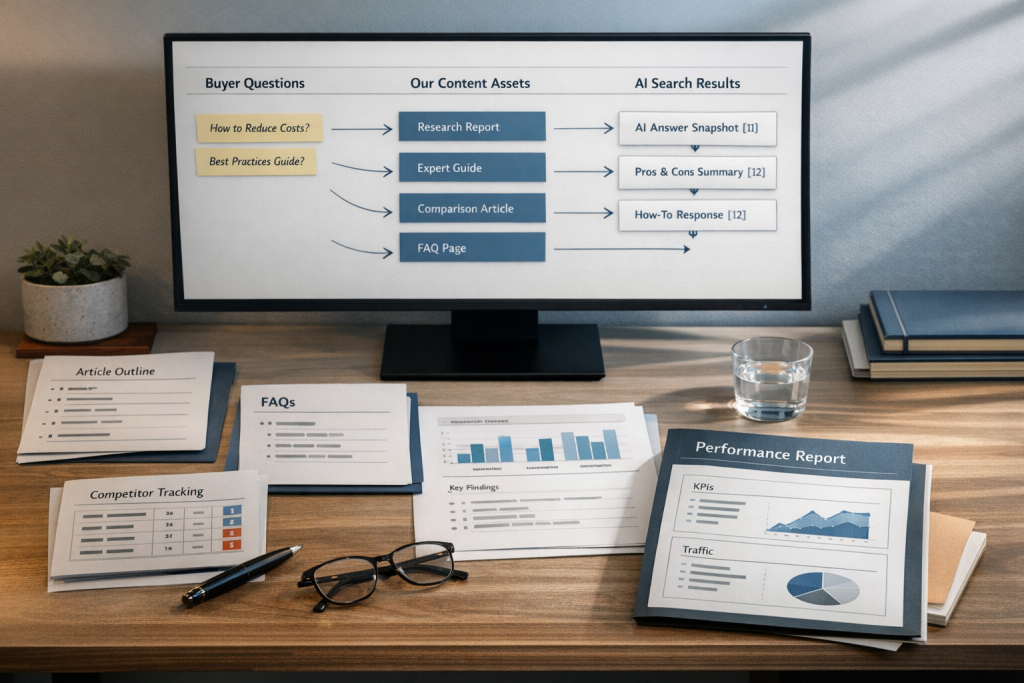
This is the core difference between traditional content marketing and a content strategy designed for AI visibility. It is not about choosing different formats. It is about starting from different questions — the specific questions your buyers are asking AI assistants — and creating content that gives AI systems something worth citing.
How CiteHarbor Approaches This
CiteHarbor exists because most businesses do not have the time or internal resources to research buyer questions across AI platforms, create content designed for citation-worthiness, publish and distribute that content consistently, track whether AI systems are actually citing them, and monitor what competitors are being cited for.
Our approach handles the entire workflow:
- AI visibility auditing: We establish a baseline of where your brand currently appears — and where it is absent — across ChatGPT, Perplexity, Gemini, Claude, and Google AI Overviews.
- Buyer-question research: We identify the specific questions your buyers are asking AI assistants, not just what keywords they are searching on Google.
- Content creation: We produce articles designed around those buyer questions, structured for both human usefulness and AI extractability.
- Publishing and distribution: We handle WordPress publishing and social media distribution so you do not need to manage another workflow.
- Citation tracking and competitive intelligence: We monitor AI citation patterns monthly, track competitor visibility, and send you a branded PDF performance snapshot.
You do not manage a dashboard. You do not log into another platform. You receive a clear monthly report showing where you stand and what has changed.
This is not a software product. It is a managed service that eliminates the operational burden of AI visibility — the research, the content, the publishing, the tracking, and the reporting.
Frequently Asked Questions
What is the difference between ranking on Google and being cited by ChatGPT?
Google ranking determines which pages appear in search results for a user to click on. AI citation determines which pages are referenced as sources when an AI system generates an answer. A page can rank well without being cited, and in some cases, a page can be cited by AI systems even if it does not hold a top Google ranking for the same query.
Which content format gets cited most often by AI search engines?
Observable patterns suggest that original research with specific data points is cited most frequently, followed by structured comparisons, FAQ-formatted content, and comprehensive informational articles. However, format alone is not the deciding factor — citation-worthiness depends on whether the content contains something the AI system cannot generate independently.
Do ChatGPT, Perplexity, and Google AI Overviews cite the same sources?
Not always. Each platform has different retrieval methods and different source preferences. Google AI Overviews draw primarily from pages that perform well within Google’s own index. Perplexity searches the live web broadly and frequently cites community content. ChatGPT may draw from sources that do not appear in top Google results. A multi-engine content strategy should aim for the common denominator: original evidence, clear structure, and crawlable accessibility.
Does schema markup help with AI citations?
Schema markup helps search engines and AI systems parse your content more accurately. Article and FAQPage schema are the most relevant types for blog content. Schema does not guarantee citations, but it removes a technical barrier that could prevent AI systems from understanding your page correctly.
Can small or newer websites get cited by AI engines?
Yes, but it is harder without established topical authority. Newer sites can improve their chances by focusing on highly specific buyer questions where competition is lower, producing original research or firsthand data that larger competitors have not published, and building topical depth over time rather than trying to cover every subject.
How do I know if my content is currently being cited by AI systems?
You can manually test by asking AI assistants the same questions your buyers ask and checking whether your brand or pages appear in the response. For systematic, ongoing tracking, a monitoring process is needed that checks citation patterns across multiple AI platforms regularly. This is one of the core functions CiteHarbor provides as part of its managed service.
How often should I update content to maintain citation likelihood?
Evergreen explanations of stable concepts do not need frequent updates. Content on topics that change — pricing, regulations, technology, market conditions — should be updated whenever the core facts shift. A quarterly review of your most important articles is a reasonable starting point for most businesses.
Where to Go From Here
If your current content strategy produces articles that attract limited engagement and do not show up when buyers ask AI assistants about your category, the issue is almost certainly not effort or volume. It is that the content was designed for a different system — traditional search — and has not been adapted for a world where AI engines synthesize answers from sources they judge to be citation-worthy.
The good news is that improving AI visibility is not about starting over. It starts with understanding your current baseline, identifying the buyer questions that matter most, and creating content that gives AI systems a genuine reason to cite you.
CiteHarbor handles all of this — the audit, the research, the content, the publishing, the tracking, and the reporting — so you get visibility without the management burden.