What Is an AI Citation Audit and What Should It Actually Reveal
Learn what an AI citation audit examines, how it differs from traditional SEO, and what a thorough audit should reveal about your brand’s AI visibility.
What Is an AI Citation Audit and What Should It Actually Reveal
An AI citation audit is a structured diagnostic that maps which sources, pages, and domains AI systems draw on when generating answers about your brand, your category, or the decisions your buyers are making — and whether those sources are accurate, current, and positioned in your favor. It is the most direct way to understand whether your business surfaces in AI-generated answers, how it is represented, and where it is absent entirely.
Most marketing leaders already monitor Google rankings, ad performance, and content engagement. But when a potential buyer asks ChatGPT, Gemini, Perplexity, or Claude for a recommendation in your space, a separate discovery layer activates — one that most businesses have never examined. An AI citation audit is how you replace assumptions about that layer with actual evidence.
This article covers what an AI citation audit examines, what a thorough audit should deliver, what separates a meaningful audit from a surface-level one, and how findings translate into real content decisions. If you are weighing whether your business needs one, this gives you enough specifics to know what to look for and what to require.
What an AI Citation Audit Actually Examines
An AI citation audit runs structured queries across major AI platforms — including ChatGPT, Google Gemini, Claude, Perplexity, and Google AI Overview — using the kinds of questions your buyers genuinely ask. It then captures which sources each system references, which URLs it links to, which brands it names, and how it characterizes the options it presents.
The objective is not to test a single prompt in isolation. It is to build a representative picture of how AI systems currently handle your brand, your competitors, and your category across a meaningful range of buyer-relevant queries. The audit produces a baseline — a structured snapshot of your current AI visibility that can be benchmarked against competitors and measured over time.
This is a fundamentally different exercise from a traditional SEO audit. An SEO audit looks at how your pages perform in Google’s ranked results. An AI citation audit looks at whether AI systems treat your content as a credible source worth referencing when they construct answers for your buyers.
Citation Versus Mention — Why the Distinction Matters
One of the clearest things an AI citation audit should establish is the difference between being mentioned and being cited. These outcomes are not equivalent, and treating them as such creates false confidence about where your brand actually stands.
What a Mention Looks Like
A mention means an AI system names your brand in its response but does not link to your website or attribute any specific content to you. This typically reflects the AI model having encountered your brand name during training. Mentions produce no direct traffic, no attribution, and no verifiable connection between what the AI said and anything on your site.
What a Citation Looks Like
A citation means the AI system links to one of your pages as a supporting source for its answer. The user can follow that link. The AI is signaling: this page contributed to what I just told you. Citations create a traceable path between AI-generated responses and your owned content.
Why the Gap Between Them Is the First Thing an Audit Should Measure
Many businesses learn through an audit that they are mentioned frequently but cited rarely — or not at all. That outcome means AI systems recognize the brand but do not treat its content as reference-worthy. The gap between mentions and citations is one of the most actionable findings an audit can surface, because it points directly to solvable problems in content structure, authority signals, and extractability.
| Characteristic | Mention | Citation |
|---|---|---|
| Brand name appears in AI answer | Yes | Yes |
| URL linked as a source | No | Yes |
| Traceable to specific owned content | No | Yes |
| Generates direct traffic | No | Possible |
| Indicates content is being used as a source | No | Yes |
| Persists when AI retrieves live sources | Varies | More likely |
How an AI Citation Audit Works
The process runs through three core stages. Each stage contributes something the others cannot replace, and omitting any one of them weakens the result.
Prompt Simulation
The audit starts by assembling a query set that reflects how real buyers actually search and ask questions in your category. These are not placeholder prompts — they are the specific, intent-driven questions buyers use when they are weighing options, comparing providers, or working through a problem.
The query set should span multiple AI platforms — at minimum ChatGPT, Gemini, Claude, and Perplexity — because each system retrieves and cites sources through different logic. A brand that appears prominently in Perplexity may be entirely absent from Gemini for the same query. The query set should also span the buyer journey: early-stage research, mid-stage comparison, and decision-stage questions each reveal different citation patterns.
The quality of the query set matters more than its volume. A focused set of well-chosen buyer questions will produce sharper findings than a large set of generic prompts.
Source Extraction
For each query on each platform, the audit records which URLs are cited, which brands are named, how the AI characterizes each option, what language it applies, and whether the information it presents holds up. This forms the raw evidence layer.
Source extraction also captures which content types are being cited — blog posts, service pages, third-party articles, forum threads, directory listings, press coverage — because those patterns reveal where authority is actually being established in your category.
Gap Mapping and Competitive Benchmarking
The audit then compares your citation and mention data against competitors running the same queries. This produces a competitive citation share view: for the buyer questions that matter most, which brands are being cited, how often, in what order, and from which sources.
Gap mapping also surfaces the queries where no brand in your category is being cited effectively — which represent openings where well-structured new content could step into a vacuum.
What a Complete AI Citation Audit Should Reveal
This is where most audits fall short. A useful audit does not simply confirm whether your brand appeared somewhere. It should deliver specific, named findings across multiple dimensions. Here is what a thorough audit should surface:
Citation rate versus mention rate. How often your brand is cited with a linked source versus simply named without attribution. That ratio tells you whether AI systems are treating your content as a source or merely recognizing your brand as a known entity.
Which URLs are actually being cited. Not just brand presence, but which specific pages AI systems are pulling from. You may find that one piece of content accounts for nearly all your citations while dozens of other pages are never referenced.
Competitor citation share. For the same buyer queries, which competitors are being cited, at what frequency, and from which sources. This is the competitive intelligence layer — it shows where you are winning, where you are losing ground, and where you are not appearing at all.
Citation position. Whether your source appears near the top of an AI answer or is listed after several competitors. Position within an AI response affects whether users encounter your brand before they stop reading.
Accuracy and sentiment of AI-generated descriptions. When AI systems describe your brand, is the description correct? Is it drawing on outdated information? Is it attributing offerings you do not have, or overlooking ones you do? Inaccurate AI representations are a genuine business problem, and the audit should bring them to the surface.
Extractability gaps. Whether your content is organized in a way that AI systems can read, parse, and reference. Pages with clear headings, direct answers, and structured sections are more extractable than pages with dense unstructured prose or content rendered dynamically through scripts.
Technical crawl accessibility. Whether your pages are reachable by the crawlers AI systems use to retrieve live sources. Blocked robots.txt directives, noindex tags, broken pages, and slow load times can all prevent AI systems from accessing your content in the first place.
Citation accuracy and evidentiary validity. This is a dimension most marketing-focused audits overlook entirely. Are the citations AI systems produce actually supported by the pages they link to? Do the cited URLs contain the information the AI attributes to them? Are any citations hallucinated — pointing to pages that do not exist or do not say what the AI claims? These findings matter for brand integrity and for understanding how reliably AI systems are drawing on your content.
Citation durability. Whether a citation appears consistently across repeated runs of the same query, or surfaces once and then disappears. Durable citations signal that AI systems reliably identify your content as relevant. Inconsistent citations may indicate your content is near the threshold of being source-worthy but has not yet crossed it.
Channel gaps. Where the cited authority in your category is originating. Is it coming from brand-owned content? Third-party press? Industry forums? Review platforms? Directory listings? Channel gap analysis tells you not only what to create but where to establish presence.
What a Good Audit Output Actually Looks Like
Understanding what an audit covers is one thing. Knowing what you should actually receive as a deliverable is another. A well-executed AI citation audit should produce a concrete, readable output — not a verbal debrief or an unprocessed data export.
A complete audit output should include:
- A query-by-query citation map showing, for each buyer question tested, which brands were cited, which URLs were referenced, on which AI platforms, and whether the information presented was accurate.
- A competitive citation share summary showing how your brand’s citation frequency compares to key competitors across the full query set.
- A list of your pages currently being cited — alongside a list of pages that are not being cited despite being directly relevant.
- Identified gaps with specific content or channel responses suggested — not broad advice to publish more, but clear identification of which buyer questions lack strong source material and what type of content would address them.
- A baseline for ongoing tracking so that future measurement reflects genuine change rather than isolated one-time snapshots.
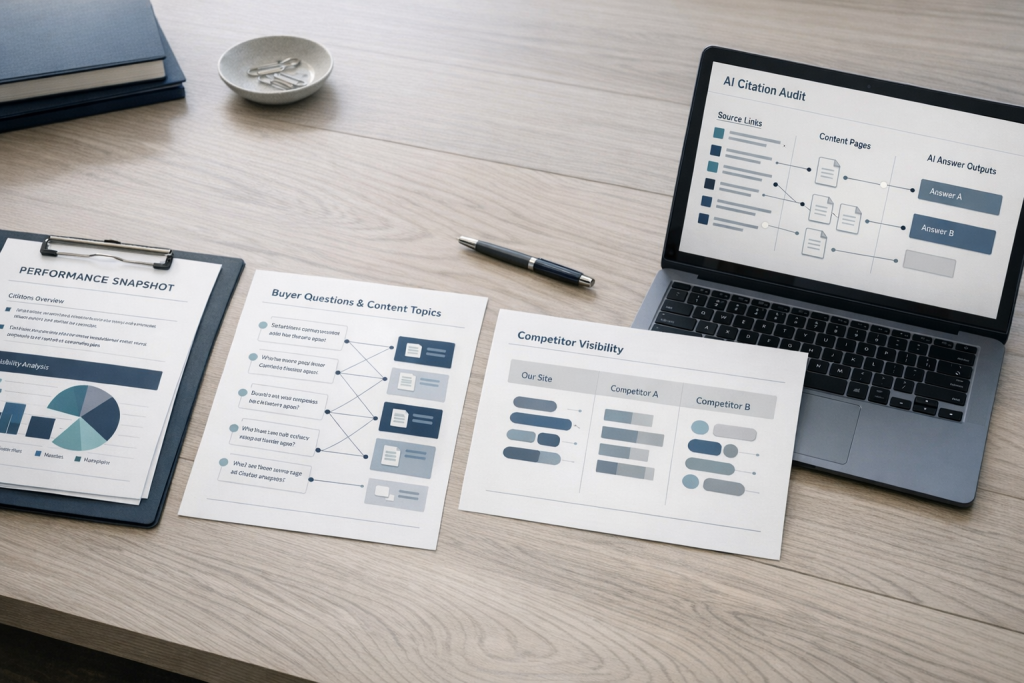
At CiteHarbor, audit output is delivered as a branded PDF performance snapshot. Clients do not need to log into a dashboard, export reports, or work through raw data. The snapshot shows where the brand currently appears, where it is absent, how it compares to competitors, and what the findings point to in terms of content and visibility priorities — sent directly to the client’s team, with no platform to manage.
What an AI Citation Audit Is Not
Being clear about what an audit cannot do protects the integrity of the process and sets realistic expectations from the start.
It is not a guarantee of AI citations. No audit can promise that AI systems will cite your brand. Each platform makes its own retrieval decisions, and no outside party directs those systems. The audit shows where you stand and what is worth improving — it does not determine what will happen next.
It is not a one-time resolution. AI systems continuously update their retrieval logic, source preferences, and underlying data. A single audit captures a moment in time. Ongoing tracking is what converts that moment into a usable strategy.
It is not interchangeable with a traditional SEO audit. SEO audits focus on Google’s organic rankings — crawl health, keyword positioning, backlink profiles, page performance. An AI citation audit focuses on whether AI-powered answer engines treat your content as a credible source. The two are complementary disciplines, but they measure distinct things.
It is not a substitute for content quality. An audit can identify where your content is not being cited, but if the underlying content is thin, generic, or unhelpful, the findings will point to a content problem. The audit is the diagnosis. Improving the content is the work that follows.
How AI Visibility Differs from Traditional SEO
A common objection to investing in AI citation work is the assumption that AI visibility is simply SEO rebranded. It is not.
Traditional SEO measures whether your pages appear in Google’s ranked list of results. AI visibility measures whether your content is selected as a source when AI systems construct a direct answer — an answer that frequently replaces the need for the user to visit any website at all.
A business can hold a page-one Google ranking for a competitive keyword and still be entirely absent from ChatGPT, Gemini, and Perplexity responses on the same topic. The reverse is equally possible: a page sitting on page two of Google may be the primary cited source in an AI-generated answer because it is better organized, answers the question more directly, or is more accessible to AI retrieval systems.
The two channels share certain foundations — crawlability, content quality, topical authority — but they operate on different selection criteria. An AI citation audit measures the channel that most businesses have not yet looked at.
How Often Should You Run an AI Citation Audit
A single audit establishes a baseline — a clear picture of where things stand at a specific point in time. But AI-generated answers shift. The sources they reference change as new content enters the web, as competitors strengthen their own visibility, and as AI platforms adjust their retrieval behavior.
For most businesses, monthly tracking against the initial baseline produces the clearest view of whether visibility is improving, declining, or moving in new directions. Monthly cadence is frequent enough to surface meaningful changes without generating so much noise that signal gets lost.
CiteHarbor builds this recurring measurement into its service. After the initial audit, the same buyer queries are tracked across AI platforms each month, and clients receive a branded PDF snapshot showing what shifted — without needing to run prompts, gather data, or manage any tracking infrastructure themselves.
What to Do with Audit Findings
An audit is only as useful as what it sets in motion. Findings should connect directly to content and visibility decisions.
If the audit reveals low citation rates for high-priority buyer questions, the response is targeted content creation — pages and articles that answer those questions directly, in a structured and extractable format. Not general blog content. Content built specifically around the queries where your brand should be a credible source but currently is not.
If the audit reveals that competitors are being cited from specific content types, that pattern informs what to build. If competitors are cited from detailed service pages, a thin homepage will not close the gap. If they are cited from long-form buyer guides, a brief blog post will not be enough.
If the audit reveals extractability problems, the response is structural — refining headings, reorganizing page layout, adding clear answer blocks, confirming crawlability. This is content infrastructure work that makes existing material more usable by AI systems.
If the audit reveals inaccurate AI descriptions of your brand, the response is to publish content that clearly states what your business does, who it serves, and what it offers — written in a format AI systems can accurately pull from.
At CiteHarbor, audit findings feed directly into the content strategy. Buyer-question research identifies which gaps to address. Targeted articles are created, published to the client’s WordPress site, and distributed through social channels. The following month’s tracking measures whether visibility moved. The full loop — audit, research, content, publish, distribute, track, report — runs as a managed service.
Frequently Asked Questions
What does an AI citation look like?
An AI citation appears as a linked source embedded within an AI-generated answer. In ChatGPT, citations take the form of numbered references with clickable links. In Perplexity, they appear as inline source markers. In Google AI Overview, they appear as linked cards below the generated summary. In each case, the AI system is directing the user to a specific URL as a supporting source for its response.
What is the difference between an AI citation and an AI mention?
A citation links to a specific page on your website and identifies your content as a source the AI drew from. A mention names your brand without linking to anything you own. Mentions may reflect brand recognition in the AI model’s training data, but they do not create a traceable connection to your content and do not produce direct traffic.
How do you track AI citations over time?
Tracking involves running a consistent set of buyer-relevant queries across multiple AI platforms on a regular schedule — typically monthly — and recording which sources are cited each time. Those results are measured against the initial baseline audit to identify trends, gains, losses, and shifts in competitive citation share. CiteHarbor manages this tracking and delivers findings as a branded PDF performance snapshot each month.
Which AI platforms should an AI citation audit cover?
At minimum, an audit should cover ChatGPT, Google Gemini, Claude, and Perplexity, as these represent the most widely used AI answer environments. Google AI Overview should be included when it appears for relevant queries. Each platform retrieves and surfaces sources differently, so a brand may be well-cited on one and entirely absent from another.
Can I run an AI citation audit myself?
You can manually query AI systems and record what they return. But assembling a representative query set, running queries consistently across multiple platforms, extracting and organizing citation data, benchmarking against competitors, identifying patterns, and tracking changes every month adds up to a substantial operational commitment. Most marketing teams are already running at capacity. The time, consistency, and analytical depth required is why many businesses opt for a managed service rather than adding another workflow to an already full plate.
How is AI visibility measured?
AI visibility is measured by tracking whether your brand and content appear in AI-generated answers for the buyer questions that matter to your business. Measurement spans platforms, query types, and time. Key metrics include citation frequency, mention frequency, citation position, competitive citation share, citation accuracy, and citation durability — all tracked against the baseline the initial audit establishes.
The Real Value of Knowing Where You Stand
Most businesses have invested years in Google rankings, paid media, and content production. Those investments remain relevant. But a second discovery layer now exists — one where AI systems respond to buyer questions directly and determine which sources to reference. If your brand is absent from those responses, you have a visibility gap that standard SEO reporting will never surface.
An AI citation audit does not promise to close that gap immediately. What it does is replace uncertainty with a clear, measurable starting point. It shows you precisely where your brand appears, where it is missing, what your competitors’ visibility looks like by comparison, and which content and structural changes are most likely to move your position over time.
CiteHarbor delivers these audits as part of a fully managed AI visibility service. The audit is where the engagement begins. From there, buyer-question research, targeted content creation, WordPress publishing, social distribution, competitor monitoring, and monthly tracking are all handled — without requiring clients to manage a new platform, expand their team, or learn another reporting system.